PDF 原檔:報告_GS_800VDC電力架構與電機廠商_20261021_original.pdf
原始內容
For the exclusive use of [訂閱者已遮蔽]
MULTI-INDUSTRY
Primer on 800VDC and implications for Electricals companies
Investor debate this year has been increasingly focused on NVIDIA's 800VDC architecture and the race among Electrical OEMs to develop the necessary product portfolios. These technological shifts are likely to reshape the competitive landscape. In this report, we outline the importance of these technologies, map the current competitive environment for 800VDC electrical equipment, and review the positioning, development efforts, and recent progress of companies across our Electricals coverage. Within our European coverage, we see the best valuation opportunity on the data center demand topic in Legrand (upgraded to Buy today) and to a lesser extent Siemens (Buy).
The transition to 800VDC power distribution is primarily driven by the need to resolve the physical and electrical bottlenecks associated with scaling next-generation AI workloads, where rack power densities are surging from tens of kilowatts to over 1MW per rack. This architecture will enable higher power efficiency, up to 45% reduction in copper mass, and better management of volatile load swings. Key products being developed include upstream MV UPS and rack-adjacent sidecars for hybrid set-ups, SSTs or MV rectifiers for primary conversion, high-efficiency DC-DC converters, solid-state breakers, and advanced energy storage systems (CESS/BESS). We assess volume impacts by product from 800VDC in Exhibit 4.
The competitive landscape for 800VDC products spans electrical incumbents, solar inverter manufacturers, and pure-play SST start-ups. We highlight that there are differences in terms of the chosen product pathways as well as expected timelines for hybrid AC/DC retrofits and fully native 800VDC architectures. Among incumbents, Legrand, Schneider, Eaton, Vertiv and Delta appear to have the most complete offerings, both for traditional products (spanning the power train, cooling infrastructure and networking infrastructure, Exhibit 4) as well as 800VDC-adapted products (with all of them planning to offer sidecars and being in the process of developing/commercializing SSTs). In particular, we note that Legrand's product portfolio announcements at its CMD exceeded our expectations, highlighted by the introduction of a new sidecar, organic liquid cooling solutions, and AI-load stabilizers, as well as indications of the development of an SST (see here). These additions establish a nearly complete product suite, diversifying away from the company's traditional concentration in white space infrastructure; one of the key thesis points for our upgrade to Buy.
Daniela Costa
+44(20)7774-8354 | daniela.costa@gs.com Goldman Sachs International
Ines Lefranc
+44(20)7051-8710 | ines.lefranc@gs.com Goldman Sachs International
Brian Lee, CFA
+1(917)343-3110 | brian.k.lee@gs.com Goldman Sachs & Co. LLC
Tyler Bisset, CFA
+1(212)357-5510 | tyler.bisset@gs.com Goldman Sachs & Co. LLC
Joe Ritchie
+1(212)357-8914 | joseph.ritchie@gs.com
Goldman Sachs & Co. LLC
Chao Wang
+886(2)2730-4195 | kuanchao.wang@gs.com Goldman Sachs (Asia) L.L.C., Taipei Branch
Do Hyoung Kim
+82(2)3788-1376 | dohyoung.kim@gs.com Goldman Sachs (Asia) L.L.C., Seoul Branch
Mark Delaney, CFA
+1(212)357-0535 | mark.delaney@gs.com Goldman Sachs & Co. LLC
Ryo Harada
+81(3)4587-9865 | ryo.harada@gs.com Goldman Sachs Japan Co., Ltd.
Hao Chen
+86(21)2401-8812 | hao.z.chen@goldmansachs.cn Goldman Sachs (China) Securities Company Limited
Christian Hinderaker, CFA
+44(20)7774-7366 | christian.hinderaker@gs.com Goldman Sachs International
Alexander Duval
+44(20)7552-2995 | alexander.duval@gs.com Goldman Sachs International
Goldman Sachs does and seeks to do business with companies covered in its research reports. As a result, investors should be aware that the firm may have a conflict of interest that could affect the objectivity of this report. Investors should consider this report as only a single factor in making their investment decision. For Reg AC certification and other important disclosures, see the Disclosure Appendix, or go to www.gs.com/research/hedge.html. Analysts employed by non-US affiliates are not registered/qualified as research analysts with FINRA in the U.S.
[浮水印碼已遮蔽]
For the exclusive use of [訂閱者已遮蔽]
Other key areas of technology that have come into focus with the transition to 800VDC include specialized cabling and liquid cooling. Lower current requirements allow thinner, smaller cables, and, while lower copper tonnage may represent a volume headwind, this transition could be margin-accretive for leading European cable manufacturers Prysmian (Buy) and Nexans (Buy) due to higher engineered ASPs. The concentration of power in next-gen AIDCs is also likely to accelerate the adoption of High-Temperature Superconducting (HTS) cables, where Nexans is a market pioneer. Liquid cooling has also emerged as a key necessity for sustaining MW-scale rack loads in 800VDC data centers, whether hybrid or complete. Envicool and Vertiv have broad offerings comprising cold plates, piping and CDUs, while Alfa Laval is the market leader in copper-brazed heat exchangers used in CDUs.
[浮水印碼已遮蔽]
For the exclusive use of [訂閱者已遮蔽]
PM Summary
Investor debate has been increasingly focused on NVIDIA's 800VDC architecture and the race among Electrical OEMs to develop the necessary product portfolios, notably Solid-State Transformers (SSTs). These technological shifts are likely to reshape the competitive landscape. In this report, we outline the importance of these technologies, map the current competitive landscape for 800VDC electrical equipment, and review the positioning, development efforts, and recent progress of companies across our Electricals coverage. Within our European coverage, we see the best valuation opportunity on the data center demand topic in Legrand (upgraded to Buy today) and to a lesser extent Siemens (Buy) - Exhibit 2.
The transition to 800VDC power distribution is primarily driven by the need to resolve the physical and electrical bottlenecks associated with scaling next-generation AI workloads, where rack power densities are surging from tens of kilowatts to over 1MW per rack. This architecture will enable higher power efficiency, up to 45% reduction in copper mass, and better management of volatile load swings. Key products being developed include upstream MV UPS and rack-adjacent sidecars for hybrid set-ups, SSTs or MV rectifiers for primary conversion, high-efficiency DC-DC converters, solid-state breakers, and advanced energy storage systems (CESS/BESS). We assess volume impacts by product from 800VDC in Exhibit 4.
The competitive landscape for 800VDC products spans electrical incumbents, solar inverter manufacturers, and pure-play SST start-ups. We highlight that there are differences in terms of the chosen product pathways as well as expected timelines for hybrid AC/DC retrofits and fully native 800VDC architectures. Among incumbents, we highlight Legrand, Schneider, Eaton, Vertiv and Delta as appearing to have the most complete offerings, both for traditional products (spanning the power train, cooling infrastructure and networking infrastructure, Exhibit 4) as well as 800VDC-adapted products (with all of them planning to offer sidecars and being in the process of developing/commercializing SSTs). In particular, we note that Legrand's product portfolio announcements at its CMD exceeded our expectations, highlighted by the introduction of a new sidecar, organic liquid cooling solutions, and AI-load stabilizers, as well as indications of the development of an SST (see our note here). These additions establish a nearly complete product suite, diversifying the company beyond its traditional concentration in white space infrastructure, one of the key thesis points for our upgrade to Buy.
As for SSTs, Delta Electronics, Eaton, ABB, and Schneider Electric appear to be the most advanced in SST development, having comprehensively outlined their planned SST product portfolios with a view to shipping them by 2H27. Other players include European incumbents Siemens (which has partnered with Reinhausen to develop modular MV SSTs) and Legrand (which is developing an SST but remains uncertain about the ROI of commercialization). In North America, GE Vernova has been developing both MV UPS and SST, but the company sees the latter as still 12-24 months away from deployment. Solar inverter companies Enphase Energy and SolarEdge are leveraging their software-defined power electronics expertise to develop GaN- or SiC-based SST solutions, although important questions remain regarding their ability to meet the stringent requirements of mission-critical data center operations. We note that APAC-based companies, including Megmeet and Kstar, appear more cautious about SST
[浮水印碼已遮蔽]
For the exclusive use of [訂閱者已遮蔽]
deployment, with management teams recently commenting that they do not expect volume SST adoption within the next 1-2 years. The SST market has also seen the entry of start-ups including Heron Power, Amperesand, Hyperscale Power, and WattEV, on which we provide further detail in the report.
Leveraging our GS Sustain team's forecasts, our GS Clean Energy team sees c.10GW of new data center capacity using 800V GPUs in 2030 (c.6% of installed base and c.60% of new additions in 2030), resulting in a total addressable market of up to $5bn for SSTs. We note that these estimates include both Blackwell servers (which our Clean Energy team suggests are compatible with 800VDC architectures) and Rubin servers. If only Rubin servers were included, this would imply c.7GW of new data center capacity using 800V GPUs in 2030 (c.4% of installed base and c.40% of new additions in 2030). This compares with: (1) ABB's 800VDC webcast expectations that 25%-40% of new data center additions would be based on Direct Current; (2) Legrand's recent CMD expectations that c.40% of its expected 30GW of total DC capacity addition in 2030 would be full or hybrid LVDC; (3) SolarEdge's analyst day forecast of a 10.3GW TAM for 800VDC in 2030; and (4) our 800VDC expert call highlighting expectations of 21%/17% of additions in the US/Europe in 2030. We also see scope for an up to $8bn TAM for solid state circuit breakers, based on an estimated price of $600k/MW (5x current circuit breakers, per our 800VDC expert call).
Other key areas of technology that have come into focus with the transition to 800VDC include specialized cabling and liquid cooling.
- Lower current requirements allow thinner and smaller cables, implying a shift from n four-wire AC to three-wire DC (POS/RTN/PE) distribution. While lower copper tonnage may represent a volume headwind, this transition could be margin-accretive for leading European cable manufacturers Prysmian (Buy) and Nexans (Buy) due to higher engineered ASPs. The concentration of power in next-gen AIDCs is likely to accelerate the adoption of High-Temperature Superconducting (HTS) cables. As highlighted by OCP and Nexans, combining 800VDC with HTS distribution virtually eliminates heat losses while only a fraction of the space required by conventional conductors is occupied. We view this as a long-term tailwind for cables; Nexans in particular is positioned as a market pioneer, having demonstrated LV DC HTS cables for data hall infrastructure at its Stella Nova Center and having unveiled its AmpaCity 700V DC microgrid pilot, which paves the way for 800VDC architectures.
- Liquid cooling has also emerged as a key necessity for sustaining MW-scale rack n loads in 800VDC data centers, whether hybrid or complete. According to Schneider Electric, it is up to 3,000 times more effective and more efficient at removing heat than air. Our China Tech research team has published global server cooling TAM estimates that reach c.$18bn in 2027, of which nearly 90% is liquid cooling. Envicool and Vertiv have broad offerings comprising cold plates, piping and CDUs, while Alfa Laval is the market leader in copper-brazed heat exchangers used in CDUs (directly supplying eight of the top 10 CDU OEMs). Carel Industries supplies high-performance controllers and sensors used in liquid cooling architectures for the control of both floor-mounted and rack-mounted CDUs. Schneider Electric and Eaton have both gained exposure to liquid cooling through acquisitions.
[浮水印碼已遮蔽]
For the exclusive use of [訂閱者已遮蔽]
Exhibit 1: Across companies with significant DC exposure, our Buy-rated names include Vertiv, Delta Electronics, and Siemens...
Data center revenues LTM (USDmn on LHS and % of group sales on RHS)
Green = Buy, Grey = Neutral, Blue = Not Rated *Wartsila is % of L12M group orders
Source: Company data, Goldman Sachs Global Investment Research
Exhibit 2: ...with stocks such as Legrand and Siemens trading below the Global Electricals implied line on EV/IC to ROIC/WACC
EV/IC vs. ROIC/WACC framework vs. Global Electricals
Source: Goldman Sachs Global Investment Research
[浮水印碼已遮蔽]
For the exclusive use of [訂閱者已遮蔽]
Top 10 Learnings
- 800VDC enables AI racks to scale beyond 1MW, overcoming the limits of traditional low-voltage 1. power architectures. It improves power efficiency by up to 5% while reducing copper volumes by 45% and freeing space for compute.
- 800VDC reshapes the entire power train. Key products include MV UPS, sidecars, Solid State 2. Transformers (SSTs), DC-DC converters, solid-state circuit breakers and advanced energy storage systems.
- Commercialization starts in 2027, with sidecars first in early 2027 and native 800VDC 3. architectures/SSTs following in late 2027/early 2028.
- MW-scale racks make liquid cooling essential, while specialized cabling creates new opportunities 4. despite lower copper requirements.
- Five incumbents stand out on breadth, with Legrand, Schneider, Eaton, Vertiv and Delta building 5. broad 800VDC offerings.
- Three players lead the SST race, with Delta, Eaton and ABB targeting shipments by 2H27. 6.
- Several new challengers are entering the SST landscape, spanning solar players Enphase/SolarEdge 7. and specialist start-ups. We profile six of them in this note.
- 800VDC could reach ~10GW of new capacity in 2030 (~6% of installed DC base), supporting a ~$5bn 8. SST TAM and an up to ~$8bn solid-state breaker TAM alone.
- Almost all suppliers expect higher revenue per MW under 800VDC, supporting the opportunity across 9. electrical equipment and cables.
- Within our European Capital Goods coverage, we see the best valuation opportunity on the data 10. center demand topic in Legrand (which trades at materially lower multiples than peers on unwarranted investor views that its portfolio will remain skewed to white space categories). We also think Nexans is underappreciated for the potential of superconducting cables to start penetrating the DC installed base.
[浮水印碼已遮蔽]
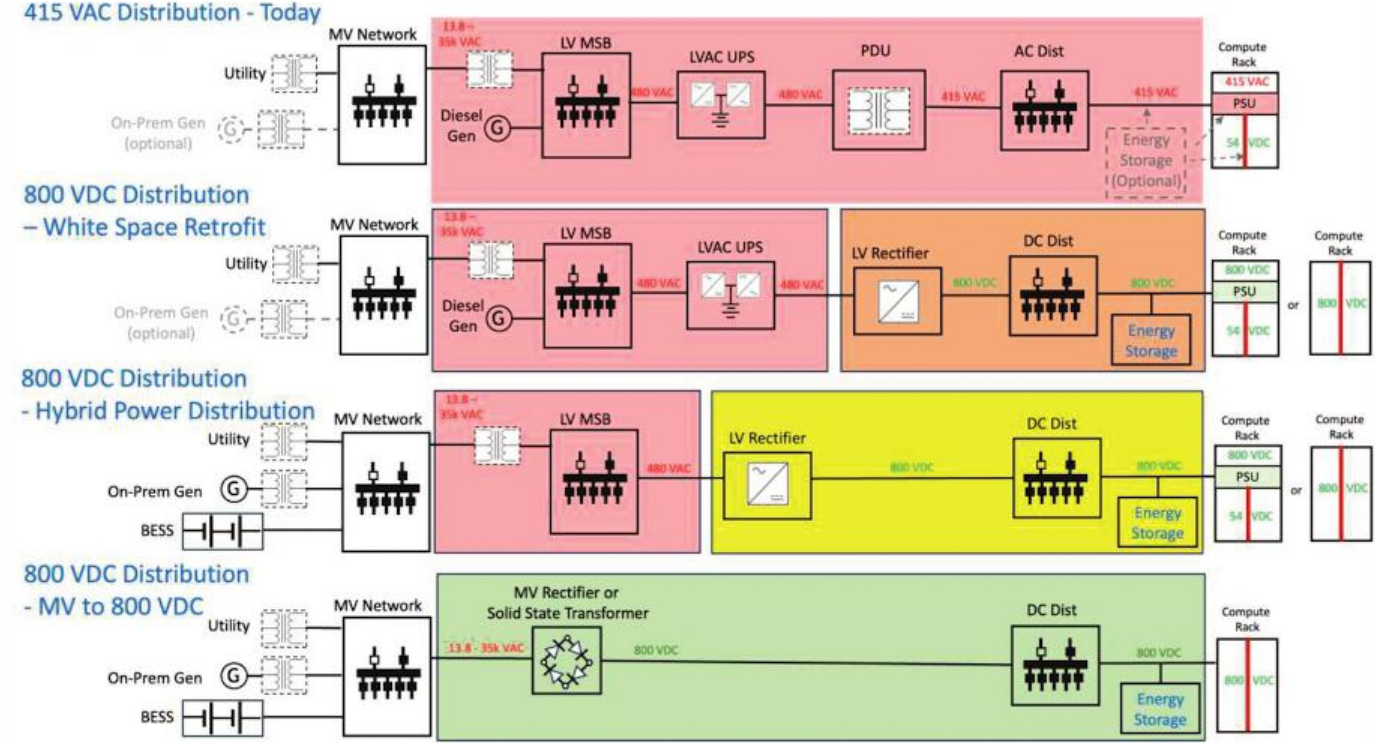
Exhibit 3: Datacenter architecture over time, according to Nvidia
Source: Company data
Multi-Industry [浮水印碼已遮蔽]
Multi-Industry
Exhibit 4: Product exposure by company for traditional architecture and potential volume impact of hybrid/complete 800VDC architecture
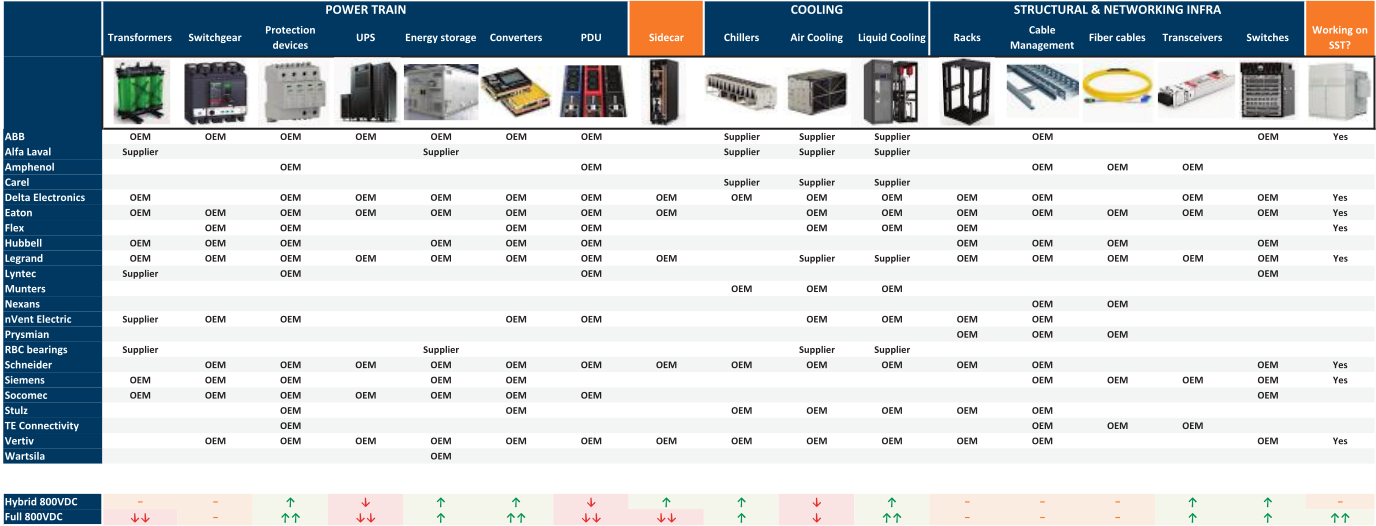
Green = product likely to bene昀t; Red = product likely to be replaced; Orange = product likely to require upgrade (potentially lower volumes for current o昀ering)
Source: Company data, Goldman Sachs Global Investment Research
[浮水印碼已遮蔽]
For the exclusive use of [訂閱者已遮蔽]
What is 800VDC and why is it needed?
800 Volts Direct Current (800VDC) is a higher-voltage direct current power distribution architecture proposed by NVIDIA to replace traditional alternating current (AC) and low-voltage direct current (such as 12VDC or 54VDC) systems, in order to address the physical and electrical bottlenecks associated with scaling next-generation AI workloads. Instead of routing power through multiple inefficient AC/DC and DC/AC conversion stages, an 800VDC architecture centrally converts utility-supplied AC power to 800VDC at the facility level and distributes it directly to the compute racks.
The driver of this transition is the need to efficiently support the unprecedented power density required by modern AI racks, which are scaling from tens of kilowatts per rack to well over a megawatt per rack (Exhibit 7), exceeding the capabilities of traditional 54VDC or 480/415 VAC systems. NVIDIA projects that its 800VDC architecture can reduce TCO by up to 30%, driven by improvements in efficiency, reliability, and system architecture, as well as lower equipment maintenance costs. This can be broken down into three main factors:
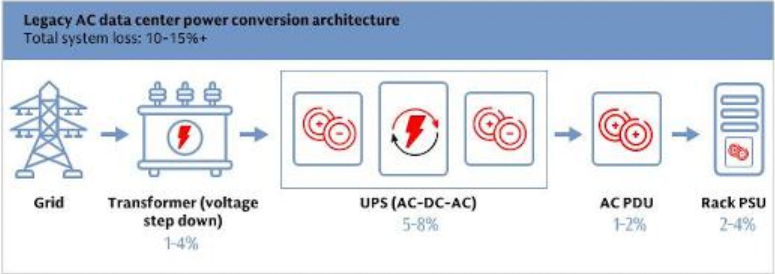
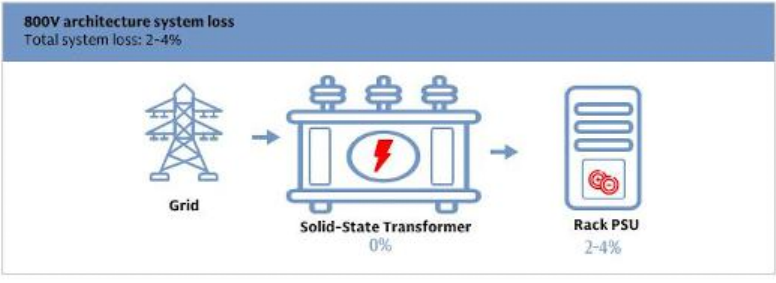
- Enabling higher power efficiency. Power consumption per server continues to 1. increase, with the current NVDA DGX NVL8 architecture now requiring 3.7x the maximum power of the A100 (Exhibit 6), driving up the power density requirement and overall power needs. Legacy data centers require multiple AC/DC and DC/AC conversion stages throughout the data center powertrain. Each conversion introduces efficiency losses (typically 1%-3% per stage), generates additional heat, and requires equipment that consumes valuable space. As power requirements are likely to step up in the coming years, this power conversion loss will become more significant and much more costly. By replacing AC with DC power distribution, multiple conversion steps are eliminated, improving end-to-end efficiency by up to 5% compared with current 54V systems (see here).
- Reduction in copper content. The amount of copper required to deliver 1MW of 2. power to a server rack at 48V could be more than 500-1000lbs. Stepping up distribution voltage to 800VDC significantly reduces the current required for the same power (as P=VI). With lower current, a higher level of resistance can be tolerated and since resistance is inversely proportional to the cross-sectional area of wire, cables and busbars can be made thinner and smaller. This enables up to 45% reduction in the copper mass required and frees up valuable physical space for compute hardware.
- Managing volatile load swings. AI training and inference workloads cause rapid and 3. substantial spikes in power demand. An 800VDC architecture allows for the direct integration of localized energy storage to buffer these swings, protecting the utility grid from instability.
[浮水印碼已遮蔽]
For the exclusive use of [訂閱者已遮蔽]
Exhibit 5: Global data centers are expected to grow by 170% in 2030 vs 2025 levels
Data center (AI + non-AI) power demand in the US and the rest of world, TWh
Source: Masanet et al. (2020), EIA, EMBER, IEA, Cisco, Data compiled by Goldman Sachs Global Investment Research
Exhibit 6: AI innovations increase maximum power consumption per server but increase compute speed Recent evolution of NVIDIA's server system specifications
Source: NVIDIA, data compiled by Goldman Sachs Global Investment Research
[浮水印碼已遮蔽]
For the exclusive use of [訂閱者已遮蔽]
Exhibit 7: Power density requirements at the rack level are materially increasing
Power density needs per rack (kW)
Exhibit 8: As AI power demand grows, we see rising inference power intensity as higher-power servers increase their share over time, even as we continue to assume double-digit annual efficiency gains
AI power use, TWh (LHS); max power use per AI server, KW (RHS)
Source: NVIDIA, data compiled by Goldman Sachs Global Investment Research
Source: Goldman Sachs Global Investment Research
Exhibit 9: Electricity loss becomes a greater concern at higher power and voltages
Average electricity loss per conversion step in legacy architecture
Source: SolarEdge, Goldman Sachs Global Investment Research
[浮水印碼已遮蔽]
For the exclusive use of [訂閱者已遮蔽]
What new products are required and how will current products be impacted?
The 800VDC architecture fundamentally changes how power is delivered in AI data centers (Exhibit 3), causing a shift away from traditional LV switchgears, AC PDU and AC UPS systems towards highly specialized and streamlined DC hardware that are designed to handle extreme power densities while maintaining rapid response times. Critical components are likely to include:
- Power sidecars. These allow current traditional AC data centers to use high-voltage n DC (HVDC) without requiring complex changes to rack architecture. They will be deployed as transitional modules in the first 800VDC rollout phase (2025-2027) ahead of fully native DC halls. They attach directly to MW-class racks, converting incoming AC to 800VDC and providing integrated short-duration energy storage to stabilize GPU load spikes. This design eliminates the need for traditional AC PDUs and UPS systems while enabling rack power to scale up to 1.2 MW.
The following companies currently offer or are developing sidecars: Delta Electronics (debuted in early 2026), Eaton (mentioned at DC world; already being offered for refurbishment, although no sales have been made yet), Flex (introduced in March 2026), Legrand (introduced at its 2026 CMD, ready for commercialization in 2027; the company believes it could be a permanent solution), Schneider Electric (already being offered; explicitly targeting racks up to 1.2MW), and Vertiv (undergoing customer validation; expected to launch early 2027). ABB is not developing a sidecar, as the company views it as a temporary solution for hybrid architectures that would not be used in full 800VDC. Many companies think sidecars could be a permanent solution, either because not all DCs may become full 800VDC (hybrid might be sufficient for certain data centers) or because sidecars could be useful in full architecture (e.g. to stabilize loads).
- MV UPS: Operating upstream at the grid connection level (up to 34.5 kVAC), these n centralized systems replace highly fragmented, low-voltage AC UPS systems in the white space, rendering traditional AC PDUs and AC UPS systems largely unnecessary. By bypassing individual, rack-specific UPS units, this set-up reduces AC PDU cabinet requirements by up to 75% and enables MW-scale rack densities. While legacy suppliers such as Schneider Electric and Legrand remain highly exposed to traditional AC PDUs and AC UPS markets, ABB currently holds dominant market share in MV DC UPS systems with its HiPerGuard product and believes that MV UPSs will not only facilitate the transition to hybrid architectures, but also be necessary for full 800VDC, as they provide increased energy efficiency. ABB notes that more players have entered the MV UPS space in recent months, which will encourage adoption by hyperscalers who often require double/multi-sourcing. These include GE Vernova (plans to start shipping its MV UPS in mid 2027) and Vertiv (MV UPS currently in validation).
- Solid-State Transformers (SSTs). These high-capacity conversion systems directly n step down and convert MV utility AC (up to 35kVAC) to a stable 800VDC output. They rely on advanced power electronics and semiconductor switches instead of heavy copper coils and iron cores to convert and control electricity. By replacing
[浮水印碼已遮蔽]
For the exclusive use of [訂閱者已遮蔽]
traditional multi-stage AC/DC transformers and centralizing the rectification process at the facility level, SSTs eliminate redundant conversion steps, reduce physical footprint, and provide galvanic isolation with millisecond-level response times to handle volatile AI workloads. While NVIDIA views SSTs as essential to the final, most efficient form of 800VDC data centers, they are not currently in mass production. The roadmap for the transition to 800V DC points to initial deployments starting as early as 2028, which has set off a race to commercialize SSTs. Various OEMs and start-ups are in the process of developing SST solutions. Our Clean Energy team's estimates indicate that the market for SSTs could reach as high as $5 billion in 2030 (see more details below). The key companies that have outlined SST development plans with clear timelines include: ABB (Infinitus MV SST for commercialization by 2H27), Schneider Electric (800VDC Power Center expected in 2H27), Eaton (MV SST orders in 2H26 with shipments in 2H27), GE Vernova (5MW SST commercialization in 12-24 months) and Delta Electronics (MV SSTs testing shipment late 2026-2H27). We dive deeper into SSTs, the market size, and the relevant players later in this note.
- Rectifiers: For facilities not deploying SSTs, centralized industrial-grade rectifiers n can be used at the perimeter of the data hall to perform the primary, high-ratio AC-to-DC conversion. Centralizing this conversion upstream creates a common 800VDC distribution backbone, eliminating redundant conversion equipment, reducing heat output in the white space, and enabling a much simpler path for integrating DC-side battery energy storage. Among the European OEMs, Schneider Electric has highlighted its development of TRUs in conjunction with SSTs in its 800VDC Power Center product, while Legrand has indicated a preference for developing TRUs over SSTs, arguing that the ROI for SSTs may not justify commercialization. In North America, Flex recently acquired EPC Power to develop both centralized rectifiers and SSTs for 800VDC, while Vertiv is developing centralized rectifiers to complement its 800VDC sidecar.
- DC-DC converters. Placed in the sidecar or directly adjacent to the GPUs on the n server tray, these high-efficiency converters utilize advanced Gallium Nitride (GaN) and Silicon Carbide (SiC) semiconductor technology to perform a late-stage conversion to step the 800VDC bus down to 12VDC or 12.5VDC. This minimizes resistive losses near the processor and occupies less board space than traditional multi-stage intermediate bus converters. ABB has noted that these DC-DC converters will see strong demand under the new 800VDC architecture. Flex, Vertiv, Eaton and Legrand have all explicitly mentioned the development of DC-DC converters for the 800VDC transition.
- Solid state breakers and switches. High voltage DC distribution introduces severe n risks of electrical arcing and fault currents due to the capacitive nature of the network. Instead of distributing AC power through numerous AC switchboards, which are large assemblies of circuit breakers, switches, and control equipment, the 800VDC architecture streamlines this. In 800VDC architectures, these are being replaced by ultra-fast semiconductor circuit breakers and solid-state switches capable of detecting and isolating electrical faults within microseconds (1000x faster than traditional circuit breakers) without mechanical wear. Various OEMs
[浮水印碼已遮蔽]
For the exclusive use of [訂閱者已遮蔽]
have been developing solutions, including ABB, with its SACE Infinitus solid-state circuit breaker, and Siemens, with its Sentron semiconductor circuit breaker and SIRIUS solid-state switching device. According to an expert call we hosted recently (see here), solid state breakers are still very expensive at c.$600k per MW (5x the price of current circuit breakers).
- Capacitive and Battery Energy Storage Systems (CESS/BESS). The shift to 800VDC n data centers demands greater battery storage to handle higher power volatility, with racks able to surge from 30% to 100% utilization in milliseconds. To handle this extreme power volatility and bypass grid interconnection limits, energy storage is expected to evolve into an active 'low-pass filter' that absorbs high-frequency spikes and smooths load ramps. This supports a layered strategy: fast-response capacitors handle millisecond fluctuations closer to the rack, while large BESS provide longer ride-through closer to the utility interconnection. Flex, Vertiv, nVent, Eaton, GE Vernova, Delta Electronics and Hitachi have all included CESS/BESS in their portfolios or are developing them. In particular for 800VDC, Flex has gained exposure to BESS technologies through its acquisition of EPC Power, and it has also introduced a new 30kW CESS for AI workloads at COMPUTEX 2026. Vertiv's 800VDC roadmap includes outdoor-rated MV BESS/UPS systems while Hitachi has integrated BESS into its 800VDC power and control architecture for the NVIDIA Vera Rubin DSX reference design.
- Specialized DC busways and cables. With lower current requirements, cables and n busbars can be made thinner and smaller. This implies a shift from four-wire AC to three-wire DC (Positive/Return/Protective Earth, POS/RTN/PE) systems, reducing conductor and connector complexity. While optimized, both cables and busways remain integral components of the 800VDC power distribution. While lower copper tonnage may represent a volume headwind, this transition could be margin-accretive for leading European cable manufacturers Prysmian (Buy) and Nexans (Buy) due to higher engineered ASPs. This reflects the need for specialized, high-margin cabling engineered with advanced materials to mitigate DC-specific electrical degradation (such as space charge accumulation) and to support innovative thermal management, including integrated liquid-cooling technologies.
Furthermore, the concentration of power in next-gen AIDCs is likely to accelerate the adoption of High-Temperature Superconducting (HTS) cables. HTS operate at -200°C, a temperature that can be reached using liquid nitrogen (an abundant, inexpensive and environmentally harmless coolant) and, unlike conventional copper or aluminium cables, which lose 5%-10% of transmitted power as heat over long distances (see here), HTS cables conduct electricity with virtually zero resistance. As highlighted by OCP, superconductors are particularly important for AIDCs, in parallel with 800VDC, given they provide high current density with negligible energy losses while occupying only a fraction of the space required by conventional conductors. The total addressable market for superconducting cables (including for data centers) has been estimated at c.$1.8bn in 2025 with the potential to grow to c.$3.6bn by 2034, as per third party sources (Fortune Business Insights, S&S Insider, Transparency Market Research). We have also seen third party estimates mentioning Nexans' market share at 10-24% depending on the [浮水印碼已遮蔽]
For the exclusive use of [訂閱者已遮蔽]
application. We view this as a long-term tailwind for the cables sector. Nexans is a market pioneer, having demonstrated LV DC HTS cables for data hall infrastructure at its Stella Nova Center and having recently unveiled its AmpaCity 700V DC microgrid pilot, which paves the way for 800VDC architectures. At our recent US roadshow with Nexans, the company flagged that superconductivity could offer a compelling total cost of ownership and recurring project revenues. However, primary drawbacks of superconductivity include higher upfront capital expenditure and operational complexities surrounding active liquid nitrogen refrigeration (required to enable HTS operating temperatures).
800VDC and liquid cooling
With the transition to high-density AI workloads, the extreme concentration of thermal energy within a highly compact physical footprint renders traditional air cooling insufficient. Liquid cooling has emerged as a key necessity for the transition to 800VDC, both in hybrid and full architectures. According to Schneider Electric, it is up to 3,000 times more effective and more efficient at removing heat than air because it captures heat directly at the chip level. Furthermore, the CapEx difference when liquid cooling is deployed at 20kW/rack and 40kW/rack for the same capacity data center results in 10-14% CapEx savings. Our China Tech research team has published global server cooling TAM estimates that reach c.$18bn in 2027, of which nearly 90% is liquid cooling.
The main components required for liquid cooling include coolant distribution units (CDUs, which circulate and regulate liquid coolant), cold plates (copper or aluminium plates that are mounted onto high-heat components to transfer heat away), coolants (formulated thermal fluids through which heat is transferred), and chillers (reject captured heat to outdoor atmosphere).
Various companies offer components for liquid cooling. At Data Center World, Alfa Laval, Envicool, Vertiv and Schneider Electric all highlighted that liquid cooling will be crucial to sustaining MW-scale rack loads in 800VDC data centers. Envicool and Vertiv have broad offerings comprising cold plates, piping and CDUs, while Alfa Laval is the market leader in copper-brazed heat exchangers used in CDUs (directly supplying eight of the top 10 CDU OEMs). Schneider and Eaton have both gained exposure to liquid cooling through acquisitions, namely Motivair and Boyd, respectively, both of which are now well integrated. In particular, Schneider Electric offers prefabricated, high-density liquid-cooled AI clusters, which combine chillers, CDUs and MV switchgear.
Carel Industries has a portfolio of components to support all major data center cooling architectures, including liquid cooling where it supplies high-performance controllers and sensors for the control of both floor-mounted and rack-mounted CDUs.
[浮水印碼已遮蔽]
For the exclusive use of [訂閱者已遮蔽]
800VDC competitive landscape
Exhibit 10: The data center equipment market has various players...
Data center equipment market share (%, LHS) and global market size over time (EURmn, RHS)
For each company/division, we use the relevant disclosed DC exposure
Source: Company data, Data compiled by Goldman Sachs Global Investment Research
Exhibit 11: ...with Schneider, Vertiv and Eaton the leaders in terms of total data center revenues
Data center revenues, LTM (USDmn)
Source: Company data, Data compiled by Goldman Sachs Global Investment Research [浮水印碼已遮蔽]
For the exclusive use of [訂閱者已遮蔽]
Exhibit 12: Most companies expect an increase in $/MW as data centers transition to 800VDC with sidecars generally expected to be commercialized in early 2027 and SSTs late 2027/early 2028
Summary of current $/MW vs expected 800VDC $/MW with expected timelines
| Current $/MW | Expected $/MW for 800VDC 800VDC | timeline | |
|---|---|---|---|
| ABB | $2mn | Increase | SST commercialization by 2H27, revenue generation from 2028. |
| Amperesand Delta Electronics DG Matrix Eaton Enphase Energy | $1.2-1.5mn | Currently SST testing Currently $1.2-2.9mn | deploying MV SSTs to Fortune 100 customers. shipment late 2026-2H27, mass production from 2028. deploying SST with data center customers. SST orders in 2H26 with shipments in 2H27. SST pilot programs in 2027 with first commercial shipments as early as 4Q27 |
| GE Vernova Heron Power Hyperscale Power | $0.2-0.3mn | Increase 2-3x Rolling out | MV UPS shipping mid 2027, SST commercialization 12-24m & industrialization 24-36m SST field demos mid-2026, pilot early 2027. initial SST prototypes. |
| Legrand | $2.5mn | $3.8mn with SSTs | Sidecar commercialization in 2027, AI load stabilizer in 2028, SST uncertain |
| Schneider SolarEdge | $1.3-3.3mn | Upper end | Sidecar already available. SST products in 2H27 with ramp in 2028-30 Small SST orders in 2026/27 and more scaled revenue potential in 2028. |
| Vertiv | $3.25-3.75mn | Increase | Sidecars to ship in 1H27, full 800VDC start in 2H27, larger shipments in 2028. |
Source: Company data, Data compiled by Goldman Sachs Global Investment Research
[浮水印碼已遮蔽]
For the exclusive use of [訂閱者已遮蔽]
Exhibit 13: EMEA competitive landscape
| Company | Schneider Electric | Siemens | ABB | Legrand | Carel |
|---|---|---|---|---|---|
| Group revenues, $mn | 47,171 | 92,644 | 33,220 | 11,138 | 739 |
| Group OSG | 8.9% | 5.0% | 7.0% | 7.7% | 10.6% |
| Group adj. EBIT margin | 17.9% | 12.2% | 20.0% | 21.4% | 13.2% |
| Datacenter revenues, $mn | 14,151 | 3,405 | 2,934 | 3,564 | 134 |
| Datacenter revenues, % group Datacenter division | 30% Energy Management | 4% Smart Infrastructure | 9% Electrification | 32% Pure Play | 19% HVAC |
| Current datacenter product portfolio | Secure power systems (32%, includes pre-fabricated solutions for modular DCs), electrical distribution (24%, includes PDUs and bus bars), transactional & edge (16%, includes inference components, cooling (7%) and building mgmt systems (5%). | Spans electrical and digital infrastructure including switchgear, protection devices, energy storage, converters and networking infrastructure such as cables and switches. | Comprehensive, "grid-to-chip" electrification and automation portfolio: MV & LV switchgear, power transformers, HiPerGuard MV UPS, busways, and the ABB Ability Data Center Automation platform. | Compute infrastructure (50%; racks, PDUs, busways, cables), critical power (35%; MV switchgear, transformers, switches), advanced cooling (5%; rear door heat exchangers, direct-to-chip) and testing & lifecycle services (10%) | Supplies components for all major DC cooling architectures currently in use including chiller-based systems, evaporative cooling towers, dry coolers, rear-door heat exchangers, and advanced liquid- cooling infrastructure |
| 800VDC datacenter product portfolio | 800VDC Power Rack (sidecar): power shelves, 1.2MW DC/ rack 800VDC Power Center (SST): LV converters, TRUs & SST tech for AC into 800VDC, 4.8MW DC 800VDC Power Block (SST): SST tech, 5-10MW DC | Portfolio of DC solutions including Sentron semiconductor circuit breaker, SIRIUS solid-state switching device, and Sivacon LV switchboard. Partnered with startup MR to develop modular MV SSTs. | Infinitus source-to-rack Direct Current product portfolio. Includes MV SSTs (3MW+ with 98.5% efficiency), HiPerGuard MV UPS & solid state circuit breakers. Not developing sidecars. | Power sidecar (up to 600kW, 415- 480V AC input, 810V DC output) and AI load stabilizer (introduced at 2026 CMD). Mentioned SST development. Also developing rectifiers, DC/DC power shelves, LV DC busbar/busways. | Carel's solutions for liquid cooling include electronic controllers and sensors (for monitoring and connectivity). It does not currently expect to modify these offerings for 800VDC. |
| Expected timelines $ content per MW | Sidecar is already available. SST products expected in 2H27 with deployment ramping in 2028-30 $1.3-3.3mn per MW & likely to trend | No timeline yet provided for SSTs n/a | SST commercialization by 2H27, revenue generation from 2028, with deployment ramping in 2028-30 $2mn per MW & likely to increase | Sidecar commercialization in 2027, AI load stabilizer in 2028, uncertain about ROI for SST commercialization $2.5mn/MW increasing to >$3mn | n/a n/a |
| Partnerships for 800VDC | to upper end for AIDCs NVIDIA, Foxconn, AVEVA | NVIDIA, Maschinenfabrik Reinhausen (MR), Rittal, Khazna, | as datacenters move to DC NVIDIA, Ferrari Hypersail | for LVDC ($3.8mn if SST included) n/a | n/a |
| Acquisitions/ investments for 800VDC | Motivair (liquid cooling) | nVent Trayer Engineering (MV switchgear) | DG Matrix (SST) | Accelsius (liquid cooling), Kratos (MV/LV switchgear), TES (modular), Girtz (power pods) | n/a |
| Revenues by division | Energy Management, 82% Industrial Automation, 18% | Smart Digital Industries, 23% Mobility, 16% Healthineers, 30% | Electrification, 52% Automation, 24% Motion, 25% | Essential Data Center, 32% Energy Transition, 22% Digital Lifestyles, 5% | HVAC, 72% Ref, 28% Non-Core, 0.1% |
| Revenues by region | North America, 37% Europe, 24% Asia, 27% RoW, 12% | Americas, 33% Europe, 47% Asia, 21% Infrastructure, 29% | USA, 29% Europe, 34% Rest of Americas, 8% China, 11% Rest of AMEA, 17% | NA, 42% Europe, 38% Row, 20% Infrastructures, 41% | EMEA, 64% Asia Pacific, 13% North America, 20% South America, 2% |
| Capex % of revenues | 3.7% | 3.1% | 3.0% | 2.6% | 3.5% |
| R&D treatment | 3.4% | 8.3% | 5.2% | ||
| R&D % of revenues | 84% Expensed, 16% Capitalised | 97% Expensed, 3% Capitalised | 4.0% 100% Expensed | 4.3% 100% Expensed | 85% expensed, 15% capitalised 13.6% |
| 15.3% | 7.2% | 25.6% | 13.8% | ||
| Group ROIC |
All as of 2025 unless otherwise mentioned
Source: Company data, Data compiled by Goldman Sachs Global Investment Research
[浮水印碼已遮蔽]
For the exclusive use of [訂閱者已遮蔽]
Exhibit 14: North America competitive landscape
| Company | Eaton | Vertiv | GE Vernova | nVent Electric | Flex |
|---|---|---|---|---|---|
| Group revenues, $mn | 27,448 | 10,230 | 38,068 | 3,893 | 27,389 |
| Group OSG* | 7.9% | 26.5% | 9.0% | 12.6% | 5.5% |
| Group adj. EBIT margin | 19.0% | 20.4% | 10.6% | 20.2% | 6.2% |
| Datacenter revenues, $mn | 6,588 | 8,695 | - | 1,168 | - |
| Datacenter revenues, % group Datacenter division | 24% Electrical | 85% Pure Play | 12% of group orders in 1H26 Electrification & Power | 30% Systems Protection | - Cloud and Power Infrastructure |
| Current datacenter product portfolio | Broad portfolio categorized into hardware (UPS, rack PDUs, ATS), software (datacenter infra management, electrical power monitoring) and networking infrastructure (racks, enclosures, cable management). | Power train (Trinergy UPS, Dynaflex energy systems) and thermal management (CoolChip liquid cooling including high- capacity CoolChip CDU). Deployed via prefabricated modular systems. | Within Power division, gas turbines for prime or backup generation. Within Electrification, complete turnkey substation solutions, HV switchyards, MV switchgear, and power transformers. | Primarily liquid and air cooling solutions including direct-to-chip liquid cooling systems, rack- and row-based CDUs, rear door heat exchangers. Also power distribution (LV/MV switchgear, switchboards, PDUs, cable management). | End-to-end power and thermal management technologies as well as integrated IT infra. Includes pre- engineered modular compute and storage racks, liquid-cooling solutions (including CDUs), power shelves and CESS. |
| 800VDC datacenter product portfolio | Already markets 2MW MV SSTs (10-34.5kV MV AC, >97% efficiency, TUV SUD certified) & scaling to 5MW. Also offer sidecars, supercapacitors, ORV3- compatible busbars, and specialized DC connectors. | 800VDC PowerDirect sidecar along with centralized rectifiers, high- efficiency DC busways, rack-level DC-DC converters. Also developing MVDC UPS and SSTs. Validation ongoing. | Already introduced MV UPS. Announced complete build-out of 5MW SST prototype for indoor applications (to be delivered to first hyperscaler for validation later this year). Also developing 6MW SSTs for outdoors. | Partnering with NVIDIA to deploy liquid cooling solutions for next gen data centers. Also partnered with Siemens to develop architecture for 100MW hyperscale AIDCs. | 800VDC power rack developed in partnership with NVIDIA in March 2026. Also offers BBUs and CBUs for the 800VDC power rack. Acquired EPC Power to develop centralized rectifier for 800V & SST |
| Expected timelines $ content per MW | SST pilots in Asia. Capex approved for 3 facilities. Orders 2H26, shipments 2H27. $1.2-1.5mn for traditional DCs increased to $1.2-2.9mn for AIDCs | Sidecar products to ship in 1H27, fully native 800V to start in 2H27 with larger shipments in 2028. $3.25-3.75mn per MW (up 10-15% vs prior range) | MV UPS shipping in mid 2027. SST commercialization 12-24m, & industrialization 24-36m. $0.2-0.3mn/MW could increase | No commentary on SSTs $1mn per MW | No clear timeline n/a |
| Partnerships for 800VDC Acquisitions/ investments for 800VDC | NVIDIA, Siemens Energy, Flexnode, Munich Electrification | NVIDIA, Caterpillar, Oklo (prefab | 2-3x with MV UPS & SSTs NVIDIA, Chevron & Engine, NRG Energy, Itron Prolec GE (transformers), Greenbird | NVIDIA, Siemens Maverick Power (switchgear), Avail Infrastructure (switchgear, bus systems), Trachte (controls) | NVIDIA EPC Power (intelligent power conversion solutions for DCs & grid) |
| Revenues by division | Resilient Power Systems (SST), Boyd Thermal (liquid cooling) Electrical, 73% Aerospace, 15% Vehicle, 9% eMobility, 2% | Utility Innovation (microgrid controls), BMarko Structures data halls) Products, 80% Services & Spares, 20% | Integration Tech (software) Power, 52% Electrification, 25% Wind, 24% | Asia-Pacific, Systems Protection, 67% Electrical connections, 33% | Integrity Technology Solutions, 41% Regulated Manufacturing Solutions, 37% Cloud & Power Infrastructure, 22% |
| Revenues by region | US, 61% Canada, 4% LatAm 7% Europe, 18% APAC, 10% | Americas, 58% EMEA , 20% APAC, 22% | US, 46% Americas ex US, 8% Europe, 20% Middle East & Africa, 14% Asia, 12% | North America, 77% EMEA, 18% 5% | North America, 44% Asia, 27% Other, 30% |
| Capex % of revenues | 3.3% | 2.2% | 3.4% | 2.4% | 2.1% |
| R&D % of revenues | |||||
| 2.9% | 4.0% | 3.1% | - | ||
| 100% Expensed | 100% Expensed | 2.2% 100% Expensed | 100% Expensed | ||
| R&D treatment Group ROIC | 18.6% | 36.8% | 100% Expensed | 11.9% | 19.4% |
| 143.5% |
*Total revenue growth for Flex
All as of 2025 unless otherwise mentioned.
Source: Company data, Data compiled by Goldman Sachs Global Investment Research
[浮水印碼已遮蔽]
For the exclusive use of [訂閱者已遮蔽]
Exhibit 15: APAC competitive landscape
| Company | Delta Electronics | Hyosung Heavy | Industries | Hitachi | Kstar | Megmeet | HD Hyundai Electric |
|---|---|---|---|---|---|---|---|
| Group revenues, $mn | 17,678 | 4,135 | 65,242 | 754 | 1,345 | 2,826 | |
| Group revenue growth | 37.9% | 25% | 1% | 32% | 20% | 26% | |
| Group adj. EBIT margin | 15.1% | 12.5% | 9.9% | 12.8% | 2.4% | 24.4% | |
| Datacenter revenues, $mn | 5,303 | 2,874 | 1,752 | 448 | 390 | - | |
| Datacenter revenues, % group Datacenter division | 30% Power Electronics & Infrastructure | 70% Heavy Industry | Energy, Digital | 3% Connective Industries, Systems | 59% Datacenter | 29% 2% Industrial Custom Power | of Power orders in 2025 Power |
| Current datacenter product portfolio | Power solutions (UPS, PDUs, power train units, HVDC solutions), cooling systems (liquid & air), rack infra, and data center mgmt systems. >60% share in AI AC/DC converter market. | Heavy grid infrastructure power stabliisation systems including ultra-high-voltage transformers, SSTs, gas- insulated circuit breakers, energy storage systems stabilisation | and and systems. Energy: power tech & Connective semiconductors Digital Systems & Hitachi Vantara solutions) & HMAX Data | grids, HVDC transformers. Industries: & UPS. Services: (storage Center (infra ops) | UPS systems, energy storage (VRLA battery backup systems, integrated lithium-ion solutions), prefab modular DC solutions (IDU, IDM, IDB series) and Direct-to-Chip liquid cooling | ORv3-HPR3 Open Compute Rack Power system (33 kW Power Shelf, 16.5 kW BBU Shelf, 15 kW Super Power Capacitor Shelf), DC-DC Power Modules, automatic transfer switches. | Power & distribution transformers ($800mn order with one big tech company and in ongoing discussions with 3 more), generators & motors (demand for DC BTM power plants), MV/LV circuit breakers |
| 800VDC datacenter product portfolio | Markets MV SSTs (6.6-35kV MV AC to 800VDC, 98.5% efficiency). Also offers 800VDC busways, 90 kW rack power shelves (800VDC to 50VDC at 98% efficiency), and 800VDC In-Row Power systems. | Markets MV SSTs (22.9kV, 1.05MVA) as well as gas- insulated circuit breakers energy storage systems for data centers. Showcased at IEEE PES T&D 2026 in Chicago in 2026. | and AI Has an 800VDC power simulation enabled by Omniverse DSX (equips developers with digital AIDC design). Also containerized MV SST solutions. | supply NVIDIA DC twins for developing | Developing 800VDC systems. JV with CATL focused on HV & LV BESS. Plans to send 800 VDC products for 3-6m onsite testing in Europe & SE Asia in Oct 2026. Investing in SST technology. | 1MW 800VDC Power Rack (converts AC directly to 800 VDC, 5% improvement in power efficiency, TCO cut by up to 30%). Has also committed R&D to establish its own SST technology. | Ongoing development of SST- based 800VDC power infrastructure and DC protection systems supported by proven experience with world's first 1MW-class DC distribution system. |
| Expected timelines $ content per MW | Running pilots in Asia & US. Testing shipment late 2026- 2H27, actual MP production from 2028. n/a | Expects global SST market grow at an average annual >40%. n/a | to rate way off as | Commercialization still some has not yet been standardized in the industry n/a | No timeline given for commercialisation. n/a | Expects transition to 800 VDC architecture to be gradual. Does not expect volume SST adoption within 1-2y. n/a | No timeline given for commercialisation. n/a |
| Partnerships for 800VDC | NVIDIA, X LABS, DTE Energy | Quanta Services | plant in synvert | NVIDIA, OpenAI, HD Hyundai Electric, MCG (AI services), factories | CATL | NVIDIA, Open Compute Project | Hitachi Energy |
| Acquisitions/ investments for 800VDC | Fremont Lab (R&D facility), Ceres Power License | Manufacturing Tennessee | (ultra-high-voltage in US & | China (transformers) | Automated battery line expansion | Expanding manufacturing and R&D in Thailand, India and US | Plant expansion in Alabama (EHV power transformers) |
| Revenues by division | Power Electronics, 50% Infrastructure, 33% Automation, 10% Mobility, 7% | transformers) Heavy Industry, 70% | Construction, 30% | Connective Industries, 33% Digital systems & services, 29% Energy, 27% Mobility, 12% | Data center, 59% New energy, 40% | Smart home appliances, 38% Industrial custom power, 29% Industrial automation, 9% New energy & Rail, 12% | Power, 51% Distribution, 18% Rotating, 14% Subsidiary, 17% |
| Revenues by region | US, 36% China, 15% Taiwan, 12% Thailand, 1% RoW, 36% | 19% Europe, ROW, | Americas, Korea, 51% Asia, 20% 7% 3% | Japan, 39% Europe, 19% Asia, 19% North America, 16% Other, 7% | China, 54% Overseas, 46% | China, 67% Overseas, 33% | Domestic , 23% Middle East, 21% North America, 40% Others, 17% |
| Capex % of revenues | 8.3% | 2.7% | 4.0% | 3.6% | 4.7% | 5.7% | |
| R&D % of revenues | 8.8% 100% Expensed | 1.0% | 2.5% | 5.6% | 11.9% | 2.4% | |
| R&D treatment | 30.2% | 100% Expensed 20.5% | 100% | Expensed 11.0% | 100% Expensed | 100% Expensed | 100% Expensed 60.9% |
| Group ROIC | 16.6% | ||||||
| 3.4% |
All as of 2025 unless otherwise mentioned
Source: Company data, Data compiled by Goldman Sachs Global Investment Research
[浮水印碼已遮蔽]
Exhibit 16: New entrants competitive landscape
| Company | Enphase Energy | Solar Edge | Heron Power | DG Matrix | Amperesand | WattEV | Hyperscale Power | Reinhausen GmbH |
|---|---|---|---|---|---|---|---|---|
| Overview | Manufacturer of inverter technology for the solar and storage markets with revenues largely generated from the residential end market | Solar equipment maker, focused on DC optimizer based inverters primarily for residential and light commercial end markets. | Advanced power electronics manufacturer founded by former Tesla executive; developing SST to connect renewables, energy storage & AIDCs to MV grids | Designed and commercialized the world's first programmable multi-port SST Interport for AI data centers and EV charging | Clean-technology hardware developer that designs and manufactures SiC-based MV SSTs for AIDCs & utility grids | Heavy-duty freight electrification company that has expanded its high- power conversion technology into the data center space | Electrical equipment startup that designs compact, rack-scale solid- state power conversion systems using wide- bandgap SIC semiconductors | Manufacturer of voltage regulation technology for power transformers that is developing know-how in MV power electronics for SSTs |
| Country | United States | Israel | United States | United States | Singapore | United States | Switzerland | Germany |
| Total funding | - | - | >$200mn ($38mn Series A, $140mn Series B, $60mn credit) | >$100mn (including $60mn Series A) | >$100mn ($80mn Series A with recent extension) | >$100mn | ¼�PQ (initial Seed round) | - |
| Key investors | - | Partnering with Infineon | American Dynamism Fund, Breakthrough Energy Ventures | Engine Ventures, ABB, Mitsubishi Heavy, Clean Energy Ventures | Walden Catalyst Ventures, Temasek | Mission Critical Group, Vitol Group | World Fund, Vsquared Ventures | Partnering with Siemens |
| Product | IQ SST (2.5MW, capable of supporting up to 5MW, supercluster of 342 intelligent power modules using GaN switching, >98.5% efficiency) | MV SST (5.25MW, converts 13.8/20/34.5kV directly to 800VDC in a single stage, >99% efficiency) | Heron Link (modular 4.2MW SST, connects directly to 34.5kV lines & delivers 800VDC output with >98.5% conversion efficiency) | Interport (multi-port software-defined SST for multi-source power routing in AIDCs) | SiC based MV SST (5- 10MW modular power conversion for 800VDC, 5x faster time to power, >98.5% MV-LV conversion efficiency) | WattEV SST (MV power conversion system) | Hyperscale Power SST (10x smaller than traditional transformer, 90% less material, conversion efficiency up to 98.5%) | Developing a modular SST for AIDCs that can connect to grid voltage of up to 36kV and deliver 800VDC output |
| Timelines | Aims to start pilot programs in 2027 with commercial shipments as early as 4Q27. | Small orders in 2026/27, more scaled revenues in 2028, $600mn target in 2029 | Field demos mid-2026, pilot early 2027 with RWE battery storage facility in Texas. | Currently accelerating pilot deployments with hyperscale, neocloud and colocation customers worldwide. | Currently deploying MV SSTs to Fortune 100 customers | Production-ready units to be available for electric truck charging in 2026 with DC applications to follow | Rolling out initial prototypes | Not disclosed |
Source: Company data, Data compiled by Goldman Sachs Global Investment Research Multi-Industry [浮水印碼已遮蔽]
For the exclusive use of [訂閱者已遮蔽]
Development efforts among electrical incumbents
EMEA
ABB (ABBN.S; Neutral, covered by Daniela Costa)
Data centers account for c.9% of ABB's revenues and have become one of its fastest-growing end markets, with sales growing more than 30% annually since 2023. ABB's current data center offering spans both medium-voltage and low-voltage products and includes transformers, switchgear, protection devices, UPS systems, converters, PDUs, cable management solutions and wiring accessories (Exhibit 4). Its current content per MW stands at $2mn/MW and ABB believes this will increase as data centers transition to DC architecture. ABB has been vocal about the limitations of conventional AC architectures and recently published a joint study with BCG outlining the efficiency, scalability and infrastructure advantages of high-voltage DC distribution (see here).
ABB has been working on HVDC and SST technologies for >10 years and, in March 2025, acquired a minority stake in DG Matrix, a pureplay SST start-up. This gave the company exposure to the DG Matrix's Power Router platform, which integrates multiple electrical devices into a smaller and more efficient single power management system. DG Matrix also recently announced a commercial agreement with TerraFlow to deploy the first integrated SST and vanadium redox flow battery (VRFB) in the US to directly power a live high-performance computing cluster.
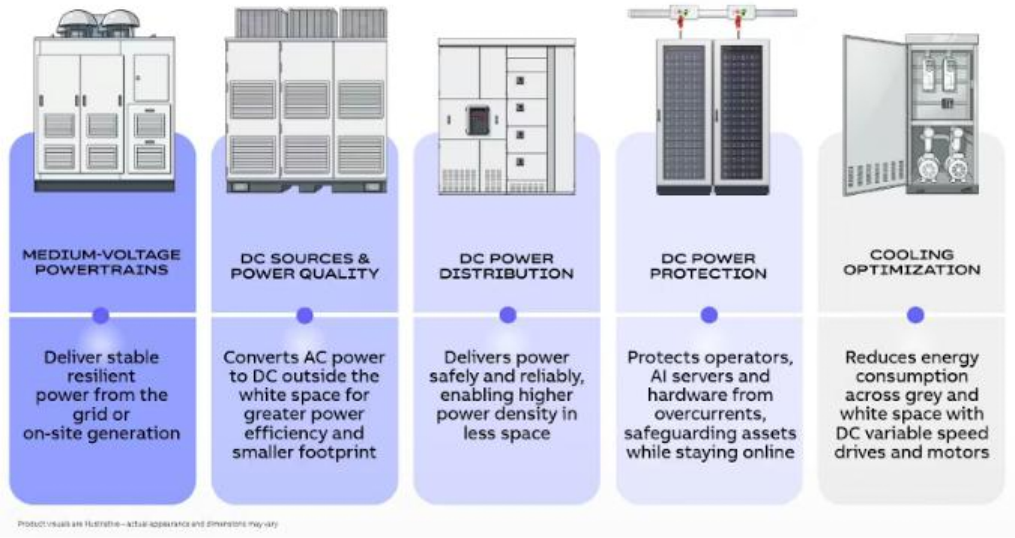
ABB has also recently introduced its new Infinitus source-to-rack DC portfolio (described in detail during a webinar on September 24; see here). The portfolio consists of five building blocks: 1) the powertrain that delivers stable power from the grid (HiPerGuard MV UPS, BESS, MV switchgear); 2) AC to DC conversion outside the white space (Infinitus SST, DC UPS and TRU), 3) DC power distribution (MNS DC switchgear, SACE DC circuit breaker, DC switchboard), 4) DC power protection (SACE circuit breakers, Infinitus Solid State Circuit Breaker) and 5) cooling optimization (DC variable speed drives and motors as well as batteries for CDUs). Unlike some competitors, ABB is not involved in developing rack-level sidecar solutions, which management views as a transitional technology.
ABB's SST provides 3MW+ power with 98.5% efficiency and should be commercially available by 2H27, providing revenue generation from 2028 onwards. Its modular HiperGuard MV UPS connects directly to 34.5kV grid power, reducing footprint by 30% versus traditional architecture, and is already available for order and installation. ABB believes MV UPS will not only facilitate the transition to hybrid architectures, but will also be necessary for full 800VDC solutions. ABB has also developed the first IEC-certified solid state breaker. Orders for these circuit breakers have already been received from other industries, and ABB is currently in discussions with hyperscalers and a few colocators regarding their application in data centers. Two new frames will be introduced by the end of next year (200A and 500A).
[浮水印碼已遮蔽]
For the exclusive use of [訂閱者已遮蔽]
Exhibit 17: ABB has recently introduced its Infinitus direct current portfolio for AI data centers which includes MV SSTs
Source: Company data
Carel Industries (CRLI.MI; Buy, covered by Christian Hinderaker)
Carel's datacenter HVAC business accounted for c.19% of group sales in 2025. The company is a market-leading supplier of niche electronic equipment and controls for HVAC and refrigeration OEMs. Its key products include electronic controllers, sensors, monitoring systems, humidifiers, valves and inverters. We estimate that Carel's datacenter HVAC business has nearly doubled its share of the group revenue mix since 2021. Looking ahead, we forecast a c.25% five-year OSG CAGR for the datacenter HVAC segment, underpinning a +14% group OSG CAGR and +17% adj. EPS CAGR over 2025-30E.
In terms of its product offering for datacenter cooling, Carel's portfolio spans all major datacenter cooling architectures currently in use. This includes chiller-based systems, evaporative cooling towers, dry coolers, rear-door heat exchangers, and advanced liquid-cooling infrastructures. Its components for liquid cooling applications are predominantly housed at the CDU level. They include high-performance controllers and sensors for the control of both floor-mounted and rack-mounted units.
The company also supplies solutions for the cooling of the secondary water loop via chillers or dry coolers. Carel does not supply components that are installed directly on the rack for the cooling of the PCBs. The company notes that adoption of warm water liquid cooling architectures is progressing gradually and is contingent on workload characteristics, hardware design, and site location. Carel also highlights that heat rejection systems are still required within liquid cooling architectures as temperature differences in the rack will remain. With regard to 800VDC, Carel believes that conventional three-phase 400V power systems will remain the predominant solution for [浮水印碼已遮蔽]
For the exclusive use of [訂閱者已遮蔽]
the external cooling equipment (e.g. chillers, dry coolers, and other cooling infrastructure). It believes CDU designs may see modifications (particularly for mechanical components), but that its electronic control systems will still be suitable, as they operate at low voltage levels (typically 24V), with voltage conversion taking place through dedicated transformers and power conversion equipment.
Though Datacenter capex spend remains Carel's key growth driver, its growth is broadening out. We forecast c.+59% OSG for Carel's datacenter HVAC segment in FY26, supporting a +21.0% FY26 OSG forecast for the group as a whole. In the long term, we forecast a c.25% five-year OSG CAGR for the datacenter HVAC segment, underpinning a +14% group OSG CAGR. Datacenter demand is currently delivering the highest segment level growth rates. However, growth is broadening out: Two-thirds of the company's growth (on an absolute €m basis) in 1H26 came from the rest of the business, with broad-based demand strength across Refrigeration and HVAC customers. All verticals in all regions grew double-digit during the half. Regulation-driven demand for Refrigeration is now materialising in both Europe and the US, Commercial HVAC growth is underpinned by Carel's energy-efficient offering, and volumes are returning to growth in European Heat Pump markets, providing a boost to Carel's Residential HVAC segment. Accordingly, we expect Carel's HVAC and Refrigeration segments to grow at a +13.8% and +13.2% OSG CAGR through 2030. The recent acquisition of Cotes should provide a further boost, underpinning our forecast for a +17% adj. EPS CAGR over 2025-30E.
Exhibit 18: Refrigeration contributes c.28% of revenue and Datacenters contribute c.19% on our estimates
GSe end-market & segment split (FY25 - GSe)
Source: Company data, Goldman Sachs Global Investment Research
[浮水印碼已遮蔽]
For the exclusive use of [訂閱者已遮蔽]
Exhibit 19: Carel offers a variety of products for liquid cooling architectures
(1) C.pCO electronic controller (2) FLOE-FLOR flood sensor (3) P.CO3 A-IN expansion board (4) Boss micro edge communication device
Source: Company data
Legrand (LEGD.PA; Buy, covered by Daniela Costa)
Legrand generates c.32% of group sales from data centers and the company has a broad product portfolio including components for the powertrain and networking infrastructure (Exhibit 4). Legrand's current data center offering can be split into: compute infrastructure (50%, includes racks, PDUs, busways and cables), critical power (35%, includes MV switchgear, transformers, switches), advanced cooling (5%, includes rear door heat exchangers and direct-to-chip products) and testing & lifecycle services (10%) (Exhibit 20). While Legrand is skewed towards the white space (c.75% of its data center sales), it has been active in increasing exposure to the gray space (which grew from 5% to 25% of data center sales between 2022 and 2025) with acquisitions such as Kratos and Accelsius (Exhibit 21).
The transition toward 800VDC architectures has emerged as one of the key investor debates around Legrand's long-term positioning. Given its historical strength in low voltage and white space data center products, investors have increasingly asked questions about its ability to continue to grow its data center business in line with data center capex. However, at its recent 2026 CMD, Legrand demonstrated its extensive product pipeline for the transition (Exhibit 22), and now expects data center content
per MW to increase from $2.5mn currently to >$3mn for hybrid/LVDC architecture.
Management expects critical power to increase the most in LVDC architectures, compute infrastructure to increase the most in hybrid architecture, services to increase the most for LVDC, and advanced cooling to increase for both hybrid/LVDC. Legrand is working on SSTs and estimates that $ per MW could increase to $3.8mn if SSTs were [浮水印碼已遮蔽]
For the exclusive use of [訂閱者已遮蔽]
to be included. However, management has not yet made the decision on launching this product given profitability and ROI is not certain.
At its 2026 CMD, Legrand presented its LVDC target architecture in three phases: 1) AC architecture with OCP ORv3; 2) Sidecar architecture and 3) LVDC architecture.
Phase 1 (current state of the most advanced DC architectures) centralizes AC-DC converters in the power shelf of OCP racks and uses rear DC busbar to power them, thus improving conversion efficiency and spatial density. Phase 2 (near term) involves taking those power shelves out of the rack and bundling them next to the rack in a sidecar, liberating premium rack space for compute while allowing operators to retain existing upstream AC infrastructure. Legrand has introduced its power sidecar (can support up to 600kW with 415-480V AC input and 810V DC output), which will be ready for commercialization in 2027 and which Legrand believes could be a permanent solution. Phase 3 (longer term) achieves end-to-end efficiency by eliminating intermediate conversion steps, distributing LVDC directly from grid tied transformers (SSTs or Rectifier Units) via DC busways to the IT rack. Legrand has also introduced its AI-load stabilizer; this will be ready in 2028 and Legrand believes it will have an advantage over MV UPS, which it views as being too far from the AI load to provide necessary protection. Legrand also highlighted its capabilities in cooling solutions, including rear door heat exchangers and liquid-cooled load banks (which it was the first to introduce and which it highlights as essential for any liquid cooling technology).
Exhibit 20: Legrand's current data center offering can be split into five main categories
Data center product portfolio split (% group sales)
Exhibit 21: While Legrand is skewed toward the white space, it has been active in increasing exposure to the grey space with acquisitions
Legrand white space vs grey space exposure (% of sales, 2022-25)
Source: Company data
Source: Company data
[浮水印碼已遮蔽]
For the exclusive use of [訂閱者已遮蔽]
Exhibit 22: At its 2026 CMD, Legrand presented an extensive product pipeline for the transition to 800VDC architecture
Source: Company data
Schneider Electric (SCHN.PA; Not Rated, covered by Daniela Costa)
Schneider Electric's Data Centers & Networks segment accounts for c.30% of group sales. In our European Capital Goods coverage, the company offers the most comprehensive data center portfolio, spanning the entire power chain from MV distribution, switchgear, UPS systems and power management solutions to cooling technologies, rack infrastructure and software (Exhibit 4). Products are split into: secure power systems (32%, includes pre-fabricated solutions for modular DC players), electrical distribution (24%, includes PDUs and bus bars), transactional & edge (16%, mainly inference related components), cooling (7%) and building management systems (5%) (Exhibit 23). Schneider Electric sees its current data center dollar content per MW at $1.3-3.3mn and expects it to trend to the upper end for high-density AI data centers.
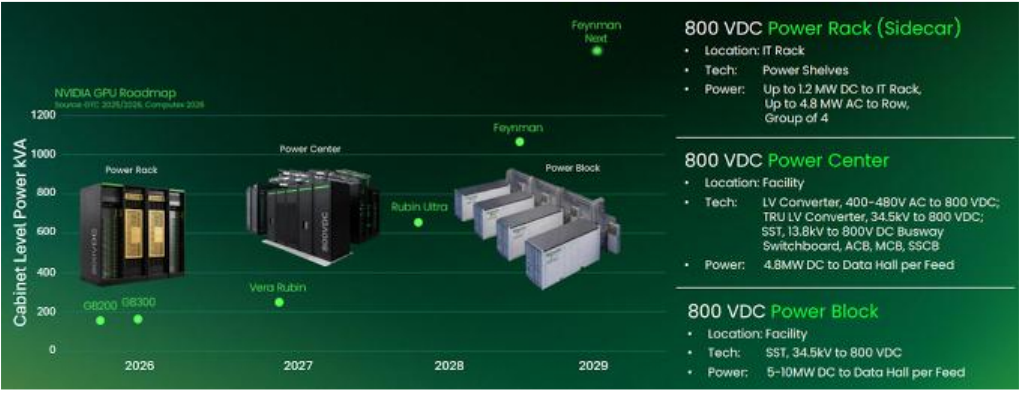
In terms of the 800VDC product offering, Schneider Electric is partnering with NVIDIA and has already introduced its Power Rack solution, a sidecar architecture that converts incoming AC power to 800VDC at the rack level (Exhibit 24). The system is designed to safely deliver MW-scale power densities while minimizing infrastructure requirements and material intensity, providing up to 1.2MW of DC power per IT rack and up to 4.8MW per row. While an important first step toward DC architectures, the Power Rack may be an interim solution for hybrid AC/DC deployments before the industry transitions to fully integrated 800VDC systems.
Schneider Electric is also developing SSTs in the format of two solutions: the
800VDC Power Center and the 800VDC Power Block. The 800VDC Power Center, targeted for 2027, combines low-voltage converters, transformer-rectifier units (TRUs) and SST-based technology to convert utility-scale AC power into an 800VDC distribution architecture capable of supplying approximately 4.8MW per feed to the data hall. The 800VDC Power Block, expected in 2028-29, further simplifies the architecture by relying primarily on SST technology to directly convert 34.5kV AC to 800VDC and deliver [浮水印碼已遮蔽]
For the exclusive use of [訂閱者已遮蔽]
5-10MW per feed. Schneider Electric expects the first commercial deployment of SSTs to emerge in 2H27, with adoption accelerating through 2028-30.
Exhibit 23: Schneider Electric's current data center offering can be split into six main categories
Data center product portfolio split (% group sales)
Source: Company data
Exhibit 24: Schneider's 800VDC roadmap has three main stages of products, which are aligned with NVIDIA's technology roadmap
800VDC product roadmap
Source: Company data
Siemens (SIEGn.DE; Buy, covered by Daniela Costa)
Siemens generates c.4% of group revenues from data centers. Its current product offering spans critical electrical and digital infrastructure including switchgear, protection devices, energy storage, converters and networking infrastructure such as cables and switches. At its CMD in November 2025, Siemens estimated the TAM from AI factories to grow from €11bn in 2025 to €25bn in 2030. Siemens is working closely with NVIDIA to define the physical and digital blueprints for AI factories. At NVIDIA GTC in March 2026, Siemens announced new AI data center reference architectures integrated with the NVIDIA Omniverse DSX blueprint including the Siemens IEC and Siemens UL AI Blueprints for Rubin DSX which provide simulation-ready digital twins of the entire power and cooling infrastructure (see here).
[浮水印碼已遮蔽]
For the exclusive use of [訂閱者已遮蔽]
Siemens launched a new portfolio of direct current solutions in April 2026, including DC protection and switching solutions designed to meet the extreme power demands of AI data centers and industrial application. This includes the Sentron semiconductor circuit breaker, which enables ultra-fast short-circuit interruption in the microsecond range (up to 1000x faster than conventional breakers); it was noted as particularly important in enabling 800VDC during an expert call we hosted recently (see here). Siemens also introduced the SIRIUS solid-state switching device optimized for high-frequency switching or resistive loads and the Sivacon LV switchboard.
To accelerate SST development, Siemens partnered with startup Reinhausen (MR) in August 2026 to develop and industrialize a modular MV SST for deployment in AI data centers (see here). The design supports operation up to 36kV and can be modularly applied to lower voltages. It delivers a stable 800 VDC output and is engineered to respond to load changes within milliseconds, preventing voltage instability and avoiding downtime. While Siemens provides the power electronics, grid protection, automation, and digitalization, Reinhausen contributes its expertise in voltage regulation and MV power electronics. Both companies are actively working to transition this technology from development to series production. Siemens has not yet
provided a timeline for SST commercialization.
Exhibit 25: Siemens expects its total addressable market from AI factories to grow 20% by 2030
*Automation and Buildings is inclusive of Services and other
Source: Company data Goldman Sachs Global Investment Research
Other
Infineon (IFXGn.DE; Buy, covered by Alexander Duval) is a leading semiconductor manufacturer, so, while it does not build complete SST systems, it provides critical enabling technology. The company's 1200V Silicon Carbide (SiC) MOSFETs and Gallium Nitride (GaN) devices are essential for the high-voltage, fast-switching, and low-loss requirements of 800VDC rectification and DC-DC conversion. They also enable SSTs to be meaningfully smaller than traditional transformers. In particular, its CoolSIC technology weighs ~500kgs, compared with 20 tons for a conventional transformer, or 40x lighter and 14x smaller. In March 2026, the company entered into a strategic [浮水印碼已遮蔽]
For the exclusive use of [訂閱者已遮蔽]
partnership with DG Matrix to integrate Infineon's SiC MOSFETs into the multi-port SST platform for AI data centers and industrial microgrids. Furthermore, in July 2026, Infineon signed an MoU to collaborate on high-efficiency direct current power infrastructure solutions. Infineon estimates the semiconductor market for SSTs could reach up to $1bn within the next five years, driven by rising electricity demand from AI and electrification trends.
[浮水印碼已遮蔽]
For the exclusive use of [訂閱者已遮蔽]
NA
Eaton Corp. (ETN; Not Rated, covered by Joe Ritchie) Eaton generates c.24% of its revenues from Data Center & Distributed IT products.
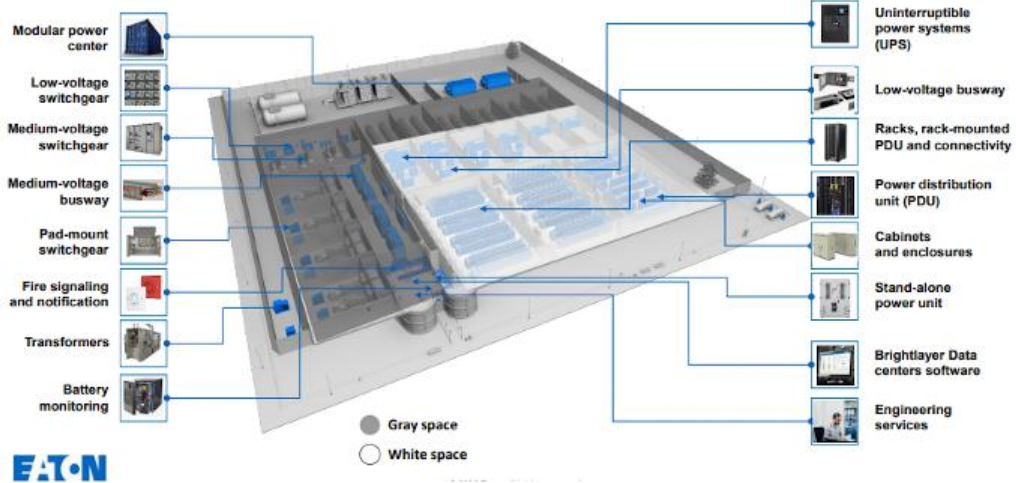
Its current portfolio can be categorized into hardware (MV and LV switchgear, UPS, PDUs, ATS and busways), software (datacenter infrastructure management and electrical power monitoring) and networking infrastructure (racks, enclosures and cable management). Eaton has positioned itself as a technology leader in the transition to 800VDC and SST architecture, actively partnering with both chip manufacturers and hyperscale data center operators. In 2025, Eaton launched a comprehensive 800VDC reference architecture in collaboration with NVIDIA. Eaton also acquired Resilient Power, a specialist in medium-voltage SST technology, for $86mn in August 2025.
Eaton debuted its 2MW MV SST in the Asian market at SEMICON Taiwan 2026, where it became the first OEM to receive TÜV SÜD certification for an SST. It is now marketed on the company's website as a 2MW transformer that directly converts 10-34.5kV MV AC to 800VDC with greater than 97% (and up to 98.5%) conversion efficiency. The company has been running internally developed SST pilots in APAC and management have recently signed off capex for 3 facilities to manufacture SSTs at scale. Eaton expects to win some orders in 2H26 leading to shipments in 2H27. At Singapore's Data Center World, Eaton said it expects first deployment of its SST with a customer in Singapore in 2Q27 with broader 800VDC adoption picking up in late 2027.
Eaton's 800VDC portfolio also includes sidecars (although not yet sold), supercapacitors for fast-cycle power backup, ORV3-compatible busbars, and specialized DC connectors. The company expects its potential sales per MW to increase from $1.2-1.5mn for traditional data centers to $1.2-2.9mn for AI data centers, representing an increase from 6-10% to 6-14% of total compute and infrastructure capex.
[浮水印碼已遮蔽]
For the exclusive use of [訂閱者已遮蔽]
Exhibit 26: Eaton offers a broad portfolio of data center solutions covering both the gray and white space
Source: Company data
Exhibit 27: Eaton expects its $ per MW to increase from $1.2-1.5mn to $1.2-2.9mn
Source: Company data
Flex (FLEX; Buy, covered by Mark Delaney)
Flex has emerged as a key player in AIDC physical infrastructure, driven by its Cloud and Power Infrastructure (CPI) business, which generated $6.6bn revenues in fiscal 2026 (c.24% of group, 38% YoY growth). In May 2026, Flex announced its intention to spin off CPI into a new independent publicly traded company and renamed to Axiom (see here). Flex is targeting Axiom to generate approximately 65-75% revenue growth in fiscal 2027, with an acceleration to >80% in fiscal 2028.
The segment's current data center product portfolio comprises grid to chip power products, thermal management technologies as well as integrated IT infrastructure.
[浮水印碼已遮蔽]
For the exclusive use of [訂閱者已遮蔽]
This includes pre-engineered modular compute and storage racks, liquid-cooling solutions (including CDUs delivering up to 1.8MW of capacity and cold plates), power shelves, and capacitor-based energy storage systems (CESS) designed to address the sharp power fluctuations characteristic of AIDCs.
In terms of 800VDC product portfolio, Flex announced an 800VDC power rack in March 2026 (see here). This was developed in collaboration with NVIDIA to support the NVIDIA Vera Rubin platform and can increase available compute power per rack from c.125kW to up to 880kW. Flex also offers BBUs and CBUs as enhanced options for the 800VDC power rack. In October 2026, the company completed its acquisition of EPC Power, a leading provider of intelligent power conversion solutions for data center and grid/utility/energy applications, whose future technology roadmap includes a centralized rectifier for 800V as well as an SST product (as highlighted at our Communacopia conference).
GE Vernova (GEV; Buy, covered by Joe Ritchie)
GE Vernova has not disclosed revenues from data centers but disclosed c.$5bn orders from data centers in 1H26 out of $42.5bn for the group (c.12%). Within the Electrification business, GE Vernova provides complete turnkey substation solutions, HV switchyards, MV switchgear, and power transformers. Within the Power business, GE Vernova delivers a scalable line-up of gas turbines capable of serving as prime or backup generation. The company currently states a dollar content per MW of $0.2-0.3mn per MW, but believes that this could increase 2-3x with its MV UPS and SST offering.
GE Vernova's MV UPS has been introduced to help accelerate the build-out of AI factories and is expected to begin shipping in mid-2027 with energization of the first project expected in late 2027. SST development ramped up in the early 2020s through GE's Advanced Research Center, and, in early 2023, General Electric (prior to the official GE Vernova spin-off) introduced a 35kV SST prototype. At 2Q26 results, GE Vernova announced the build-out of its 5MW SST prototype for indoor applications, which will be delivered to its first hyperscaler later this year. In parallel, the company has started developing a 6MW SST for outdoor applications. However, management expects full commercialization of SSTs to still be 12-24 months away, and industrialization to be 24-36 months away.
nVent (NVT; Buy, covered by Joe Ritchie)
nVent generates c.30% of its revenues from data centers and provides a broad portfolio through both its Systems Protection and Electrical Connections divisions. nVent primarily provides liquid and air cooling solutions under its Schroff and Hoffman brands including direct-to-chip liquid cooling systems, rack- and row-based CDUs, rear door heat exchangers and technology cooling systems. It has also expanded into power distribution, offering LV/MV switchgear, switchboards, PDUs and cable management through key acquisitions such as Maverick Power and Avail Infrastructure Solutions.
At its 2026 Investor Day, nVent gave forecasts of $7tn cumulative global capex for data centers between 2025-2030 and expects data centers to provide $25bn of total growth opportunity for nVent, representing $1mn/MW. nVent is partnering with NVIDIA and Siemens to deploy liquid cooling solutions at scale to support next generation platforms. However, the company has not made specific references to [浮水印碼已遮蔽]
For the exclusive use of [訂閱者已遮蔽]
solid-state transformers.
Vertiv Holdings (VRT; Buy, covered by Mark Delaney) Vertiv generates c.85% of its revenues from data centers (with >50% of total revenue tied to cloud and colocator customers) and provides a broad portfolio including the power train (Trinergy UPS and Dynaflex energy systems) and thermal management (CoolChip liquid cooling including CoolChip CDU). These physical infrastructure and thermal layers can be deployed as a point product but are fit-out and MegaMod hybrid-cooled containerized platforms).
Vertiv has developed an 800VDC power portfolio with NVIDIA. The core near-term offering centers on an 800VDC sidecar architecture (PowerDirect 5000), which is currently undergoing customer validation and is expected to launch early 2027. This moves conversion out of the rack and into the pod and can provide up to 900kW. The design returns 8 to 16 rack units to compute while allowing much of the upstream AC MVDC UPS system (similar to ABB), as well as SST solutions. Management expects sidecars to launch in 1H27 and fully native 800V to start in 2H27 with larger volume shipments in 2028.
increasingly being deployed via prefabricated modular systems (SmartRun whitespace At its 2026 Investor Day, Vertiv outlined its data center market forecasts for the 2025-2030 period, projecting a 38% CAGR for inference compute, 11% for training, and 10% for traditional compute workloads. The company also expects the data center market to grow at c.18-20% CAGR, led by cloud and colocation segments expanding at c.23-25%, with the company expecting to gain share. Management anticipates 140GW of cumulative power to be added between 2026-2030, with 20-35GW of power added per year. Vertiv now sees its $ content per MW at $3.25-3.75mn per MW (which is 10-15% higher than its prior range), noting that this figure is a blend of both AI and non-AI workloads, and there are applications and use cases that exist above this range such as its converged solutions (e.g. SmartRun and OneCore). infrastructure to stay in place. For more complete architecture, Vertiv is developing a [浮水印碼已遮蔽]
For the exclusive use of [訂閱者已遮蔽]
Exhibit 28: Vertiv's PowerDirect sidecar should provide up to 900kW and is expected to launch in early 2027
Source: Company data
[浮水印碼已遮蔽]
For the exclusive use of [訂閱者已遮蔽]
APAC
Delta Electronics (2308.TW; Buy, covered by Chao Wang)
Delta Electronics has >30% revenues from data center power related products. We believe the number will increase to ~40/50%+ of total revenue in 2026/27, not only due to solid demand growth for AI PSU and DC/DC converters, but also owing to Delta Electronics' clear market leader position in AC to DC conversion technology (>60% market share in both AI AC and DC converter markets and leading edge AI AC/DC products for power racks).
At the OCP Global Summit 2025, Delta Electronics unveiled its next-generation 800VDC grid-to-chip power solutions (see here), which include solid state transformers, 90 kW DC/DC power shelves (converting 800VDC to 50VDC at up to 98.5% efficiency), and 800VDC In-Row Power systems.
Delta Electronics' SST converts MV AC (10kV - 35kV) to 800VDC at up to 98.5% efficiency. While Delta Electronics has not disclosed the MW capability of its SST, our expert call (see here) noted that it is targeting a 5MW design (deemed the sweet spot in terms of size and flexibility for data center SSTs). Delta Electronics' SST comprises MV input componentry; power conversion, protection, and control capabilities; and SiC power modules in a compact, modular system. Delta Electronics has already deployed SST units in Asia (including a joint project with Meituan and Chindata in China - see here) and is currently conducting customer pilots in the US. Given that one of the key technology bottlenecks in the SST system is the AC/DC conversion ratio, we believe that Delta Electronics is now in a good position to capture a significant share of the opportunity. However, the company's lack of experience in on-site service (which is essential for SST solution products) leads us to believe that share gains could be slow in the first few years of SST demand ramping up, although we view the company as a key beneficiary in the SST industry longer term. Based on management commentary, Delta Electronics appears to be working not only with AI GPU chip providers on SST design references, but also with several CSP customers on testing/R&D progress. Management expects testing shipment to occur throughout late 2026-2H27, while mass production should take place from 2028.
[浮水印碼已遮蔽]
For the exclusive use of [訂閱者已遮蔽]
Exhibit 29: Delta Electronics has introduced a MV SST that converts MV AC (10-35 kV) directly to 800VDC at up to 98.5% efficiency
Grid Load MVAC 10kV-35kV
LVDC 200V- 1000V
Source: Company data
HD Hyundai Electric (267260.KS; Neutral, covered by Do Hyoung Kim) HD Hyundai Electric is a global supplier of power transformers and electrical equipment. While it does not yet generate meaningful revenues from data centers, the end market accounted for 1.8% of Power business orders in 2025 and management anticipates it to grow to 6.3% in 2026 and 16% in 2027. HD Hyundai Electric offers various products that are relevant to data centers including power & distribution transformers, generators & motors and MV/LV circuit breakers. The company has highlighted a c.$800mn long-term supply agreement for power & distribution transformers with a big tech company, as well as increasing orders for generators and motors driven by growing demand for data center BTM power plants. HD Hyundai Electric is also expanding its MV/LV circuit breaker supply for North American data centers and advancing DC distribution system design for domestic data centers. It established the first Korean-owned US transformer plant in Montgomery, Alabama, in 2011 and has expanded multiple times since then; it is currently constructing a second Alabama facility to lift its US capacity by 33%.
More recently, management has highlighted increased focus on data center DC power infrastructure expansion supported by proven experience with the world's first 1MW-class DC distribution system. In October 2025, HD Hyundai Electric signed an MOU with Hitachi Energy to collaborate on domestic HVDC projects. The company is currently developing SST-based 800V DC power infrastructure and associated DC protection systems, although it has not yet provided a timeline for commercialization of these products.
Hitachi (6501.T; Buy, covered by Ryo Harada)
Hitachi has a diverse business portfolio comprising four segments, of which three contribute to total data center revenues: Energy (formerly ABB Power Grid), Connective Industries and Digital Systems & Services. The Energy business provides power grids, HVDC technology, and transformers for data centers. While data centers [浮水印碼已遮蔽]
For the exclusive use of [訂閱者已遮蔽]
accounted for <10% of Hitachi Energy's sales in 2025, the company said at its Investor Day in June 2026 that data center orders in this division have been expanding rapidly and are expected to increase by 5x from FY3/25 to FY3/28. The company also said that it has an advantageous position with container-type solutions and 800V-compatible SSTs. Within Connective Industries, the company offers UPS for data centers as well as semiconductors, with the company recently announcing the development of edge AI semiconductors in April 2026. Within Digital Systems & Services, the data center offering includes Hitachi Vantara (storage solutions) and HMAX Data Center (suite of solutions for integrated DC infra operations, launched in September 2026). The company views the rise of AI as a huge growth opportunity for DSS, creating a new market estimated to be worth $600bn.
In terms of 800VDC, Hitachi and Hitachi Energy established a partnership with NVIDIA in October 2025 and later unveiled an 800 VDC power supply simulation in March 2026, enabled by the NVIDIA Omniverse DSX Blueprint, to help accelerate the development of GW-scale AIDCs. The solution equips data center developers and utilities with SimReady digital twin assets to help design and deploy GW-scale AIDCs, as well as grid stability and predictive management.
On the SST front, back in 2021, Hitachi ABB Power Grid announced a partnership with Nanyang Technology University Singapore for SST technology (see here) as well as the development of a 350kW multi-port EV charging system equipped with compact SSTs based on SiC (see here). More recently at its Investor Day in June 2026, Hitachi explicitly identified SSTs as a key high-growth technology and that the company has a global footprint and capacity expansion efforts in progress here. It is focusing on SSTs at the MV level and has started with containerized solutions. At a CFO meeting in September 2026, Hitachi disclosed that it has technology for 800VDC-related products, which will expand Hitachi Energy's TAM. However, it thinks that 800VDC commercialization is still some way off as this has not yet been standardized in the industry.
Hyosung Heavy Industries (298040.KS; Buy, covered by Do Hyoung Kim) Hyosung Heavy Industries focuses on heavy grid infrastructure and power stabilization systems needed to feed electricity into high-density and hyperscale AI data centers. Its current product offering includes ultra-high-voltage transformers (including 765kV and 345kV models), solid-state transformers, gas-insulated circuit breaker (800kV 7000A GCB) as well as energy storage systems (ESS) and its STATCOM power stabilization systems.
In 2022, the company successfully developed the world's first 22.9kV 1.05MVA-class SST capable of direct connection to urban distribution networks.
Management highlights that global market research firms expect the global SST market to grow at an average annual rate of >40%. However, large-capacity SSTs for data centers are at a nascent stage, with only a limited number of companies worldwide pursuing commercialization and demonstration projects. The company has invested $300mn in the acquisition and expansion of its ultra-high-voltage transformer manufacturing facility in Memphis, Tennessee. Once the ongoing expansion is completed, the company will secure one of the largest ultra-high-voltage transformer production capacities in the US.
[浮水印碼已遮蔽]
For the exclusive use of [訂閱者已遮蔽]
Hyosung has also entered a joint venture with Quanta Services, a North American energy infrastructure solutions company, to produce 72.5kV to 800kV ultra-high-voltage circuit breakers in Pennsylvania. This makes Hyosung the first Korean power equipment manufacturer to secure local production capabilities for both ultra-high-voltage transformers and circuit breakers in the US. The company showcased its SST, gas-insulated circuit breaker and HVDC transmission systems at the IEEE PES T&D 2026 exhibition and is actively conducting R&D on more advanced, higher-voltage SST models to support next-generation AI data centers.
Megmeet (002851.SZ; Neutral, covered by Hao Chen)
Megmeet is undergoing a structural transformation from an automation & control specialist to a global AI server power supply contender, offering high-efficiency power solutions for AI driven data centers. It provides standard OCP compliant hardware, including its Open Compute Rack Power system, which comprises the 33 kW Power Shelf, the 16.5 kW Battery Backup System (BBU Shelf), and the 15 kW Super Power Capacitor Shelf. For board-level power conversion, Megmeet supplies DC-DC Power Modules as well as automatic transfer switches. The company has secured volume orders for 5.5kW PSUs (GB200/GB300), with new orders and shipments to continue through 2026 (see here).
Megmeet is designing and manufacturing advanced power solutions including an 800VDC data center architecture for NVIDIA MGX architecture (see here). Its flagship next-generation offering is its 1MW 800VDC Power Rack (Exhibit 30), which is designed as a space-saving sidecar power system. This native HVDC architecture converts AC input directly to 800 VDC and is designed to achieve up to 5% improvement in end-to-end power efficiency, reduce copper usage weight by up to 45%, and cut total cost of ownership by up to 30%. Megmeet has also committed R&D to establish its own SST technology. While its entry into the NVIDIA MGX ecosystem validates its R&D capabilities, our China Industrial Tech team believes that a gap remains in its high-efficiency product portfolio compared to tier-1 peers such as Delta Electronics (see here). At the recent GS Asia Leaders Conference (see here), management said it expects the transition to 800 VDC architecture to be gradual. It does not expect volume SST adoption within the next 1-2 years given that reliability tests and component availability take time.
Exhibit 30: Megmeet's Power Rack enables 800 VDC distribution to payload racks and DC/DC conversion to 12 V for GPUs
MEGMEET
Source: Company data
[浮水印碼已遮蔽]
For the exclusive use of [訂閱者已遮蔽]
Shenzhen Kstar Science & Tech (002518.SZ; Buy, covered by Hao Chen)
Kstar generates c.60% of group sales from data centers. It offers a broad range of UPS systems (Memorpower-IV and YDC3300, achieving up to 95.5% conversion efficiency), energy storage systems (VRLA battery backup systems and integrated lithium-ion solutions) and prefabricated modular datacenter solutions (IDU, IDM, and IDB series). Kstar also offers the LiquiX Direct-to-Chip liquid cooling platform, which spans 10 kW to 2 MW in cooling capacity.
Kstar is in the process of developing 800VDC systems specifically designed to meet high-density power requirements of next-gen AI servers. The company has entered into a JV with CATL focused on HV and LV battery energy storage systems (BESS), where the DC power from CATL's lithium iron phosphate battery cells is converted by Kstar power conversion systems. Kstar is also investing in SST technology, but it does not have an active commercial SST development program and the company has not yet received any orders for SSTs. Its 800VDC power conversion module (launched May 2026) is expected to see initial small-batch orders as early as 2H26, while its SST (solid-state transformer) roadmap targets a prototype by late 2026 and system completion by mid-2027 (see here). Most recently at the GS Asia Leaders conference, Kstar said it plans to send its 800 VDC products for onsite testing for 3-6 months in Europe and Southeast Asia in October 2026. The company notes there are intensive debates in the supply chain and among its customers on the penetration trajectory of 800 VDC architecture given the trade-off between reliability and efficiency.
Other companies
Hainan Jinpan Smart Technology (Not Covered) is a China-based manufacturer of digital and smart power transmission equipment. While it has not disclosed % of total revenue derived from data centers, it reported that data center revenues increased c.200% in 2025, as the company captured opportunities in AIDC. The company has completed the overseas delivery of 345kV power transformers and put a 110kV transformer into operation. Jinpan has been advancing its SST R&D since 2024 and has successfully completed several generations of SST prototypes ranging from 2.4MW to 3.3MW with samples sent to overseas customers for testing and verification.
Shenzhen INVT Electric (Not Covered) is a Chinese technology company specializing in power electronic products, with c.17% of revenues coming from data centers. The company has developed modular 800-1000kVA UPS systems and recently unveiled a strategic roadmap outlining its research priorities for AIDCs, focusing on HVDC, SSTs and liquid cooling. It plans to build dedicated testing platforms, including an SST load testing platform and an HVDC functional testing platform to support capacity expansion and model diversification.
Bizlink Holding (Not Covered) is a global provider of interconnect solutions specializing in high-performance cabling and power connection products. The company recently announced in September that it has started mass production and shipping of 800VDC products for Nvidia's Vera Rubin platform to support new high-power server architecture requirements. To expand its capacity for high-current connection solutions, BizLink also announced the acquisition of Singapore-based Interplex Datacom, a specialist in components for AI server racks, which is expected to close in 2H26.
[浮水印碼已遮蔽]
For the exclusive use of [訂閱者已遮蔽]
Development efforts among solar inverter manufacturers
Enphase Energy (ENPH; Buy, covered by Brian Lee)
Enphase Energy is a leading manufacturer of inverter technology for the solar and storage markets with revenues largely generated from the residential end market. While it does not yet generate revenues from data centers, it plans to enter the market with SSTs as data centers transition to 800VDC, leveraging its two decades of experience in software-defined, microinverter-based power conversion.
In April 2026, Enphase formally announced the development of the IQ SST and published a presentation discussing the product in more detail. The IQ SST deploys a supercluster of 342 intelligent power modules utilizing GaN switching rather than SiC, as outlined in our recent expert call here. The system converts medium-voltage AC directly to 800VDC in a single stage, at 2.5MW (although it is capable of supporting up to 5MW) and targets >98.5% efficiency. During a GS-hosted investor call, management noted that it is in active discussions with more than 20 prospective customers, including hyperscalers, and in terms of its go-to-market strategy, the company is likely to work directly with project developers rather than distribution partners. The company aims to start pilot programs in 2027 with first commercial shipments as early as 4Q27.
SolarEdge (SEDG; Sell, covered by Brian Lee)
SolarEdge is a solar equipment maker, focused on DC optimizer based inverters primarily for residential and light commercial end markets. Similar to Enphase Energy, SolarEdge is currently developing SSTs for 800VDC data centers. Management views the SST opportunity as a sizable adjacent market opportunity that leverages the company's two decades of DC power electronics expertise.
In November 2025, SEDG announced that it was developing SST technology with Infineon, and separately published a white paper on addressing data center needs.
The system converts medium-voltage AC (13.8/20/34.5kV) directly to 800VDC in a single stage, at up to 5.25MW per block, and targets >99% efficiency. We note that management has discussed that it does not anticipate any revenue from SST solutions before 2027. The company is currently involved in pilot-scale testing with customers and vendors to determine which is the best fit into its overall architecture. The company anticipates small orders in 2026 and 2027 to support these small-scale tests in existing data centers or labs. However, management sees more scaled revenue potential in 2028 and beyond, with a target of reaching c.$600mn in revenue in 2029 as outlined at its recent Investor Day. Additionally, SEDG has highlighted that its current spending on the SST market in 2026 is in the mid-single digit millions for opex and high-single digit millions for capex.
[浮水印碼已遮蔽]
For the exclusive use of [訂閱者已遮蔽]
Development efforts among new entrants
Amperesand (private)
Amperesand is a prominent modular power conversion start-up that raised $80 million in a Series A funding round in November 2025. The company is developing MV SSTs utilizing SiC technology, purpose-built for AI data centers and heavy industry. It is currently deploying its MV SSTs to Fortune 100 customers and targets 30 MW of commercial deployments in 2026. Per the company, its SST technology can deliver power 5x faster in 50% less space (vs traditional MV architecture) with >98.5% MV-LV conversion efficiency.
DG Matrix (private)
DG Matrix is a pure-play SST manufacturer for data centers that closed a $60mn Series A funding round in February 2026. The start-up has been collaborating with NVIDIA for over two years and introduced its Interport SST, the first multi-port SST, at NVIDIA's GTC 2026 in March. The Interport platform is purpose-built to integrate with the NVIDIA MGX modular rack architecture, simultaneously routing power from multiple sources to multiple loads at differing voltages to deliver 800VDC directly to GPU racks. DG Matrix is now scaling up and accelerating pilot deployments of its AI-enabled Interport platform with hyperscale, neocloud and colocation customers worldwide.
Heron Power (private)
Heron Power is a start-up in the SST space that closed a $140 million Series B funding round in February 2026. Its flagship product, Heron Link, is a 4.2 MW software-defined solid-state transformer that connects directly to 34.5kV lines and delivers 800VDC output with over 98.5% conversion efficiency. The Heron Link features an integrated battery buffer that allows it to replace LV transformers, LV switchgears, centralized UPSs, and PDUs, resulting in 70% smaller electrical equipment footprint, per the company.
Hyperscale Power (private)
Hyperscale Power is an emerging start-up that closed a €5mn seed round in March 2026. The company is developing ultra-compact, rack-scale SST solutions designed to enable direct MV to 800VDC conversion, minimizing the footprint of power infrastructure in dense AI data centers and allowing operators to maximize space for compute racks. The product is intended to be 10x smaller than traditional transformers, using 90% less material while maintaining up to 98.5% conversion efficiency.
Reinhausen GmbH (private)
Reinhausen GmbH (formerly Maschinenfabrik Reinhausen) is a leading manufacturer of voltage regulation technology for power transformers and has developed extensive know-how in the field of MV power electronics and related components, which are at the heart of modern SST architectures. In August 2026, Siemens and Reinhausen announced a strategic partnership to jointly develop, industrialize, and eventually begin serial production of a modular SST for AI data centers (see here). The design supports the operation up to 36kV and can be modularly applied to lower voltages, making the architecture scalable for different grid-connection [浮水印碼已遮蔽]
For the exclusive use of [訂閱者已遮蔽]
conditions. It delivers a stable 800 VDC output and is engineered to respond to load
changes within milliseconds, preventing voltage instability and avoiding downtime. However, neither Reinhausen nor Siemens have provided a timeline yet for SST
commercialization.
WattEV (private)
WattEV is a heavy-duty freight electrification company that has expanded its high-power conversion technology into the data center space. The company has developed a compact, medium-voltage SST (funded in part by the California Energy Commission) that connects directly to 12-15 kV utility lines to deliver 1.2 MW to 3.8 MW DC output. While initially designed to replace step-down transformers, switchgear, and low-voltage rectifiers for Megawatt Charging Systems (MCS) for electric trucks, the technology is being actively adapted for direct MV-to-800VDC data center distribution.
[浮水印碼已遮蔽]
For the exclusive use of [訂閱者已遮蔽]
Deep-dive into SSTs
What do transformers do and why are they important? Traditional transformers are passive electromagnetic devices that step alternating current (AC) voltage levels up or down to enable efficient long-distance transmission and safe local distribution. By stepping up voltage for transmission, transformers allow the same amount of power to be delivered at a significantly lower level of current, which minimizes resistive heat loss, reduces the required conductor size, and lowers overall infrastructure costs. Conversely, step-down transformers are vital for the safe distribution of electricity, reducing high transmission voltages to levels suitable for industrial and residential end-uses. While highly reliable, their reliance on heavy iron cores and copper coils makes them bulky, heavy, and incapable of active power management.
How are solid-state transformers (SSTs) different? SSTs, often referred to as 'smart' transformers, replace the heavy iron cores and copper coils of traditional transformers with high-frequency power electronics by leveraging advanced Silicon Carbide (SiC) and Gallium Nitride (GaN) semiconductors. This allows SSTs to act as intelligent energy routers, offering bidirectional power flow, active power management and real-time voltage regulation (in contrast to passive traditional transformers), while also being more efficient and 50% smaller. Crucially, they are able to convert high voltage AC to 800VDC (Exhibit 32). This typically occurs through main three stages: 1) Input stage: high-voltage AC from the power grid (ranging from 13.8-34.5kVAC) is converted into DC, 2) Isolation stage: voltage is reduced (by converting the DC back into very high-frequency AC, passing it through a tiny transformer and converting it back to DC) and galvanic isolation is provided (preventing dangerous electrical shocks or short circuits) and 3) Output stage: final power is outputted as 800VDC.
Advantages of SSTs. SSTs are viewed as critical enablers for 800VDC data centers, especially as the power density needs increase. Importantly, as power systems are increasing in complexity, there is a growing focus on leveraging equipment with more advanced controls, better efficiencies, and greater compatibility with renewable energy, rather than simply increasing or decreasing voltage levels. While SSTs maintain similar efficiency levels as traditional transformers (~98%-99%+) under normal conditions, SSTs outperform when there are variable or partial load conditions, which is very relevant to AI training and inference workloads. Additionally, since SSTs are 50% smaller and lighter than traditional transformers, they not only free up space for compute hardware, but they can also sit closer to the actual data center rack, reducing redundant AC-to-DC conversion stages, which minimizes energy loss and improves overall efficiencies.
Disadvantages of SSTs. A primary drawback of SSTs is the higher initial cost compared with traditional transformers. Based on market data, our Clean Energy team sees SSTs at c.5-10x the cost of a traditional transformer, and, during a recent expert webcast discussing 800VDC (see here), current SST pricing was indicated at c.$400-500k per MW. However, as companies continue to advance capabilities around SSTs and production capacity increases, this can help reduce costs, making them more affordable. Additionally, as data center power requirements are expected to step up in the coming years, the power conversion loss associated with traditional architecture will become more extreme and much more costly. While SSTs entail meaningfully higher unit costs compared with traditional transformers, they offer the potential to reduce the total cost of ownership for data centers.
[浮水印碼已遮蔽]
For the exclusive use of [訂閱者已遮蔽]
Exhibit 31: Traditional transformers use heavy iron cores and copper coils with magnetic flux to step AC voltage up or down
Diagram of traditional transformer and overview of magnetic flux
Source: Goldman Sachs Global Investment Research
Exhibit 32: By contrast, SSTs can convert high voltage AC from the power grid to 800VDC through the use of high-frequency power electronics
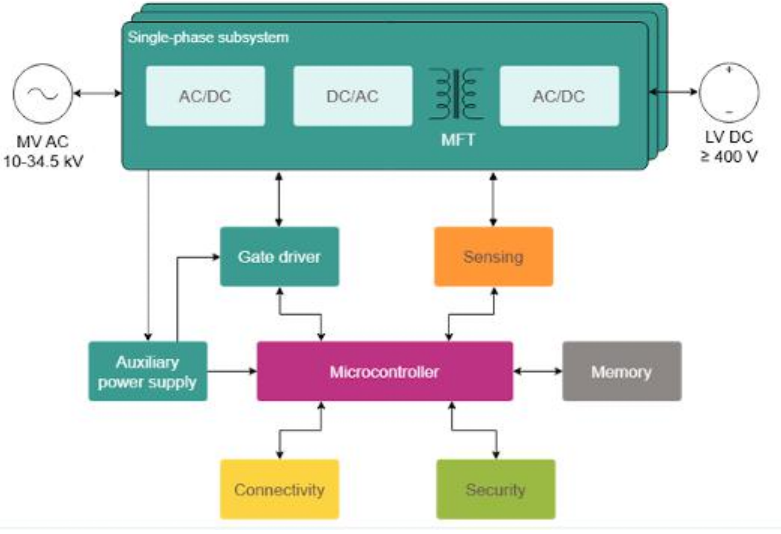
Source: Infineon Technologies, Data compiled by Goldman Sachs Global Investment Research
[浮水印碼已遮蔽]
For the exclusive use of [訂閱者已遮蔽]
Exhibit 33: Solid-state transformers are expected to be c.5-10x the cost of traditional transformers
Price estimates for transformers $/MW ($000s)
Source: Electric Motor Supply Company, Taishan Transformer, Data compiled by Goldman Sachs Global Investment Research [浮水印碼已遮蔽]
For the exclusive use of [訂閱者已遮蔽]
Global SST market may reach up to $5bn in 2030E
Leveraging our GS Sustain team's forecasts, we estimate c.10GW of new data center capacity using 800V GPUs in 2030 (c.6% of the installed base and c.60% of new additions in 2030E). This equates to a revenue opportunity from SSTs as high as ~$5bn, assuming various pricing levels for the technology. We note the early stage juncture of this opportunity implies that market sizing will evolve as visibility improves and products start to move into pilot stage, likely in 2027.
What is the opportunity and potential timing? In aggregate, the global transformer market is estimated at ~$65bn per year. Infineon has characterized the SST market as having an expected market value of more than $1bn in 2030, which compares with the conventional transformer market of more than $15bn. Our industry checks indicate that SSTs can have power capacities of 1MW-10MW, providing capabilities to power multiple server racks. As a result, a 1 GW data center could require 100-1,000 SSTs, although we believe larger data centers would likely be utilizing larger SSTs. Additionally, data centers will likely build in some redundancy in case there is an issue with one or more of the SSTs, with a typical build potentially requiring 110%-130% of the required capacity.
At a price of ~$100,000-$350,000/MW per SST (reflecting expected cost deflation and manufacturing scale relative to current pilot pricing), this equates to a
- ~$110mn-$450mn opportunity per 1 GW data center. We note that our SUSTAIN team estimates that between 2028 and 2030, there will be 37 GW of data center deployments globally, and we calculate that 32 GW should be derived from
Blackwell/Rubin/Feynman/other GPUs that can leverage the 800V opportunity. As a result, we estimate the 800V market as offering ~$3bn-$14bn in total market potential for SSTs between 2028 and 2030 depending on pricing. Specific to 2030, based on the SUSTAIN team's forecast, we see ~10 GW of global data centers leveraging 800V GPUs, with this representing a ~$1bn-$5bn annual market opportunity depending on where pricing shakes out. We note that these estimates include both Blackwell servers (which our Clean Energy team suggests are compatible with 800VDC architectures) and Rubin servers. Were we to include only Rubin servers, this would imply c.7GW of new data center capacity using 800V GPUs in 2030 (c.4% of installed base and c.40% of new additions in 2030). Applying similar logic to solid state circuit breakers, which, per our DC expert call (here), is estimated to cost c.$600k per MW (5x the price of current circuit breakers), we see a potential TAM of $5-8bn in 2030E.
Other potential markets for SSTs. We highlight that these estimates are solely representative of the data center market. However, given the ability for SSTs to operate at high voltages as well as high frequencies, they are being pursued for other applications such as EV fast-charging, renewable integration (solar and wind), railway systems and transportation, and broader grid modernization. As a result, there is likely upside to these estimates based on the market penetration within these other verticals.
[浮水印碼已遮蔽]
For the exclusive use of [訂閱者已遮蔽]
Exhibit 34: We expect the total addressable market for SSTs to ramp with the 800VDC transition...
GS annual market potential for SSTs, 2025-2030, $mn
Exhibit 35: ...and estimate a global SST market potential of $3bn-$14bn in total between 2028-2030...
GS forecast for SST market potential for data center deployments between 2028-2030
Source: Goldman Sachs Global Investment Research
Exhibit 36: ...with c.$1bn-$5bn annual potential in 2030E
GS annual market potential in 2030
Source: Goldman Sachs Global Investment Research
Exhibit 37: We also see a potential TAM for solid state circuit breakers ranging at $5-8bn
GS annual market potential for solid state circuit breakers, 2025-2030E, $mn
Source: Goldman Sachs Global Investment Research Source: Goldman Sachs Global Investment Research [浮水印碼已遮蔽]
For the exclusive use of [訂閱者已遮蔽]
Valuation and risks
ABB (ABBN.S). Our 12m target price of SFr82 remains based 75% on our sector-relative EV/IC to ROIC/WACC methodology and 25% on our SOTP (using 6m27/6m28 estimates). Key upside/downside risks to our view and price target include: (1) A stronger/weaker-than-expected capex environment in key end markets; (2) Market share gains/losses as a result of better/weaker execution; (3) Stronger/weaker-than-expected pricing; (4) Favorable/unfavorable FX volatility; and (5) Value-accretive/dilutive M&A and/or portfolio pruning.
Carel Industries (CRLI.MI). Our 12-month price target of €36 is based on our sector-relative EV/IC vs. ROIC/WACC methodology on 6m27/6m28E. Key downside risks to our view and price target include: (1) Datacentre capex cuts; (2) An unexpected slowdown in European heat pump demand; (3) Faster-than-expected rate hikes or overall rate volatility; (4) Less supportive policy changes (e.g., related to F-Gases and the use of natural refrigerants); (5) Higher inflationary pressures on costs (e.g. labour/critical components); (6) Risk of margin pressure or share loss from rising trade tariffs (e.g. on imports into the US); and (7) Supply chain risk from the conflict in the Middle East.
Legrand (LEGD.PA). Our 12-month target price of €172 is based on our 12-month rolling sector-relative EV/IC to ROIC/WACC methodology. Key downside risks to our view and price target: (1) Higher-for-longer-than-expected interest rates leading to more protracted construction softness; (2) Material macro instability in France or Italy; (3) Challenges in complementing organic growth via Legrand's established bolt-on M&A strategy/ requiring value dilutive multiples to achieve historical levels of M&A; (4) Datacenter implementation delays; and (5) Technological shifts in datacenters particularly disadvantaging Legrand's portfolio.
Siemens (SIEGn.DE). Our 12-month target of €308 is based 50% on our SOTP and 50% on our sector-relative EV/IC to ROIC/WACC methodology. Key downside risks to our view and target price include: (1) Prolonged automation weakness, especially in China; (2) Pricing pressure due to EM competition; (3) Contract execution issues; and (4) Value-dilutive capital deployments.
Flex (FLEX). Our 12-month price target of $145 is based on 19X Q5-Q8 EPS estimates including SBC. Key downside risks to our view relate to macroeconomic demand, supply/demand dynamics, Flex's ability to expand margins, tariff impacts and geopolitical uncertainty, and FCF.
GE Vernova (GEV). Our 12-month PT is $1,224 with a target multiple of 28.0x applied to our projected Q5-Q8 EBITDA estimates. Key downside risks include: slower growth due to regulatory/geopolitical changes; project delays from supply chain disruptions; and execution risk.
nVent (NVT). Our 12-month PT is $192 based on a Q5-Q8 EBITDA multiple of 21.0x. Key downside risks include: growth deceleration; pricing headwinds in a deflationary environment; AI/Data Center sentiment worsening; limited capital deployment.
Vertiv (VRT). Our 12-month price target of $301 is based on a 22X EV/EBITDA multiple applied to Q5-Q8 EBITDA estimates. Key downside risks to our view include: 1) Revenue growth - Vertiv has a portion of its datacenter revenue still tied to traditional [浮水印碼已遮蔽]
For the exclusive use of [訂閱者已遮蔽]
on-premise datacenters, which is a part of the market that could be impacted by either enterprise spending weakness or by the shift to the cloud. In addition, Vertiv's ability to continue to improve its cloud/hyperscale revenue and grow in the channel will be important factors in how fast its revenue will increase. Also, market share will be a factor in revenue trends. 2) Margins - There are risks to our expectation for margin expansion. This could come from increased competitive pressure, mix, or execution, tariffs.
Delta Electronics (2308.TW). Our 12m TP of NT$4,120 is based on a target P/E multiple of 26.5x (1.6x s.d. higher than Delta's past 15-year average valuation) applied to our 2028E EPS and discounted back to 2027 at a CoE of 11%. Key downside risks: (1) Slower-than-expected AI server power consumption growth momentum, (2) Potential market share loss risk in AI server DC-DC power system or the potential design change on AI server DC-DC system, and (3) Slower than expected future product deployment, including power rack, SST and SOFC.
HD Hyundai Electric (267260.KS). Our 12-month target price of W850,000 is based on a target P/E multiple of 22x applied to our 2028E EPS estimate of W38,768. Key upside risks include: new order momentum; capacity expansion and diversification into distribution. Key downside risks: Order momentum waning, execution risks; technological breakthroughs.
Hitachi (6501.T). Our 12-month target price of ¥6,600 for Hitachi is based on an EV/EBITDA multiple of 13X (base year is FY3/28E; the multiple is based on the EV/EBITDA and EBITDA margin correlation across its domestic and global competitors). Key downside risks include: Digital systems & services: delays and losses on large projects, weaker IT capex sentiment at customers, supply disruptions; Energy (Power grid): delays on power transmission/distribution projects, a sharp rise in input costs; Connective industries: weaker new construction demand in China, losing out on new repair/maintenance orders to competitors in Japan; Company-wide: forex swings and an increase in PPA amortization due to forex swings.
Hyosung Heavy Industries (298040.KS). Our 12-month target price of W4,160,000 is based on a target mid-cycle PE multiple of 25.0x applied to 2028 EPS. We see three downside risks: 1) New order momentum waning 2) Delays or slower ramp-up of HSHI US plants 3) Slow down in AIDC build out or fast adoption of orbital data centers could be sentiment negative.
Megmeet (002851.SZ). Our 12-month TP of Rmb120.0 is based on 32x 2028E P/E discounted back to 2027E with 11% CoE. Key up/downside risks: (1) Faster/slower AI server PSU market share gain within NVIDIA ecosystem; (2) Faster/slower product validation progress with ASIC hardware supply chains; (3) Better/worse-than-expected execution on mass production; (4) Shorter/longer R&D cycles on 800VDC power products; (5) Faster/slower industry adoption on 800V DC power distribution architecture; (6) Global AI capex growth sustainability and AIDC supply/demand dynamics.
Shenzhen Kstar Science & Tech (002518.SZ). Our 12m target price of Rmb60.0 is based on a 2028E P/E of 26x discounted back to 2027E at 11% CoE. Key downside risks: (1) Lower-than-expected US ODM order growth; (2) Slower new product launches especially 800V DC products; (3) Lower-than-expected overseas ESS growth and margin.
[浮水印碼已遮蔽]
For the exclusive use of [訂閱者已遮蔽]
Enphase Energy (ENPH). Our 12-month target price of $47 is based on our target P/E multiple of 20.0X applied to our Q5-Q8 EPS, and then adding back ~$7 of net cash per share. Key downside risks include lower-than-expected market growth, market share losses, lower-than-anticipated ASPs, higher power costs and lower ex-US growth.
SolarEdge (SEDG). Our 12-month price target of $29 is based on a 20X P/E multiple on Q5-Q8 EPS. Key upside risks include inverter ASPs getting better, more favorable macro policy, falling interest rates and increase in energy consumption/prices.
[浮水印碼已遮蔽]
For the exclusive use of [訂閱者已遮蔽]
圖片清單(已驗證 2026-10-27)
共 33 張抽圖;≥40KB 者逐張檢視(20 張),<40KB 者(005、007、008、012、016、017、019、029–033)為簡單長條/圓餅資料圖,未逐張驗,僅依原文 Exhibit 標題記錄,lib 不嵌用。無裝飾圖。
| 檔名 | size | 分類 | 親眼所見內容 |
|---|---|---|---|
報告_GS_800VDC電力架構與電機廠商_20261021_001.png |
43.6KB | 真資料圖 | Exhibit 1:各電機公司資料中心營收(LTM,USD mn)長條圖,疊加佔集團營收比例紅點(Schneider 約 14,000、Vertiv 約 8,700、Eaton 約 6,600、台達電約 5,300…;Vertiv 85%、Hyosung 70%、Kstar 59%) |
報告_GS_800VDC電力架構與電機廠商_20261021_002.png |
39.0KB | 真資料圖 | Exhibit 2:EV/IC 對 ROIC/WACC 散點圖,標 ABB、nVent、Hitachi、Flex、Legrand、Siemens 等,Legrand 與 Siemens 在回歸線下方 |
報告_GS_800VDC電力架構與電機廠商_20261021_003.png |
832.7KB | 真資料圖 | Exhibit 3:NVIDIA 資料中心供電架構四列單線圖——415VAC 現況(MV 網路→LV MSB→LVAC UPS→PDU→AC Dist→機櫃 PSU)、800VDC 白區改裝(UPS 後加 LV Rectifier→DC Dist)、800VDC 混合配電(LV MSB 後 LV Rectifier→DC Dist,BESS 接中壓端)、800VDC MV 直轉(MV Rectifier 或 SST→DC Dist→800VDC 機櫃),各段標 480VAC/800VDC/54VDC |
報告_GS_800VDC電力架構與電機廠商_20261021_004.png |
237.8KB | 真資料圖 | Exhibit 4:約 24 家公司對電力鏈(變壓器、開關櫃、保護、UPS、儲能、轉換器、PDU、Sidecar)、冷卻(冰水機、空冷、液冷)、機構與網路(機櫃、線纜管理、光纖、收發器、交換器)各環節標 OEM/Supplier,並標「是否在做 SST」;底部兩列以綠/紅箭頭標示混合與完整 800VDC 對各環節量的影響(Sidecar 增、UPS/PDU 減) |
報告_GS_800VDC電力架構與電機廠商_20261021_006.png |
215.9KB | 真資料圖(財務/規格類) | Exhibit 6:NVIDIA DGX A100 6.5kW/5 pFLOPS、H100 10.2kW/32、B200 14.3kW/72、NVL8 24kW/140 的最大功耗與算力長條圖,標每 pFLOPS 功耗下降 |
報告_GS_800VDC電力架構與電機廠商_20261021_009.png |
172.4KB | 真資料圖 | Exhibit 9 左:傳統 AC 資料中心轉換鏈(電網→降壓變壓器 1–4%→UPS AC-DC-AC 5–8%→AC PDU 1–2%→機櫃 PSU 2–4%),總損耗 10–15%+ |
報告_GS_800VDC電力架構與電機廠商_20261021_010.png |
123.6KB | 真資料圖 | Exhibit 9 右:800V 架構(電網→固態變壓器 0%→機櫃 PSU 2–4%),總損耗 2–4%(SolarEdge 來源) |
報告_GS_800VDC電力架構與電機廠商_20261021_011.png |
89.6KB | 真資料圖(市場/財務類) | Exhibit 10:2016–2025 資料中心設備市占堆疊長條圖(Schneider 約 16–18%、Vertiv 7–12%、Eaton、Siemens 4%、Legrand 等)疊全球市場規模線(約 35,000 升至約 64,000 EUR mn) |
報告_GS_800VDC電力架構與電機廠商_20261021_013.png |
405.6KB | 真資料圖 | Exhibit 17:ABB Infinitus 直流產品五大區塊示意——中壓動力鏈、DC 電源與電能品質、DC 配電、DC 保護、冷卻最佳化,各附設備外觀圖 |
報告_GS_800VDC電力架構與電機廠商_20261021_014.png |
97.4KB | 真資料圖(財務類) | Exhibit 18:Carel 終端市場圓餅圖,冷凍 28%、資料中心 19%、工業非 DC 9%、商用 36%、住宅 8% |
報告_GS_800VDC電力架構與電機廠商_20261021_015.png |
255.7KB | 真資料圖 | Exhibit 19:Carel 液冷架構產品——CDU 與機櫃管路示意圖(FWS 冷卻水進出),編號 1 水漏感測線、2 電子控制器、3 擴充板、4 通訊裝置,下方附實物照 |
報告_GS_800VDC電力架構與電機廠商_20261021_018.png |
557.9KB | 真資料圖 | Exhibit 22:Legrand 2026 CMD 五列架構圖——傳統 AC、OCP ORv3(機內 power shelf+DC busbar)、Sidecar 橋接、原生 LVDC(整流器+AI Load Stabilizer)、原生 LVDC(SST),虛線框標 Legrand 新產品;右側 Highlights 文字 |
報告_GS_800VDC電力架構與電機廠商_20261021_020.png |
359.5KB | 真資料圖 | Exhibit 24:Schneider 800VDC 路線圖,橫軸 2026–2029、縱軸機櫃功率 kVA,GB200/GB300、Vera Rubin、Rubin Ultra、Feynman 資料點;Power Rack(Sidecar,1.2MW DC/機櫃,列 4.8MW)、Power Center(LV 轉換器/TRU/SST,4.8MW 每饋線)、Power Block(SST 34.5kV→800VDC,5–10MW)設備照與規格 |
報告_GS_800VDC電力架構與電機廠商_20261021_021.png |
328.8KB | 真資料圖(市場類) | Exhibit 25:Siemens AI 工廠 TAM,FY25 €11bn 至 FY30e €25bn(約 20% CAGR),分電氣化、自動化與建築、數位與軟體;左側四塊文字 |
報告_GS_800VDC電力架構與電機廠商_20261021_022.png |
432.2KB | 真資料圖 | Exhibit 26:Eaton 資料中心廠區等角圖,標示灰區(模組化電力中心、LV/MV 開關櫃、變壓器等)與白區(UPS、母線槽、機櫃 PDU、機櫃等)設備 |
報告_GS_800VDC電力架構與電機廠商_20261021_023.png |
290.4KB | 真資料圖(財務類) | Exhibit 27:Eaton 每 MW 潛在銷售額,傳統資料中心 $1.2–1.5M(占運算與基建 capex 6–10%)對 AI 資料中心 $1.2–2.9M(6–14%),附設備縮圖 |
報告_GS_800VDC電力架構與電機廠商_20261021_024.png |
436.7KB | 真資料圖 | Exhibit 28:Vertiv 800VDC Sidecar——現況單櫃約 140kW(框出機內電源區)、Sidecar 架構(電源移出 GPU 機櫃,約 300kW 至 1MW+ 每機櫃)、PowerDirect 5000 實體(最高 900kW,客戶實驗室驗證中,預計 2027 初商用);中間四項效益條列 |
報告_GS_800VDC電力架構與電機廠商_20261021_025.png |
125.6KB | 真資料圖 | Exhibit 29:台達電 MV SST 貨櫃內部——左側 MV 側(MV Fuse、MV Cable),右側 MV to LV AC/DC Converter(Control Box、SiC Power Module)(圖上未見 800VDC 標示,原文圖說稱 10–35kV 直轉 800VDC、效率最高 98.5%) |
報告_GS_800VDC電力架構與電機廠商_20261021_026.png |
125.6KB | 真資料圖 | Exhibit 30:Megmeet Power Rack 示意——三相 AC 輸入→AC/DC(Power Source/Power Rack)→PWR_POS/PWR_RTN 800V 母線→IT Rack 內 DC/DC Isolated→54/12V→DC/DC→GPU |
報告_GS_800VDC電力架構與電機廠商_20261021_027.png |
270.9KB | 真資料圖 | Exhibit 31:傳統變壓器結構——鐵芯、初級繞組、次級繞組與磁通方向(左),及高低壓套管剖面的實體切面(右) |
報告_GS_800VDC電力架構與電機廠商_20261021_028.png |
178.8KB | 真資料圖 | Exhibit 32:SST 方塊圖(Infineon 來源)——MV AC 10–34.5kV→單相子系統(AC/DC→DC/AC→MFT→AC/DC)→LV DC ≥400V,下方閘極驅動、感測、輔助電源、微控制器、記憶體、連線與安全模組 |
報告_GS_800VDC電力架構與電機廠商_20261021_005.png |
<40KB | 未逐張驗 | Exhibit 5:全球資料中心用電 TWh 預估(美國與其他地區) |
報告_GS_800VDC電力架構與電機廠商_20261021_007.png |
<40KB | 未逐張驗 | Exhibit 7:機櫃功率密度需求(kW) |
報告_GS_800VDC電力架構與電機廠商_20261021_008.png |
<40KB | 未逐張驗 | Exhibit 8:AI 用電 TWh 與單台 AI 伺服器最大功耗 |
報告_GS_800VDC電力架構與電機廠商_20261021_012.png |
22.7KB | 未逐張驗 | Exhibit 11:各公司資料中心營收 LTM |
報告_GS_800VDC電力架構與電機廠商_20261021_016.png |
24.2KB | 未逐張驗 | Exhibit 20:Legrand 資料中心產品組合占比 |
報告_GS_800VDC電力架構與電機廠商_20261021_017.png |
16.7KB | 未逐張驗 | Exhibit 21:Legrand 白區與灰區曝險 2022–25 |
報告_GS_800VDC電力架構與電機廠商_20261021_019.png |
24.0KB | 未逐張驗 | Exhibit 23:Schneider 資料中心產品組合占比 |
報告_GS_800VDC電力架構與電機廠商_20261021_029.png |
10.0KB | 未逐張驗 | Exhibit 33:變壓器 $/MW 價格估計(SST 約傳統 5–10 倍) |
報告_GS_800VDC電力架構與電機廠商_20261021_030.png |
24.8KB | 未逐張驗 | Exhibit 34:GS SST 年度市場潛力 2025–2030 |
報告_GS_800VDC電力架構與電機廠商_20261021_031.png |
9.4KB | 未逐張驗 | Exhibit 35:2028–2030 資料中心 SST 市場潛力 |
報告_GS_800VDC電力架構與電機廠商_20261021_032.png |
9.5KB | 未逐張驗 | Exhibit 36:2030 年度市場潛力 |
報告_GS_800VDC電力架構與電機廠商_20261021_033.png |
30.1KB | 未逐張驗 | Exhibit 37:固態斷路器年度市場潛力 2025–2030E |