PDF 原檔:報告_SemiAnalysis_NPO光互連接棒_20260713_original.pdf
OCR 品質備註
pdf_parse 對本篇字型映射不完整(字母 l 與部分數字遺失,如「July 13, 2026」殘為「Juy 1, 202」、「NVL576」殘為「NVL57」)。ingest 時已以 PyMuPDF 直接抽取 PDF 原文交叉校正關鍵數字;引用數字以 PDF 原檔為準。
圖片清單(已驗證 2026-07-14)
ingest 時建立的「眼見為憑」圖片索引,是 lib/ 嵌圖的唯一真相來源;嵌入時只從這裡挑分類為「真資料圖」的。
| 檔名 | size | 分類 | 親眼所見內容 |
|---|---|---|---|
NPO Takes the Baton_ How Next-gen Optical Interconnect is Now Focused on NPO – SemiAnalysis_001.png |
318KB | 裝飾·logo·banner | 藍橘色抽象油畫風橫幅(文章頭圖),無資料 |
NPO Takes the Baton_ How Next-gen Optical Interconnect is Now Focused on NPO – SemiAnalysis_002.png |
158KB | 真資料圖 | CPO and NPO TAM Build-Up 單位表(Install Base Convention):NPO/CPO 各自 Scale-Out 與 Scale-Up 3.2T 等效 OE 出貨量 2026–2030,總計 410,847 → 81,100,074 顆 |
NPO Takes the Baton_ How Next-gen Optical Interconnect is Now Focused on NPO – SemiAnalysis_003.png |
59KB | 真資料圖 | Pluggable Optics 架構示意:Switch ASIC → Substrate → Host PCB 銅走線(Copper Trace)→ QSFP Connector → 面板 Transceiver Module → Fiber |
NPO Takes the Baton_ How Next-gen Optical Interconnect is Now Focused on NPO – SemiAnalysis_004.png |
80KB | 真資料圖 | NPO 架構示意:OE(PIC+EIC)在自己的 Engine Substrate 上、經 Socketed NPO Connector 接在 High-performance Substrate,與 ASIC Substrate 相距 150mm;FAU 出纖、外接 Remote Laser Source |
NPO Takes the Baton_ How Next-gen Optical Interconnect is Now Focused on NPO – SemiAnalysis_005.png |
78KB | 真資料圖 | CPO on Substrate 架構示意:OE(PIC+EIC)直接放在 ASIC Substrate 上、距 Switch ASIC 10mm;FAU 出纖、外接 Remote Laser Source |
NPO Takes the Baton_ How Next-gen Optical Interconnect is Now Focused on NPO – SemiAnalysis_006.png |
279KB | 真資料圖 | Optical Interconnect Solutions Comparison 七欄比較表:傳統 Pluggable/LRO/LPO+CPC(XPO)/NPO/CPO/Pluggable CPO/CPO(OCI-MSA) 的通道長度、pJ/bit(OE+ELS:~13/~10/~6/~6/~6/~6/~3;含 switch:~27/~24/~20/~20/~19/~19/~15)、可維修性、部署時點(Now/2026-27/2027+/2027-28/2027?/2027?/2030?)、OE 與 ELSFP 供應商開放性 |
NPO Takes the Baton_ How Next-gen Optical Interconnect is Now Focused on NPO – SemiAnalysis_007.png |
334KB | 真資料圖 | Samtec Si-Fly HD 224G PAM4 產品渲染圖:同一封裝周邊左側 CPC(Co-Packaged Copper,Scale-Up 短距)、右側 CPO(Scale-Out 長距)並存 |
NPO Takes the Baton_ How Next-gen Optical Interconnect is Now Focused on NPO – SemiAnalysis_008.png |
432KB | 真資料圖 | Trainium4 NL144x8 Switched 機架圖:Rack 1 標註「每 GPU 經 backplane 連 9 個 switch tray 上共 36 顆 switch chip」「GPU 用 NPO 連到其他 7 個 rack」;Rack 2/8 各 36 個 compute tray + 10 個 switch tray |
NPO Takes the Baton_ How Next-gen Optical Interconnect is Now Focused on NPO – SemiAnalysis_009.png |
423KB | 真資料圖 | Trainium3 NL72x2 Switched NeuronLinkv4 scale-up 拓撲圖(Scorpio X,72+ Port UALink):每 UALink switch 連 72 顆 Trn3;Local Tray ICI x64、Cross Rack ICI x16 per Trn3(uni-di);compute tray 上有 Scorpio P 32L 小 switch |
NPO Takes the Baton_ How Next-gen Optical Interconnect is Now Focused on NPO – SemiAnalysis_010.png |
161KB | 真資料圖 | 8 Oberon Rack Rubin Ultra NVL576 CPO 圖(576 Logical GPUs):每 rack 72 顆 R300、54 顆 28.8T NVLink Switch;4-switch tray 共 108.8T,76.8T backplane + 32.0T CPO;9,600 Gbit/s 至其他 rack 標註 |
NPO Takes the Baton_ How Next-gen Optical Interconnect is Now Focused on NPO – SemiAnalysis_011.png |
637KB | 真資料圖 | Huawei Ascend 950 兩張拓撲圖(網頁截圖):Rack Architecture(32 LRS、64 NPUs per rack、4 planes、4x 256 I/O exiting rack)+ Intra-rack 2D Mesh Topology(每 NPU 7x 4x100G 連同板 NPU、7x 連他板 NPU);中段夾原文文字 |
NPO Takes the Baton_ How Next-gen Optical Interconnect is Now Focused on NPO – SemiAnalysis_012.png |
759KB | 真資料圖 | Meta OFC 2026 投影片現場照「CPO Evaluation Infrastructure - Updated March'26」:400G device hours 與 MTBF 表——2x400G FR4 pluggable ~8M hrs/MTBF 0.71M;CPO Phase 1 >40M/1.47M;排除 ELSFP 雷射驅動 SMT 問題後 8.2M(>10X);non-serviceable >20M;Phase 2 於 50M 小時故障數過少無法給 MTBF |
NPO Takes the Baton_ How Next-gen Optical Interconnect is Now Focused on NPO – SemiAnalysis_013.png |
439KB | 真資料圖 | Arista 204.8Tbps switch 圖:上方 XPO 1U 機箱 vs 下方 OSFP 多 U 機箱,標註 4X density improvement |
原始內容
17 minutes semicinalysis
By Daniel Nishball, Wega Chu, Clara Ee, Gerald Wong, Terence Ong, Julien Martin-Prin and Myron Xie
Juy 1, 202
NPO Takes the Baton: How Nextgen Optica nterconnect is Now Focused on NPO // Mutipe Scaeup and Scae-out projects are now orienting towards NPO.
17 minutes
By , , , , , and Danie Nishba Wega Chu Cara Ee Gerad Wong Terence Ong Juien Martin-Prin Myron Xie

Executive Summary
- We have discussed the chaenges that vendors are facing in quicky bringing CPO to market. NPO and Puggabe CPO provide an aternative that deivers power efficiency whie sidestepping the attach yied probem and enabing optica engine vendor diversity.
- For Scae-up, Amazonʼs Trainium wi use NPO for both the UALink and NVLink versions; Huaweiʼs Ascend 50 UBMesh-Pod wi aso use NPO.
- Nvidiaʼs VRU NVL57 remains on CPO for now, and they coud pivot to NPO. They coud aso opt to scrap the optica cross-rack soution and try again with Feynman.
- We expect the tota key component TAM for CPO and NPO to reach $1.5B by 200. NPO shoud drive most of the growth in this TAM in 2028 and 202, representing 070% of optica engines shipped in those years. By 200, however, CPO wi ikey represent the majority of OE shipments as more patforms successfuy deveop their CPO soutions and as OCMSA becomes an option.
System Vendors Faing back to NPO
We have facing even the ower risk and simper use cases for CPO, namey scae-out switching. Nvidia has been strugging with its CPO optica engine OE production and with fiber attach issues and is currenty hamstrung by ower than idea Optica Engine attach yieds. This might not ony stymie their scae-out switch projects but coud aso derai pans to ship their VRU NVL57 8-rack scae-up word size system if these issues persist. Ramping scae-up optics is not easy and discussed at ength the various chaenges carries significant production risk. Meanwhie, the first systems to use optics for scae-up appear to be tapping NPO and Puggabe CPO first instead of CPO in part to de-risk, whie sti harnessing some of the benefits of CPO. Amazonʼs Trainium wi be the first arge custom siicon system to attempt adopting NPO, whie Huaweiʼs Atas UBMesh-Pod buit around the Ascend 50 is aso adopting NPO for scae-up networking. On the scae-out front, Meta is paying many anges. Not ony does it have a
DR Optics CPO scae-out switch program buit by Ceestica, but it is aso exporing an NPO scae-out switch program. Meta is aso driving an OC MSA based CPO scae-up Tomahawk based switch program that coud be used for its own MTA system or in conjunction with systems from merchant
CPO and NPO TAM Build-Up (Install Base Convention)
siicon vendors that are aso part of the OC MSA, but as depoyment is sti a few years out Meta sti has time to wait for the kinks to be ironed out.
CPO Scale-Out 3.2T Equiv OEs
CPO Scale-Up 3.2T Equiv OEs
Units
Units
11,847
0
1,407,865
0
4,776,733
2,731,308
6,362,874
15,182,183
9,081,450
46,810,600
The impication is that NPO wi drive much of Optica Engine shipments in the eary days of CPO/NPO making up most shipments in 2028 and 202 before scae-up CPO matures in earnest in 200.
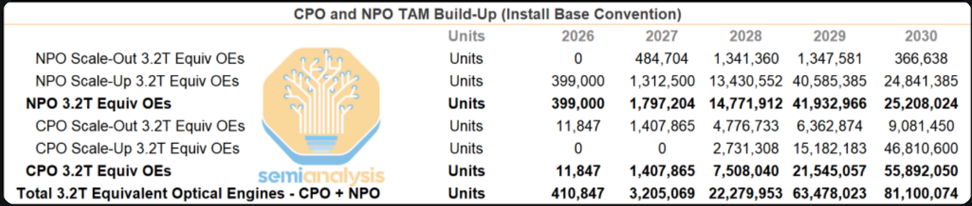
Source: SemiAnaysis A Networking Mode
Reca that in the A Networking Mode, estimates and outputs such as pivot tabes are on an insta base convention. The 'nsta Base Conventionˮ aocates units and $ spend to the quarter in which the custer is brought onine. Each component and company wi differ in ead times and revenue recognition and wi require a different ead time to reconcie to revenue. Our company reconciiation tabs wi use a ead time that is typicay a 'bring forwardˮ of the unit demand indicated under the insta base convention to refect that fact that equipment is usuay purchased in advance of custer instaation.
Puggabes vs NPO vs CPO vs XPO and CPC
To understand the current batteground with respect to optica connectivity soutions, etʼs quicky recap the definitions and basic architecture of these soutions.
The most common form factor today is the puggabe transceiver - the optica engine sits at the facepate in a standardized cage, and the eectrica signa must trave from the ASC through the package BGA and across roughy 00mm of host PCB trace before it reaches the modueʼs connector.
Host PCB
Near-Packaged Optics (NPO)
The copper trace is ossy enough that the transceiver modue carries a fu/partia DSP to retime the signa - and that DSP is most of what the industry is trying to remove since it accounts for roughy haf the modueʼs power. Switch ASIC Juuuuu semicinalysis Remote Laser Source
Substrate
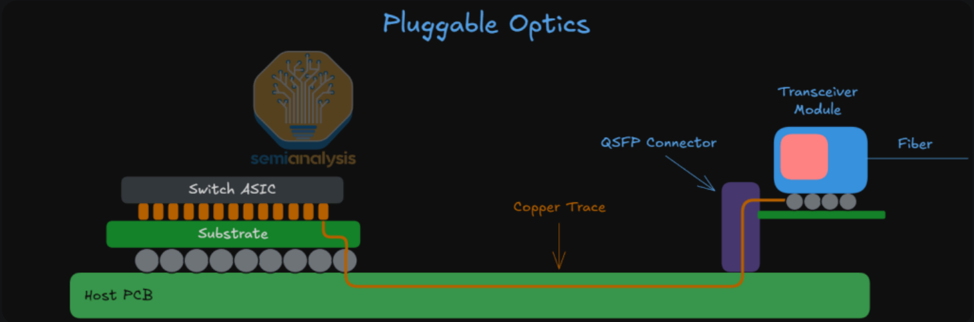
Source: SemiAnaysis A Networking Mode
A few form factors to repace puggabe optics exist. Near-Packaged Optics NPO moves the optica engine of the facepate and ands it next to the ASC package - but criticay, not on the ASC substrate. As the diagram beow shows, the engine sits on its own substrate, mated through a socketed NPO connector, with the high-speed channe running roughy 150mm through a high-performance substrate rather than an ordinary host PCB ony owspeed signas and power are deivered through the channe.
We expect current NPO impementations to adopt 200G per ane PAM moduation and that most NPO soutions wi be a puggabe form factor (as detaied by the CPXMSA, which enabes vendor diversity within the rack.
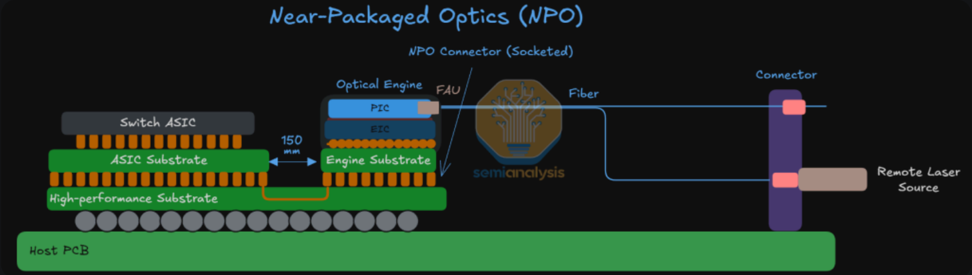
Source: SemiAnaysis A Networking Mode
Copper Trace
Co-Packaged Optics (CPO) on Substrate
Co-Packaged Optics CPO puts the engine on the ASC substrate itsef, cutting the eectrica channe to 10mm. The key eement at pay here is that CPO is on the ASC substrate - this is what differentiates CPO vs NPO as opposed to whether the optica engine is puggabe. For exampe, Nvidiaʼs Quantum CPO soution uses three 1.T optica engines on an assemby that is puggabe onto the substrate - and for most, it sti counts as 'CPOˮ. wm
To carify what we mean, if the optica engine is puggabe AND it connects to the ASC substrate, then we wi ca it 'Puggabe CPOˮ, but if it is permanenty attached to the ASC substrate, then we wi simpy refer to this as 'CPOˮ. A few industry payers have set out to push for CPO soutions to be puggabe as this is the ony way to open the ecosystem to third-party OE vendors and as it aso Puggabe CPO dramaticay more depoyabe by derisking yied and rework.
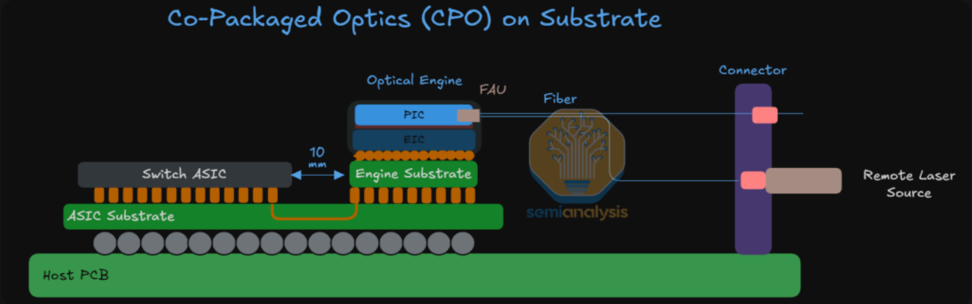
Source: SemiAnaysis A Networking Mode
What is the impetus for exporing CPO in the first pace? CPO saves power because it eiminates the DSP by pacing the optica engine next to the XPU or switch ASC. However, if this is not matched by a commensurate downgrade in power for the Switch or XPU SerDes from LR SerDes to shorter reach SerDes, power benefits are imited beyond what can be achieved by Linear Puggabe Optics.
Todayʼs CPO impementations focus on DR Optics based Optica Engines, but if the OCMSA version of CPO is achieved, power savings on the optica engine wi be even more significant with the optica engine running on 50G NRZ anes instead of 200G PAM SerDes anes, taking down the OE ELSFP power down from 5pJ/bit in the case of DR Optics CPO down to beow
pJ/bit for OCMSA CPO. Further system power savings can be achieved by eiminating SerDes on the Switch or XPU and using a chip-to-chip interconnect to the optica engine. CPO aso has the benefit of supporting bandwidth density scaing beyond what is possibe with OSFP puggabe optics. CPO eiminates the facepate therma and throughput imit, since unike a puggabe modue, data transmission occurs within the package. n fact, Nvidiaʼs scae-out CPO switches wi excusivey use denser MMC connectors for the facepate, abandoning the ubiquitous MPO connector form factor. Optica Engines on nterposer wi aso unock more overa bandwidth escape from the package as shoreine density can be far greater if OEs are connected directy to the Switch or XPU, much ike HBM is connected today. The technica chaenges with impementing CPO from the get-go are the reiabiity and serviceabiity issues associated with packaging optica engines cose to the ASC as we as as the suppy chain ramps to support growing voumes. On top of this, one of the argest hesitations over CPO adoption stems from the fact that CPO impementations that are not puggabe resut in vendor ock in, and the resuting oss of sourcing fexibiity, fied serviceabiity and have the consequence of the switch vendor ikey taking a 70% gross margin stack on the optica engines vs the 0% gross margin that a third party puggabe Optica Engine vendor might charge. Meanwhie NPO and Puggabe CPO offers much of the above benefits but without the vendor ock in. t aso inherenty sidesteps the attach yied issue that is the current headache for scae-out CPO switch production. We compare key interconnect soutions from power efficiency and cost per bit perspective in the tabe beow. NPO, CPO, and Puggabe CPO a have the potentia to drive better energy efficiency than LPO if a opportunities for power savings are harnessed. Ony OCMSA on interposer has the potentia to deiver even greater power savings, but this wi require customers to yied issues at the initia stages of CPO impementation potentiay accept vendor ock in, or at the very east accept that the switch
Traditional
or ASC vendor wi be the protagonist when it comes to deciding which vendor wi be chosen for Optica Engines. Substrate On Substrate, Not Pluggable Substrate On Substrate, Pluggable Interposer On Interposer
Signal Conditioning?
Electrical Channel Length
Energy Efficiency - OE + ELS
Energy Efficiency - Scale-Out + Switch? M
Hot Swappable
Serviceability
Expected Deployment Timeline
Pluggable Option?
Optical Engine Vendors
ELSFP Vendors
' Numbers presented are preliminary and are subject to change.
Fully Retimed
Linear
Retimed on Tx
Channel
Linear
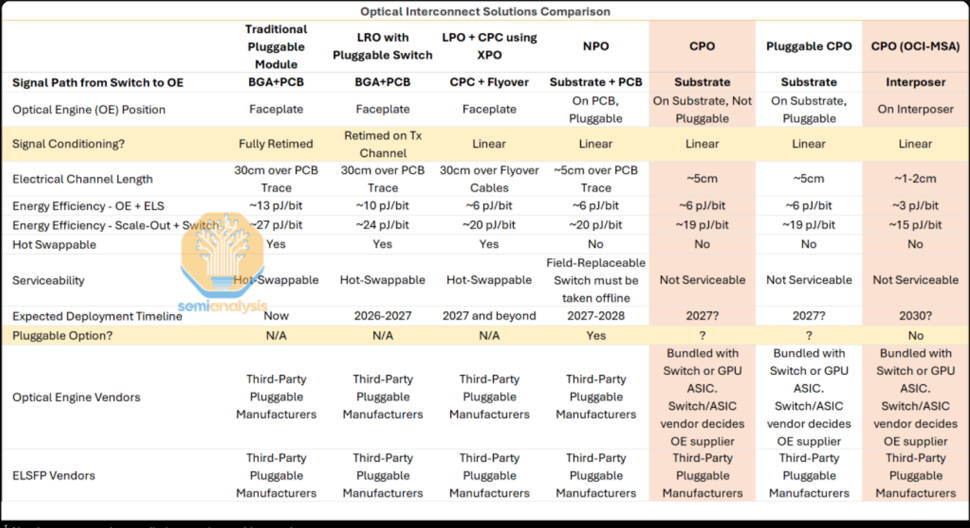
| 30cm over Flyover ~5cm over PCB ~5cm ~5cm ~1-2cm | 30cm over Flyover ~5cm over PCB ~5cm ~5cm ~1-2cm | 30cm over Flyover ~5cm over PCB ~5cm ~5cm ~1-2cm | 30cm over Flyover ~5cm over PCB ~5cm ~5cm ~1-2cm | 30cm over Flyover ~5cm over PCB ~5cm ~5cm ~1-2cm | 30cm over Flyover ~5cm over PCB ~5cm ~5cm ~1-2cm | 30cm over Flyover ~5cm over PCB ~5cm ~5cm ~1-2cm | 30cm over Flyover ~5cm over PCB ~5cm ~5cm ~1-2cm |
|---|---|---|---|---|---|---|---|
| Trace ~13 pJ/bit| ~27 pJ/bit | Trace ~10 pJ/bit ~24 pJ/bit | Cables ~6 pJ/bit ~20 pJ/bit | Trace ~6 pJ/bit ~20 pJ/bit | ~6 pJ/bit ~19 pJ/bit | ~6 pJ/bit ~19 pJ/bit | ~3 pJ/bit ~15 pJ/bit | |
| Yes | Yes | Yes | No | No | No | No | |
| Hot-Swappable | Hot-Swappable | Hot-Swappable | Field-Replaceable Switch must be | Not Serviceable | Not Serviceable | Not Serviceable | |
| semiana Now | 2026-2027 | 2027 and beyond | taken offline 2027-2028 | 2027? | 2027? | 2030? | |
| N/A | N/A | N/A | Yes | ? Bundled with | ? Bundled with | No Bundled with | |
| Third-Party | Third-Party | Third-Party | Switch or GPU | Switch or GPU | Switch or GPU | ||
| Third-Party Pluggable | Pluggable | Pluggable | Pluggable | ASIC. | ASIC. | ASIC. | |
| Manufacturers | Manufacturers | Manufacturers | Manufacturers | Switch/ASIC vendor decides | Switch/ASIC vendor decides | Switch/ASIC vendor decides | |
| Third-Party | Third-Party | Third-Party | Third-Party | OE supplier Third-Party | OE supplier Third-Party | OE supplier Third-Party | |
| Pluggable Manufacturers | Pluggable | Pluggable Manufacturers | Pluggable Manufacturers | Pluggable Manufacturers | Pluggable Manufacturers | Pluggable Manufacturers | |
| Manufacturers |
Source: SemiAnaysis A Networking Mode
We outine beow how tota power coud ook ike when contempating the use of CPO/NPO for scae-out switching. Here we see that NPO, CPO and Puggabe CPO can offer the best energy efficiency, especiay if Switch ASCs can be designed with ower power SerDes.
Turning to tota system cost from a scae-out perspective, we see that the CPO and CPO OCMSA have higher tota switch seing prices than Puggabe CPO and NPO. This is because we are assuming a 70% vendor margin stack on the Optica Engines and FAU Assemby.
As mentioned above, OCMSA based CPO remains the most efficient interconnect with 2 times better energy efficient than NPO and 5 times better efficiency than LRO, but as with CPO, it inherenty means vendor ockin.
Linear
Linear
Linear
Optical Interconnect Solutions Comparison
Optical Engines and FAU Assembly
ELSFP
CPO
Gross Yielded COUPE Wafers
Pluggable Modules
102.4T Switch Chip + SW Box Items
Total Switch Power
OE Unit Test Yield
Bandwidth
OE Attach Yield per OE
pJ/bit (including Switch)
pJ/bit (OE+ELSFP Only)
Switch Die Attach Yield - 32 OEs
Total Cost of Ownership
Optical Engines and FAU Assembly
NPO
ELSFP
Gross Yielded COUPE Wafers
Pluggable Modules
102.4T Switch Chip + SW Box Items'
OE Unit Test Yield
Total Selling Price
1 Assuming 30% Gross Margin and 3 year warranty
Optical Interconnect Solutions Comparison
Traditional
Attached Optical Engine Yield Worksheet
LRO with
Yielded Die per
LPO + CPC using
Wafers per
NPO
| Pluggable Switch XPO Pluggable CPO Yield Rate Month Dies/mth Yield Switches/Yr | Pluggable Switch XPO Pluggable CPO Yield Rate Month Dies/mth Yield Switches/Yr | Pluggable Switch XPO Pluggable CPO Yield Rate Month Dies/mth Yield Switches/Yr | Pluggable Switch XPO Pluggable CPO Yield Rate Month Dies/mth Yield Switches/Yr | Pluggable Switch XPO Pluggable CPO Yield Rate Month Dies/mth Yield Switches/Yr | Pluggable Switch XPO Pluggable CPO Yield Rate Month Dies/mth Yield Switches/Yr | Pluggable Switch XPO Pluggable CPO Yield Rate Month Dies/mth Yield Switches/Yr | Pluggable Switch XPO Pluggable CPO Yield Rate Month Dies/mth Yield Switches/Yr | Pluggable Switch XPO Pluggable CPO Yield Rate Month Dies/mth Yield Switches/Yr |
|---|---|---|---|---|---|---|---|---|
| W W | Pluggable Module | 1,056 Wafer 788 | 100% | 480 128 10,000 | 480 128 | 480 128 | 179 128 | |
| W W | 1,344 hn | 1,420 | 640 | 7,880,000 | 100% | 2,955,000 | ||
| 1,420 N | 481 | 1,420 | 1,420 10,000 | 1,320 4,810,000 | 1,320 61% | 1,245 1,803,750 | ||
| W | 2,764 | 2,476 | 2,060 61% 98% | 2,028 | 1,928 | 1,928 | 1,552 | |
| Tbit/s pJ/bit | 102.4 | 102.4 | 102.4 | 102.4 10,000 | 102.4 | 102.4 | 102.4 | |
| 27.0 | 24.2 Y252 | 20.1 52% | 19.8 10,000 | 18.8 2,519,878 | 18.8 32% | 15.2 944,954 | ||
| /bit| | 13.1 | 10.3 | .3 | 5.9 | 5.9 | 5.91 | 3.0 | |
| semicinalysi $ | 18,393 | 33,720 | 16,860 | 33,720 | ||||
| semicina 788 | 46,080 | 36,480 100% | 6,400 10,000 | 6,400 7,880,000 | 6,400 100% | 6,400 2,955,000 | ||
| $ $ | 51,840 | 481 | 61% | 10,000 | 4,810,000 | 61% | 0 1,803,750 | |
| 38,714 | 38,714 | 38,714 | 38,714 | 38,714 | 38,714 | 38,714 | ||
| $ | 90,554 | 84,794 | 75,194 100% | 63,507 10,000 | 78,834 | 61,974 | 78,834 | |
| 481 | 100% | 10,000 | 4,810,000 | 61% | 1,803,750 |
OE Attach Yield per OE
Switch Die Attach Yield - 32 OEs
Source: SemiAnaysis A Networking Mode
What is cear from the tabe is that the intersection of best power efficiency and owest cost today is in puggabe CPO and NPO, and this is why these soutions are becoming the foca point for current system depoyment. What is not expicity speed out in this tabe is the fact that a ess-than-idea optica engine attach yied tends to increase unit optica engine costs, driving up overa costs for everyone.
Source: SemiAnaysis A Networking Mode
As promising as CPO is, it remains risky to eapfrog straight to CPO, and NPO is becoming a viabe choice for go-to market in ate 2027 and beyond for both scae-out and scae up. Some scae-up programs have eected to start with NPO for instance Trainium, whie other scae-up programs ike Nvidiaʼs VRU NVL57 appear to be pivoting into NPO given chaenges with yieding CPO.
Scae-up NPO Projects
Units
Yielded
CPO
Cumulative 102.4T Equiv
CPO (OCI-MSA)
Amazon Trainium
Units
Quantity
36
The design for Trainium remains in fux sti - but as a base case scenario we see Trainium as being designed to impement a arge word size architecture using both copper backpanes and NPO.
We use the Trainium iquid cooed NL722 switched (i.e. Trainium MAX as a starting point but this time rather than forming a two-rack word size through cross-rack AECs, we wi form a higher desnity rack and a arger word size using NPO to connect oca GPUs to distant switches. Each Trainium rack wi have 1 GPUs, four GPUs per each of compute trays. For the UALink version, 57.T UALink switches wi be used, with four switches per each of compute trays.
Source: SemiAnaysis A Networking Mode
A copper backpane wi be used to connect each of the 1 Trainiums in each rack ocay to every switch within the rack, and NPO wi be used to connect each GPU directy to distant switches within each of 7 other racks within the word size. We expect that Amazon coud continue to make use of smaer scae-up switches within compute trays to provide additiona scaeup switching capacity.
Trainium NeuronLinkv5 Protoco UALink or NVLink)
AWSʼs Trainium scae up interconnect protoco is known as NeuronLink, a modified version of PCe protoco with AWSʼs own definition that suits the scae up requirements. Trainium 2 uses NeuronLinkv, which corresponds to PCe 5, and Trainium uses NeuronLinkv, which corresponds to PCe .
For Trainium , NeuronLinkv5 wi be a bit more compicated as AWS aims to support both UALink and NVLink protocos. Off the package, Trainium wi offer UALink protoco running at 128G based on PCe 7. This wi be the basis of NeuronLinkv5 and a the scae up connections coming out of the Trainium packages. For NVLink Fusion integration, the UALink protoco signa wi be converted into NVLink anes via an externa gearbox off the Trainium package. Beow we wi discuss the content each suppier pays in the NeuronLinkv5 UALink or NVLink protoco as we as how NPO ties into a of this.
Therefore, there wi be two versions of the Trainium rack:
- UALink running at 128G based on PCe Gen7
- PCe Gen7 gearboxed into NVLink Fusion running at 200G per ane
The NPO modues are paced on the PCB via ' CPXˮ connectors from Samtec cose to the Trainium package. The ' CPXˮ connector socket is speced up to 22Gbs coonnectivity and 128DPs each. The connectors can support both fy over cabes and NPO modues, which means AWS aso have the fexibiity to decide on NPO ater given the fexibiity. n the image beow, Samtec demo their CPX connector under the CPO or CPC form factor, yet, the CPX connector aso supports NPO and NPC (fyover cabes) form factor. The use of SiFy wi foow Amazonʼs design, which is the UALink rack, whie Nvidia wi ikey use another soution. Si-Fy Si-Fy
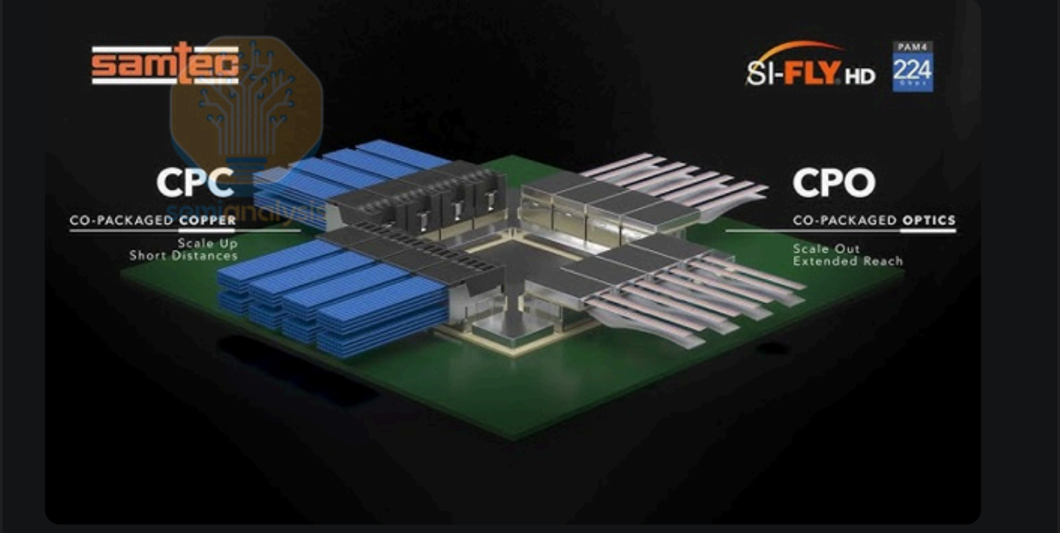
Source: Samtec
Trainium Scae-up Network Suppiers
The utimate production mix among the two rack types is highy uncertain, and one track coud even get cut, but for now we penci in a 50%/50% UALink/NVLink spit over the product ifetime.
For UALink - we think Astera Lab wi be the primary vendor, bunding itʼs /O chipet, its UALink switch as we as an NPO soution. Astera has been puing its timeines for NPO/CPO ate ast year it had pencied in 20282 for scae-up optics, whie by June 202 it was expecting first optica revenue by 2027 with NPO revenue in 2H27 for rack-to-rack connectivity, foowed by CPO scae-up by 2028 and after.
Simiary, for the NVLink-based SKU, Astera wi be providing the /O chipet with a gearbox, whie Marve wi tacke the NPO modue as we as the NVLink switch. n fact, a key revision to NVLink fusion in the past few months means that Nvidia is no onger the ony pace to get an NVSwitch, creating an opening for Marve. ndeed, on the Q F1/2 earnings ca, 'NPOˮ entered Marveʼs vocabuary for the first time, and the company introduced a broader 'scae-up opticsˮ category guided to roughy $00M for F1/28 more than doube the prior outook of $150M which was soey based on Ceestia A. t is important to highight that the design of the rack wi be heaviy driven by Nvidia to ensure successfu impementation of the NVLink scae-up network, and as such, Nvidia may have the fina word on whether NPO is used at a. For now, we penci in the use of NPO for the NVLink SKU.
Though the $500M quartery revenue run rate for Ceestia exiting F1/28 guided during the acquisition announcement was inked to a Tier 1 customer win and for a scae-up product (thus aigning with Trainium , subsequent commentary has highighted CeestiaAʼs EAM based technoogy as one soution of a broad portfoio of NPO and CPO impementations that aso incude MRMs and MZMs and we think that Ceestiaʼs EAMs wi not be used in the Trainium NPO soution. nstead, we expect to see Ceestia products coud be depoyed in appications that utiize the photonic bridge or coud incude depoyments of the Photonic Fabric Memory Appiance PFMA given that Marve is we into the design phase for various hyperscaer CXL / memory attach products.
Trainium Scae-up Network Architecture
We think that Trainium wi mirror the rack design of the Trainium NL722 (Teton MAX, ony with greater density at compute trays, with 1 XPUs per rack vs the 72 GPUs per rack of the Teton MAX. t wi use backpane to connect to switch trays, coud aso use PCB traces to connect to smaer switch chips on the compute tray, and finay wi use NPO to connect XPUs to distant switch trays in the other racks.
Trainium4 NL144x8 Switched
Source: SemiAnaysis A Networking Mode
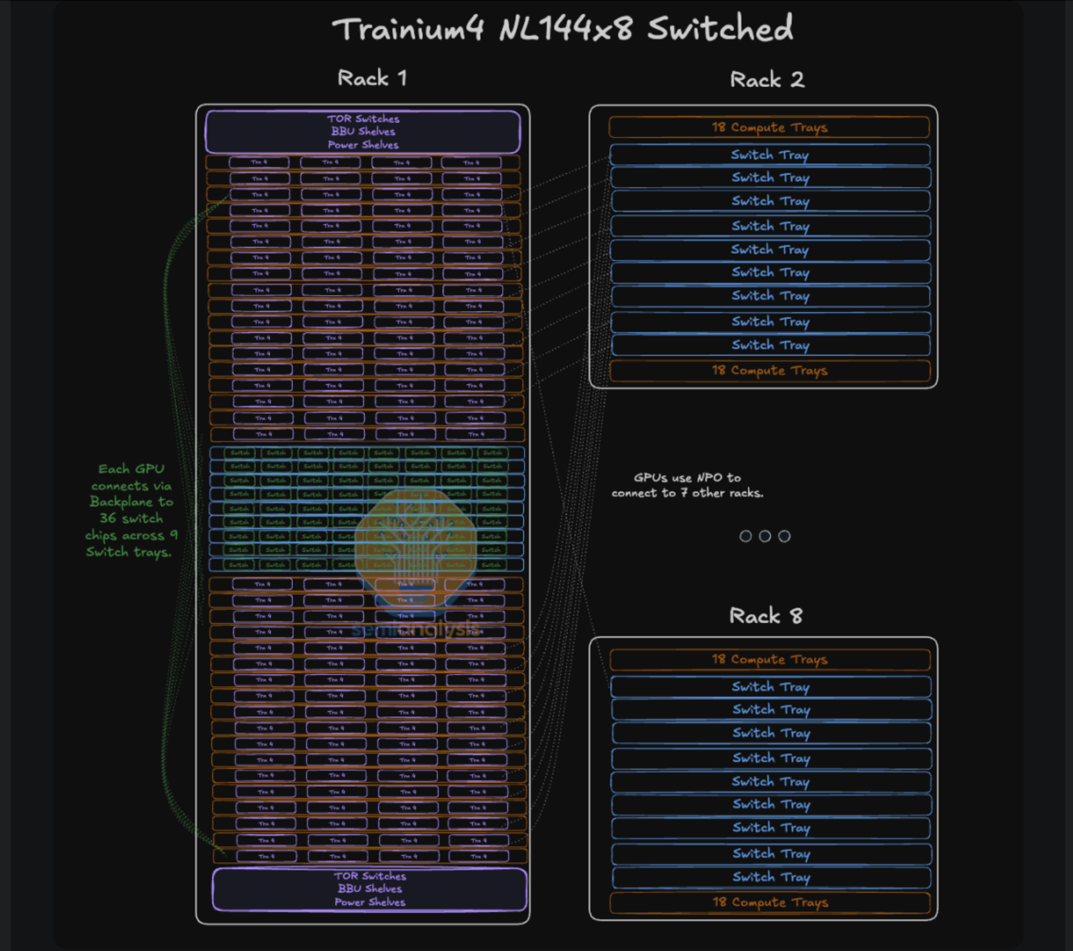
We are sti finaizing our view on what the scae-up networking topoogy coud ook ike, but the coud be a starting point. We shoud expect that Trainiumʼs topoogy coud incude smaer switches on the compute tray itsef in addition to a backpane that connects to a set of arger bandwidth switches. Again, the main evoution woud be that each Trainium is now aso connecting via NPO to distant scae-up switches in other racks. scae-up network topoogy empoyed in the Trianium
Each UALink Switch connects to 72 Trn3
72+ radix
Local Tray ICI
x64
per Trn3 (Uni-di)
Local Tray ICI
x64
per Trn3 (Uni-di)
Cross Rack ICI
×16
per Trn3 (Uni-di)
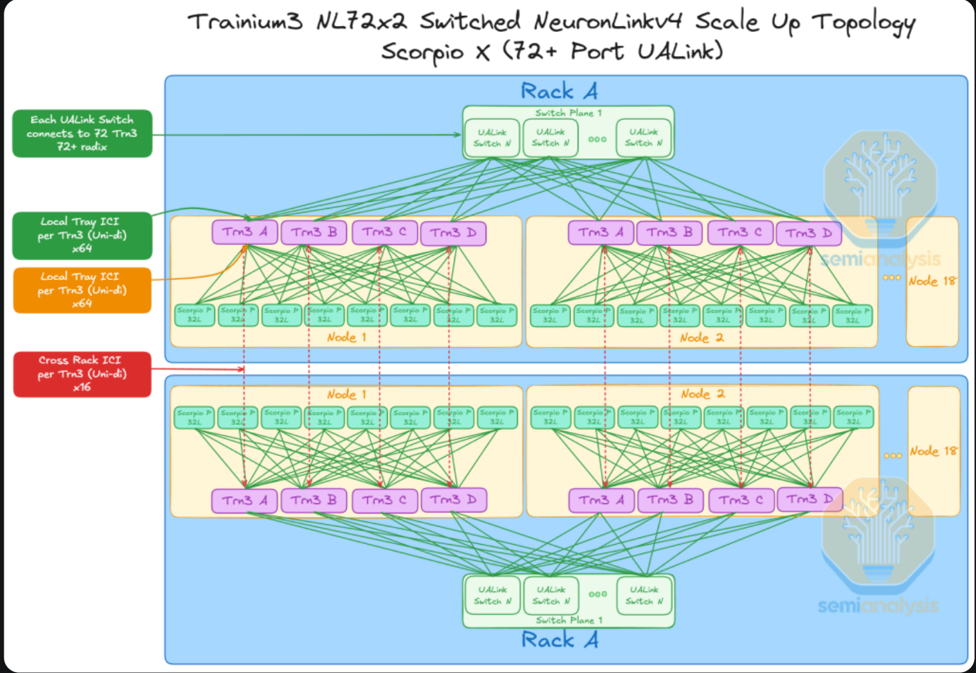
Source: SemiAnaysis A Networking Mode
Whie we are sti finaizing our view on what the scae-up topoogy woud ook ike, we see 1 GPUs deivering .72 Pbit/s uni-di of tota scae-up bandwidth in the UALink configuration and . Pbit/s in the NVLink configuration, which equates to and .75 of .2T-equivaent NPO OEs per GPU.
Trainium3 NL72x2 Switched NeuronLinkv4 Scale Up Topology
Optical Engine and ELS Content per Rack Estimates
Logical GPUs per Compute Tray
Compute Blades per Rack
Logical GPUs per Rack
Switch Blades per Rack
L1 Scale-up Switch Chips per Rack
L2 Scale-up Switches allocated per Rack
OE Attached to GPU (3.2T Equiv.)
OE per L1 Switch Chip (3.2T Equiv.)
OE per L2 Switch Chip (3.2T Equiv.)
ELS Attach to GPU (6.4T Equiv.)
ELS per L1 Switch Chip (6.4T Equiv.)
ELS per L2 Switch Chip (6.4T Equiv.)
GPU OE per Rack (3.2T Equiv)
L1 Switch OE per Rack (3.2T Equiv)
External Laser Source per Rack (6.4T Equiv.
Optical Engines per GPU (3.2T Equiv.)
External Laser Source per GPU (6.4T Equiv.)
| VRU NVL576 Trainium 4 Trainium 4 | VRU NVL576 Trainium 4 Trainium 4 | VRU NVL576 Trainium 4 Trainium 4 | VRU NVL576 Trainium 4 Trainium 4 | VRU NVL576 Trainium 4 Trainium 4 |
|---|---|---|---|---|
| GPUS | Unit | NVLink' 4 | UALink' 4 | |
| Blades | 36 | 36 | ||
| GPUs | 144 | 144 | ||
| L1 Scale-up Switch Chips per Switch Blade | Switches | 8 | 8 | |
| Switches | ||||
| 72 | 72 | |||
| 12kn L2 Scale-up Switches per Scale-up Domain Uk all» Switches | 0.0 | 0.0 | ||
| & Switches | 0.0 | 0.0 | ||
| OES | 4.8 | 6.0 | ||
| senie | OES OES | 9.5 | 12.0 | |
| 2.38 | 3.00 | |||
| ELSFPS | 4.8 | 6.0 | ||
| 684 | 864 | |||
| OE/Rack | 684 | 864 | ||
| L2 Switch Allocated OE per Rack (3.2T Equiv) | OE/Rack | |||
| ELSFP/Rack | 684 | 864 | ||
| OE/GPU | 9.5 | 12.0 | ||
| ELSFP/GPU | 6.0 | |||
| 4.8 | ||||
| 1. Specifications are all preliminary - no architectures have yet been confirmed. |
Source: SemiAnaysis A Networking Mode
Nvidia Scae-up NPO
We have discussed the various yied issues and fiber attach chaenges Nvidia has been facing on its CPO program - these aso impact the Vera Rubin NVL57 8-rack scae-up CPO project and may even carry over to a future OCMSA stye DWDM-based CPO that woud have otherwise made its debut in Feynman. This is why Nvidia has been contingency panning by ramping a potentia NPO impementation that focuses on 200G or 00G PAM aso using DWDM.
Nvidiaʼs VRU NVL72 CPO architecture wi empoy the QM5 NVLink Switch with .2T Optica engines as a buiding bock. Each switch wi have 1.2Tbit/s uni-di of connectivity using a copper backpane connecting to a
133)
1 Асня
14,100 012/s w-
R300
GPUs within the same rate and wi empoy either two or three optica engines to connect with at most .Tbit/s uni-di via CPO to NVLink switches in other racks. Each compute tray of NVSwitch chips wi have a tota of 108.8Tbit/s uni-di of bandwidth, 7.8Tbit/s connecting within the rack over the backpane, and 2.0Tbit/s via a tota of 10 activey used .2T Optica Engines to connect to the other 7 racks in the system. Ony 10 out of the 12 optica engines avaiabe in each switch tray are used, giving rise to the irreguar CPO bandwidth coming off each NVLink switch - two connect with .Tbit/s of bandwidth and two with .Tbit/s.
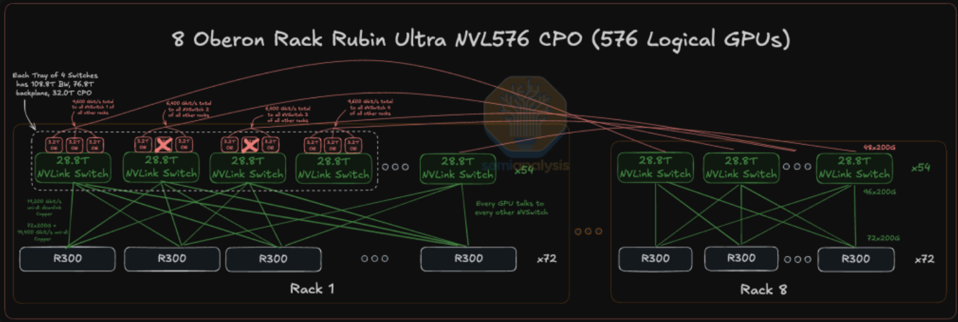
Source: SemiAnaysis A Networking Mode
f the above NPO impementation is ready in time for the VRU NVL57, then Nvidia coud ook to substitute NPO optica engines in pace of the CPO optica engines. t is aso quite possibe given the high production risk that Nvidia sheves the cross-rack scae-up design for Vera Rubin Utra and continues with Oberon stye racks unti Feynman.
Huawei NPO
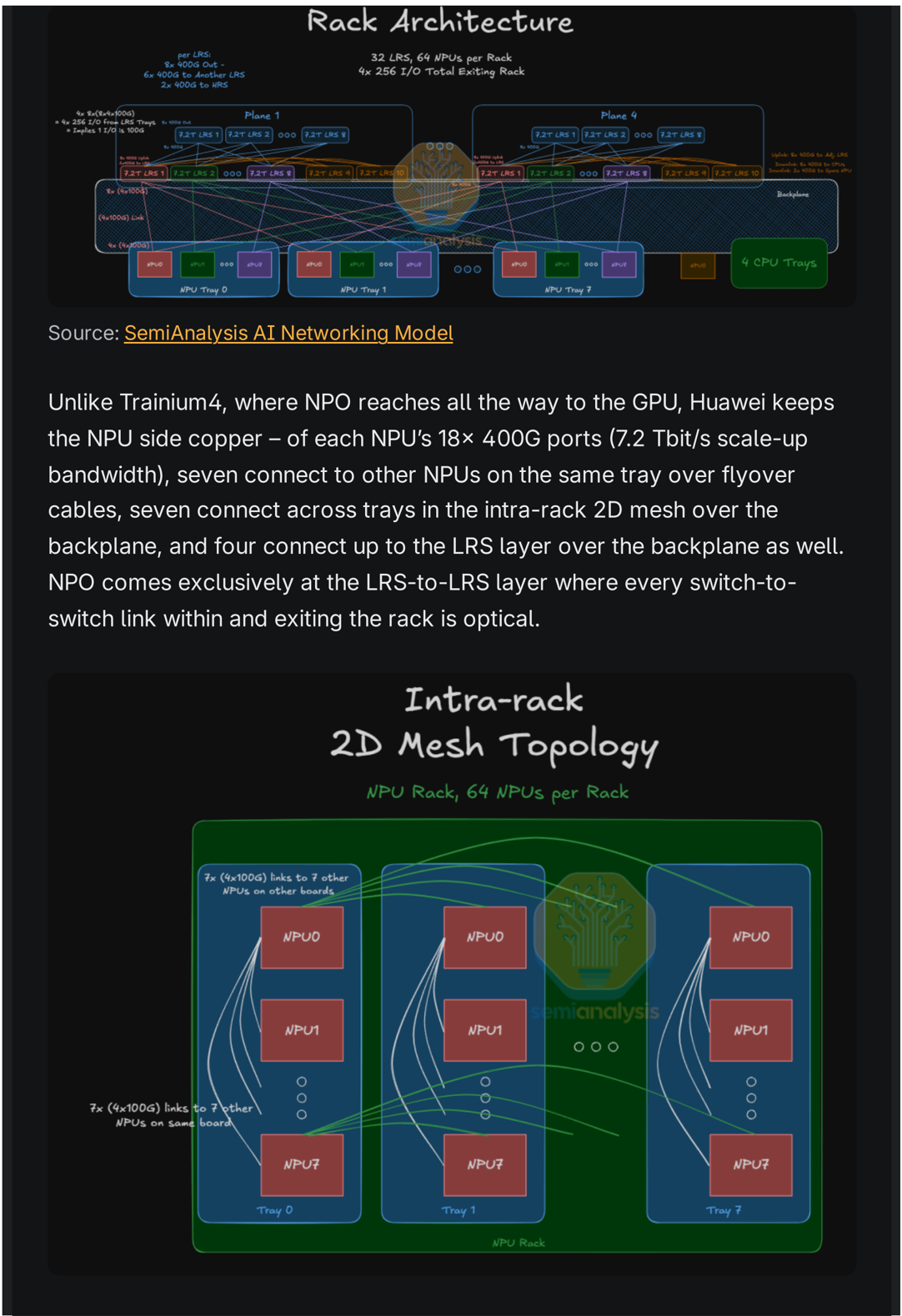
Huaweiʼs Atas 50 SuperPod impements a muti-stage dragonfy with a scae-up word size of 8k NPUs: 8 1,02NPU UBMesh-Pods connected by high-radix switches HRS, each UBMesh-Pod comprising 1 racks connected in a D FuMesh, and each rack pairing NPUs with 7.2T owerradix switches LRS across panes. We covered the architecture in depth , incuding our estimate of $12 per NPU of in-rack copper backpane content. here
Rack Architecture
32 LRS, 64 NPUs per Rack Intra-rack
Source: SemiAnaysis A Networking Mode
GPUs per Server
Total Backplane Content
Flyover Cables
Total Backplane Content per XPU
Ascend 950 In-Rack Copper Content
Source: SemiAnaysis A Networking Mode
Unit Cost
Ascend 950
Quantity per
Extended
| Server Price | Server Price | Server Price | Server Price |
|---|---|---|---|
| 8,192 N/A | 8,192 N/A | 8,192 N/A | |
| 112Gb/s 48DP Connector (Female) $22 | 8,192 180,224 | ||
| 112Gb/s 48DP Connector (Male) 2122 Single DP Copper Cable 712. $66 $1 | 8,192 393,216 540,672 | 393,216 | |
| $1,114,112 | |||
| Mid-Board Connectors N/A | 0 | 0 | |
| $8 | 57,344 458,752 | ||
| Total Compute Tray Contenf emicincilysis | $458,752 | ||
| $1,572,864 | |||
| $192 |
Source: SemiAnaysis A Networking Mode
The LRS network is a two-eve hierarchy per pane 10 L1 switches and 8 L2 switches in each pane which comes to 72 LRS switches per rack. The first eight L1 switches LRS 18 are NPU-facing eaves - each takes 8 00G downinks from NPUs through copper and drives 10 00G of upinks through NPO eight upinks in a fu mesh to the paneʼs L2 switches and one ink each to the intra-pane LRS switches LRS and LRS 10. Each L2 switch takes 8 00G downinks from the L1 eaves and drives 8 00G up to the L2 switches in the other 15 racks of the UBMesh-Pod, a through NPO.
Cacuating NPO attach rate, on the L1 side, 25 eaf upinks and 128 hub inks give 8 ports, on the L2 side, 25 downinks and 25 rack exits give 512 ports - which in tota gives us 8 00G optica port-ends per rack, or 58. Tbit/s of NPO bandwidth. At .2T per optica engine, that is 112 optica engines per rack - an attach ratio of 1.75 .2T-equivaent OEs per NPU.
Total L1 Links
Total L2 Links
Total Links
BW per Link
NPO BW per Rack
NPO BW per Module
3.2T-equivalent NPO per Rack
3.2T-equivalent NPO per GPU
| Units Quantity | Units Quantity | Units Quantity |
|---|---|---|
| LRS 1-8 Uplinks to L2 # | 256 | |
| LRS 1-8 Downlinks from LRS 9-10 # | 64 | |
| LRS 9-10 Uplinks to LRS 1-8 # | 64 | |
| # | 384 | |
| LRS 1-8 Downlinks from LRS 1-8. # | 256 | |
| LRS 1-8 Uplinks to Other Racks # | 256 | |
| # | 512 | |
| semicinalysis | 896 | |
| Gbit/s | 400 | |
| Tbit/s | 358.4 | |
| Tbit/s | 3.2 | |
| # | 112 | |
| 1.75 |
Source: SemiAnaysis A Networking Mode
Scae-out NPO Projects Meta NPO
Meta has spent considerabe time and energy highighting the advantages of Broadcomʼs CPO soution. Their ECOC paper pubished reiabiity data across 1,0,000 00G-port device hours of operation for Baiy 51.2T CPO Switches. ts tak at ECOC presenting the paper went even further, presenting resuts for up to 15M 00G-port device hours, showing no uncorrectabe codewords UCWs) for the first M 00G-port device hours as we as a 0.5 0.1M device hour mean time before faiure MTBR for 00G 2xFR transceivers 550k for 2xFR gobay) vs 2.M device hour MTBF for CPO.
A foow-up update at OFC 202 highighted that testing had now reached 0M 00G-port device hours, and pointing out the 20M 00G-port device hours MTBF.
Huawei NPO Content per Rack
| 40°C | Temperature (400G) ~8M | 0.71M | |
|---|---|---|---|
| 40°C | >40M | 1.47M | |
| 40°C | >40M | 8.2M (>10X improvement) | |
| 40°C | >40M | >20M |
00 Meta
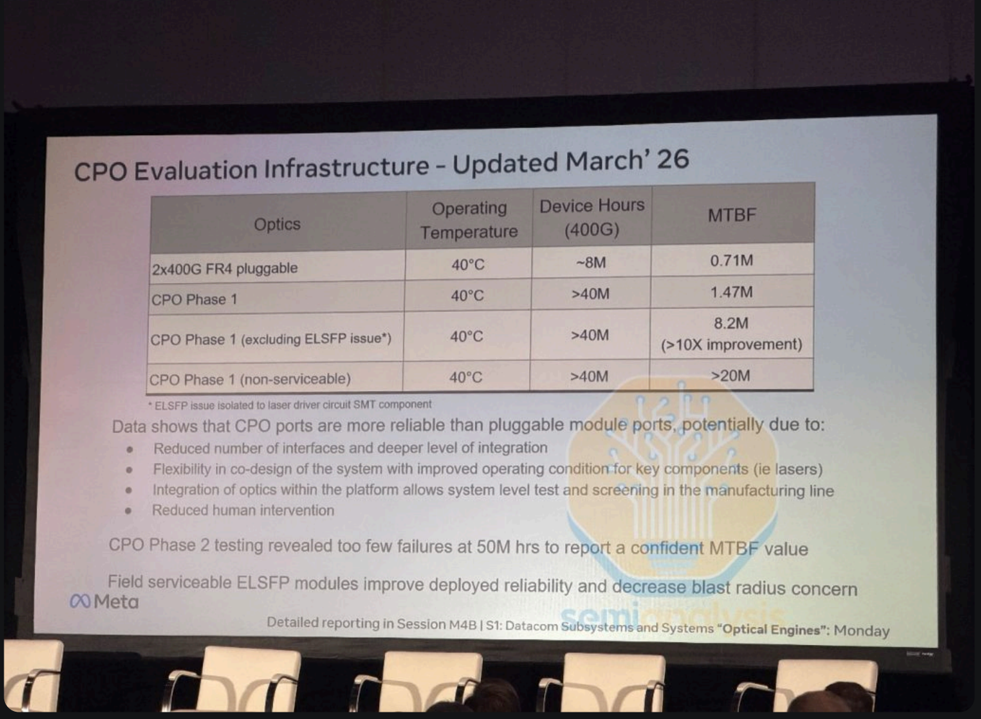
Source: Meta
There has been some foow thru on CPO switches Ceestica wi be manufacturing 102.T switches for Meta, with production ramping in 2H27. However, Meta is aso simutaneousy pursuing an NPO switch program based on Broadcomʼs 102.T Tomahawk Switch. n theory, CPO shoud be abe to provide a better channe than NPO and thus eventuay superior power and BoM cost - but NPOʼs advantage ies in optica engine modue vendor fexibiity and the cost savings from unbunding the optica engines from the switch ASC vendor and effectivey paying a 00% gross margin instead of a 70% margin. Another factor in favor of depoying NPO-based soutions at this stage is the ongoing yied and production issues for CPO optica engines buit using TSMCʼs COUPE.
Unike the Davisson CPO patform, this NPO approach aows a mutivendor sourcing approach for optica engines, and Meta wi amost certainy be working with its current transceiver vendors such as nnoight, Eoptoink, Coherent, and others. This NPO switch aso aows operators to mix and match various types of optica engines. For instance, some hyperscaers are
Meta NPO
Meta CPO and NPO Content TAM (Install Basis Convention)
opting to depoy FR optics in some eaf to spine inks to simpify fiber depoyments and reduce fiber costs - so a switch that coud utiize DR NPO for downink and FR NPO for upink coud be usefu.
Meta CPO - DR Optics
Meta NPO
Meta NPO
OEs
OEs
484,704
784,000
1,341,360
368,000
1,347,581
366,638
Meta is taking its CPO program panning one step further and has been exporing CPO Optica Engines and ELSFPs that support OC MSA Gen1 specs - with 8 different waveengths per 12.8T ELSFP. The ight source can be spit across two .T Optica Engines, with each .T OE providing 2 anes of 200G each, and each ane in turn buit up with ambdas moduated at 50G NRZ each. The use of OC MSA means it wi amost certainy be for a scae-up roe, possiby with the Tomahawk Utra 2 102.T switch.
n pursuing an OC MSA based CPO switch, Meta may be aiming to bootstrap the OC MSA switch and OE ecosystem and coud be ooking to see how much traction it can get and whether it can not ony buid its own MTA scae-up networks around the OC MSA but aso incorporate this into merchant siicon systems ike that of AMDʼs, which is aso an OC MSA consortium member. f there is good buy in from vendors and suppiers, then this coud potentiay give rise to broader adoption of OC MSA beyond Meta, but time wi te how much traction they get. f Meta has enough cout, they might even convince Broadcom to work with them to create a puggabe CPO version, which woud doubtess be wecomed by hyperscaers and ASC vendors.
Source: SemiAnaysis A Networking Mode
Aristaʼs nterconnect Options XPO vs. NPO
We as an answer to CPO right after the MSA dropped in March 202. The arge form-factor puggabe promotes better therma management by enabing LPO and coud quadrupe the bandwidth density of a facepate. The XPO soution retains the puggabe mode, but in a new, much arger form factor, packing 200G anes in the same modue, a whie aowing better therma management with iquid cooing. This woud ony require 112.8T transceivers per switch; Arista caims that they can deiver a tota of 20.8T on a 1OU front pane and keeping the benefits of the puggabe: being hot swappabe. XPO aims to come to market aongside, Tomahawk 7, which wi doube the port radix to 1,02 200G SerDes compared to Tomahawk , which has 512 200G SerDes. Switch vendors that are buiding Tomahawk 7 based switches, but are stopping short of non-puggabe CPO, therefore have three avaiabe options: Use XPO, NPO/Puggabe CPO and OSFP transceiver cages. Arista Networks is ceary focused on bringing XPO to market for Tomahawk 7 switches, but it woud not be surprising if they are aso entertaining NPObased soutions aso. Both achieve the objective of a much denser facepate, and both open the door to eiminating DSPs. The main difference bois down to where it wants to take impementation risk, in getting optics to work or in getting a onger eectrica channe to work with Linear optics. An NPO soution woud aow for a very high facepate density as the optica engine is now paced on the PCB, ony eaving fiber connectors on the front of the switch. However, servicing a faied optica engine requires opening the box and reseating or repacing a socketed engine - far more intrusive than hot-swapping a front-pane puggabe, though externa aser sources remain fied-repaceabe. discussed the merits of the XPO MSA
The OSFP transceiver-based option wi sti ikey remain popuar among operators that have an estabished, ow-cost 1.T transceivers suppy chain, despite the arge switch form factors that this impies.
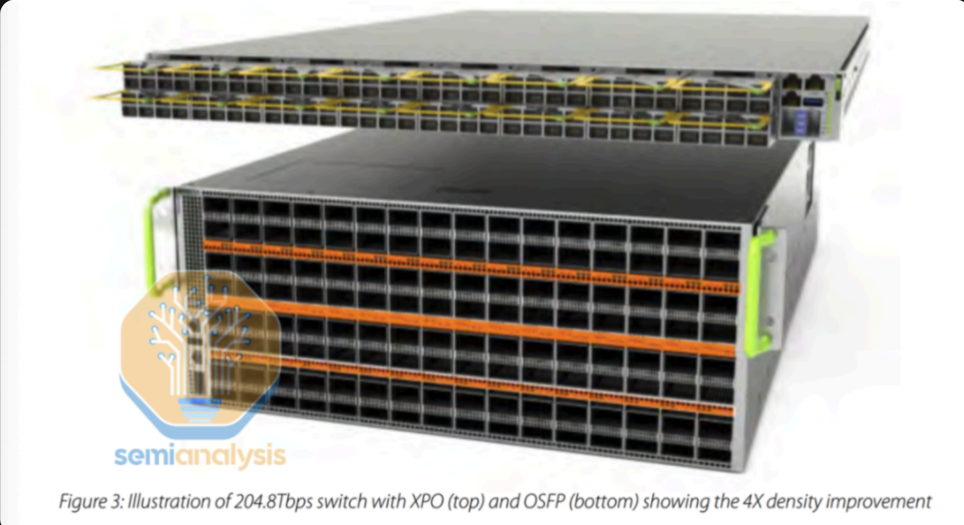
Source: SemiAnaysis A Networking Mode, Arista Networks
Googe NPO
Googe has in the past been very puggabe optics focused, but in future TPU versions, with considerabe orders aready paced for deivery in ate 202 and eary 2027! We think Googe coud expore NPO ater for its Virgo network, but we donʼt see a roe for NPO in the next few years and think these reports probaby stem from some kind of misunderstanding. some have caimed that they are aso exporing the use of NPO
The argument here is that NPO coud be used to enabe higher density interconnect on the compute trays, repacing the use of ACCs and DACs. However - the TPUv8i Boardfy) ony requires 2 1.T ACCs, 1 1.T DAC and 1 1.T puggabe optica transceiver, empoying another 1.T over fyover cabes and 1.T over PCB traces to achieve .T of bandwidth. Meanwhie, the TPU V8t D Torus) aso has .T of scae-up bandwidth per TPU, carried over PCB as we as OSFP cages per TPU to which ACCs or DACs or Puggabe transceivers can be inserted depending on where in the
D Torus topoogy that TPU is. Again, this is hardy pushing the imits on facepate density - so the use of NPO here seems to ony add risk and compexity, with the main positive, NPOʼs greater range, not needed for the copper-based inks. Some aso say that Googe coud use NPO for Virgo. The first instances of the Virgo network are currenty being depoyed and wi be in use with the TPUv8t, which means that Virgo network is not using XPO or NPO as of now, and current scae-out bandwidth needs can easiy be covered by current puggabe soutions. Googe is ikey to keep the Virgo network for scae-out with the upcoming version of the TPUs, mainy with Humufish TPUvt) and cefish TPUv10t). Current scae-out bandwidth for Zebrafish generation TPUv8t) sits at 800G per TPU but is very ikey to increase over time with next generations, which coud require the Virgo network to adopt XPO with Tomahawk and TPUvt, but NPO woud ony come in with Tomahawk 7 and TPUv10t in the coming years. Here, the benefits are ike what has been mentioned above in our XPO vs NPO discussion. NPO is another way to impement inear optics, but the tradeoff vs XPO is taking on different risks XPO uses CPC to deiver a ceaner eectrica channe to the facepate, but the attenuation due to distance is unavoidabe. NPO cuts that eectrica channe distance consideraby, but it introduces the risk of ramping optica production and reiabiity risk.
CPO and NPO Market Estimates Updated
We have updated our CPO and NPO market projections to incorporate the deveopments outined.
NPO Scale-Out 3.2T Equiv OEs
NPO Scale-Out 3.2T Equiv OEs
NPO Scale-Up 3.2T Equiv OEs
NPO Scale-Up 3.2T Equiv OEs
NPO 3.2T Equiv OEs CPO Scale-Out 3.2T Equiv OEs NPO 3.2T Equiv OEs CPO Scale-Out 3.2T Equiv OEs
CPO Scale-Up 3.2T Equiv OEs CPO Scale-Up 3.2T Equiv OEs
CPO 3.2T Equiv OEs semianalysis Total 3.2T Equivalent Optical Engines - CPO + NPO CPO 3.2T Equiv OEs Total 3.2T Equivalent Optical Engines - CPO + NPO
CPO and NPO TAM Build-Up (Install Base Convention)
CPO and NPO TAM Build-Up (Install Base Convention)
Units
2026
2027
2028
2029
2030
2027
2028
2029
2030
1,341,360 1,347,581
1,347,581
366,638
366,638
1,312,500 16,161,860 55,767,568 71,651,985
2026
Units
Units 0 484,704 1,341,360 Units 0 484,704
Units
Units
Units
Units
Units
Units
Units
Units
Units
Units
Units
Units
Scale-out FAUs and Assembly - CPO + NPO
EUnits,
Scale-up FAUs and Assembly - CPO + NPO Units.
| 399,000 399,000 | 1,312,500 | 13,430,552 40,585,385 | 24,841,385 |
|---|---|---|---|
| 399,000 399,000 | 14,771,912 41,932,966 1,312,500 13,430,552 40,585,385 24,841,385 1,797,204 14,771,912 41,932,966 25,208,024 | 25,208,024 | |
| 11,847 11,847 | 1,797,204 1,407,865 | 4,776,733 6,362,874 1,407,865 4,776,733 6,362,874 | 9,081,450 9,081,450 |
| 0 | 0 | 2,731,308 15,182,183 2,731,308 15,182,183 46,810,600 | 46,810,600 |
| 11,847 11,847 | 1,407,865 | 7,508,040 21,545,057 1,407,865 7,508,040 21,545,057 55,892,050 | 55,892,050 |
| 410,847 410,847 | 3,205,069 22,279,953 63,478,023 | 81,100,074 3,205,069 22,279,953 63,478,023 81,100,074 | |
| 11,847 | 1,892,569 6,118,093 7,710,455 9,448,088 |
399,000
Source: SemiAnaysis A Networking Mode
Scale-up 6.4T ELS - CPO + NPO
6.4T External Laser Source (ELS)
Scale-out Shuffle Box
Scale-out Optical Engines
Scale-up Optical Engines
Total Optical Engines
Scale-out FAUs
Scale-up FAUs
Fiber Attach Unit (FAUs)
Scale-out 6.4T ELS
Scale-up 6.4T ELS
6.4T External Laser Source
Scale-out Shuffle Box
Total Key Component TAM
.. Of which: Scale-out
.. Of which: Scale-up semic
Units
Units
3,205,069 22,279,953 63,478,023 81,100,074
946,284
3,619,046 4,575,227
656,250
4,804,044
8,080,930 27,883,784 35,825,993
1,602,534 11,699,976 32,459,011 40,630,037
| Units 304 33,005 133,414 179,032 253,788 | Units 304 33,005 133,414 179,032 253,788 | Units 304 33,005 133,414 179,032 253,788 | Units 304 33,005 133,414 179,032 253,788 | Units 304 33,005 133,414 179,032 253,788 | Units 304 33,005 133,414 179,032 253,788 | Units 304 33,005 133,414 179,032 253,788 |
|---|---|---|---|---|---|---|
| SM | $1 | $189 | $612 | $771 | $945 | |
| SM | $40 | $131 | $1,616 | $5,577 | $7,165 | |
| $M | $41 | $321 | $2,228 | $6,348 | $8,110 | |
| $2 | $331 | $1,071 | $1,349 | $1,653 | ||
| $32 | $115 | $1,159 | $5,438 | $6,912 | ||
| $34 | $446 | $2,230 | $6,787 | $8,565 | ||
| $2 | $331 | $1,071 | $1,349 | $1,653 | ||
| $70 | $230 | $2,828 | $9,759 | $12,539 | ||
| $72 | $561 | $3,899 | $11,109 | $14,193 | ||
| $M | $1 | $83 | $334 | $448 | $634 | |
| SM | $148 | $1,410 | $8,691 | $24,691 | $31,502 | |
| $M | $6 | $934 | $3,087 | $3,917 | $4,886 | |
| SM | $142 | $475 | $5,604 | $20,774 | $26,616 | |
| 1. GPU Shipment figures are preliminary and will likely change once the Al Accelerator Model initiates demand forecasts through 2030. |
Source: SemiAnaysis A Networking Mode
Discaimers
Anayst Certifications and ndependence of Research.
Each of the anaysts whose names appear in this report hereby certify that a the views expressed in this Report accuratey refect our persona views about any and a of the subject securities or issuers and that no part of our compensation was, is, or wi be, directy or indirecty, reated to the specific recommendations or views in this Report. SemiAnaysis LLC (the 'Companyˮ) is an independent equity research provider. The Company is not a member of
199,500
205,424
the FNRA or the SPC and is not a registered broker deaer or investment adviser. SemiAnaysis has no other reguated or unreguated business activities which confict with its provision of independent research. Limitation Of Research And nformation. This Report has been prepared for distribution to ony quaified institutiona or professiona cients of SemiAnaysis LLC. The contents of this Report represent the views, opinions, and anayses of its authors. The information contained herein does not constitute financia, ega, tax or any other advice. A third-party data presented herein were obtained from pubicy avaiabe sources which are beieved to be reiabe; however, the Company makes no warranty, express or impied, concerning the accuracy or competeness of such information. n no event sha the Company be responsibe or iabe for the correctness of, or update to, any such materia or for any damage or ost opportunities resuting from use of this data. Nothing contained in this Report or any distribution by the Company shoud be construed as any offer to se, or any soicitation of an offer to buy, any security or investment. Any research or other materia received shoud not be construed as individuaized investment advice. nvestment decisions shoud be made as part of an overa portfoio strategy and you shoud consut with a professiona financia advisor, ega and tax advisor prior to making any investment decision. SemiAnaysis LLC sha not be iabe for any direct or indirect, incidenta or consequentia oss or damage (incuding oss of profits, revenue or goodwi) arising from any investment decisions based on information or research obtained from SemiAnaysis LLC. Reproduction and Distribution Stricty Prohibited. No user of this Report may reproduce, modify, copy, distribute, se, rese, transmit, transfer, icense, assign or pubish the Report itsef or any information contained therein. Notwithstanding the foregoing, cients with access to working modes are permitted to ater or modify the information contained therein, provided that it is soey for such cientʼs own use. This Report is not intended to be avaiabe or distributed for any purpose that woud be deemed unawfu or otherwise prohibited by any oca, state, nationa or internationa aws or reguations or woud otherwise subject the Company to registration or reguation of any kind within such jurisdiction.
Copyrights, Trademarks, nteectua Property. SemiAnaysis LLC, and any ogos or marks incuded in this Report are proprietary materias. The use of such terms and ogos and marks without the express written consent of SemiAnaysis LLC is stricty prohibited. The copyright in the pages or in the screens of the Report, and in the information and materia therein, is proprietary materia owned by SemiAnaysis LLC uness otherwise indicated. The unauthorized use of any materia on this Report may vioate numerous statutes, reguations and aws, incuding, but not imited to, copyright, trademark, trade secret or patent aws. Private nvestment Discosure. Each anayst and/or author contributing to this Report hereby discoses that they may hod, directy or indirecty, private investments in companies, sectors, or asset casses discussed or referenced herein. Such hodings, if any, are discosed externay with a third-party vendor. SemiAnaysis LLC requires that no author or anayst aow their persona investment positions to infuence the views, opinions, anayses, or concusions expressed in this Report. Readers shoud be aware that the existence of such hodings, even where discosed, may present a potentia confict of interest, and are encouraged to weigh this accordingy when evauating the contents of this Report. ETF and Reguatory Status Discaimer. Company does not sponsor, endorse, se or promote any ETF, and makes no
From time to time, The Company may coaborate with asset managers, issuers, sponsors, index providers or other financia institutions in connection with the deveopment, aunch or support of exchange-traded funds ('ETFsˮ) and other investment products, incuding by providing research, market anaysis, index-reated research or other research reated services. The representation or warranty, express or impied, regarding the advisabiity of investing in any such ETF. n connection with the services described herein, the Company does not act as a fiduciary to any investor, fund, sponsor, issuer or other party. The Company is not registered with the U.S. Securities and Exchange Commission or any state securities authority as an investment adviser or exempt reporting adviser. The Companyʼs roe is imited to providing research and reated services, and it does not provide individuaized investment advice, portfoio management, brokerage services or other services requiring registration as an investment adviser.