PDF 原檔:報告_Omdia_CIOE2026展會回顧_20261003_original.pdf
圖片清單(已驗證 2026-10-03)
ingest 時建立的「眼見為憑」圖片索引,是 lib/ 嵌圖的唯一真相來源;嵌入時只從這裡挑分類為「真資料圖」的。<40KB 未 Read 者免列。
| 檔名 | size | 分類 | 親眼所見內容 |
|---|---|---|---|
報告_Omdia_CIOE2026展會回顧_20261003_003.png |
103KB | 真資料圖 | 長條圖:CIOE 光通訊展品數量(Number of products),2025 vs 2026 分類比較(光通訊晶片、光次組件、光通訊器件、光模組、傳輸設備、半導體設備與製造等);來源 Omdia |
報告_Omdia_CIOE2026展會回顧_20261003_008.png |
109KB | 真資料圖 | 同上展品數量長條圖,以粉框標出光晶片/次組件/器件/模組四類、紫框標出儀器/半導體材料/半導體設備與製造/車用光通訊四類 |
報告_Omdia_CIOE2026展會回顧_20261003_004.png |
355KB | 裝飾·banner | 「NPO Summit — Realistic Solution for AI Infrastructure」IPEC x OIF,2026-09-10 中國深圳活動海報,無資料 |
報告_Omdia_CIOE2026展會回顧_20261003_005.png |
271KB | 真資料圖 | 1U 交換器開蓋照片:中央交換晶片以液冷冷板覆蓋,前面板兩側為綠色光纖連接器;對應報告標題「TH5 chip with cold-plate liquid-cooling」,來源標示 Ruijie(銳捷) |
報告_Omdia_CIOE2026展會回顧_20261003_006.png |
341KB | 真資料圖 | 海思 Hi-ONE 光引擎模組實拍與標語「Hi-ONE: World's first 7.2 Tbps NPO optical engine,Now in mass production」(全球首個 7.2T NPO 光引擎、實現規模量產);來源標示 HiSilicon |
報告_Omdia_CIOE2026展會回顧_20261003_007.png |
717KB | 真資料圖 | 交換器機箱俯視照片:中央 25.6T Switch ASIC 散熱鰭片,上下兩側各標註多組 3.2T NPO 光引擎(紅字標註);位於 NPO 中國 ICP 時程頁 |
報告_Omdia_CIOE2026展會回顧_20261003_009.png |
377KB | 真資料圖 | 示意圖:矽光子(被動,藍色波導)與 III-V 光子(主動,紅色雷射陣列)整合,標題「BRIDGING SILICON AND III-V」;來源標示 Photon Bridge |
報告_Omdia_CIOE2026展會回顧_20261003_010.png |
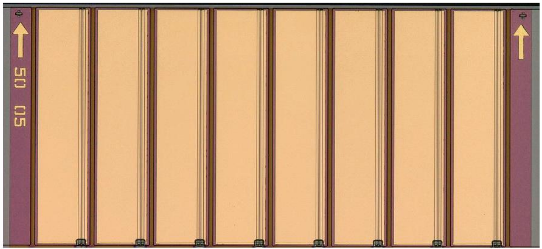
127KB | 真資料圖 | 雷射晶粒顯微影像,8 條並列橘色雷射條(陣列),左右紫色邊框含箭頭與小字標記;報告該頁為 Sivers 陣列光源 |
報告_Omdia_CIOE2026展會回顧_20261003_011.png |
618KB | 裝飾·banner | 長飛(YOFC)CopackAlign 品牌發表會現場照,台上六人,布幕寫 Polalign 保偏光纖、EzAlign 單模光纖「正式發布」,無技術資料 |
報告_Omdia_CIOE2026展會回顧_20261003_012.png |
167KB | 真資料圖 | CPO/NPO 光學元件示意圖:透鏡陣列、光纖排線連接器、多波長雷射(雷射器陣列+波長分配器);中文標註,來源標示 Suna |
報告_Omdia_CIOE2026展會回顧_20261003_013.png |
123KB | 真資料圖(財務/capex) | 左:資料中心 capex 分區長條圖(2022-2030,北美 18% CAGR、亞太 11%、EMEA 20%、拉美 17%);右:美洲各公司 2025-26 capex 長條與成長率(Microsoft 29%、Amazon 40%、Meta 68%、Google 39% 等);屬 capex 財務類圖,不嵌公司頁 |
原始內容
Event Recap: CIOE - September 2026
Mingyang Lyu Senior Principal Analyst
Executive summary
- This comprehensive report provides an in-depth analysis of the latest trends, technological breakthroughs, and market dynamics showcased at the 2026 China International Optoelectronic Exposition (CIOE). By synthesizing insights from key industry players, the report delivers a full view of the optical component landscape.
Key highlights covered in this report
- Industry insights and major optics announcements
- -An exploration of the strategic (capex) shifts and deployment roadmaps from leading telecom operators. This section highlights their latest opticsrelated perspectives, network upgrade strategies, and significant technological announcements shaping the future of telecommunications infrastructure.
- Customer perspectives
- -A deep dive into the evolving demands of major web and telco customers: we summarize their pivotal announcements, focusing on data center innovations (scale X), bandwidth scalability requirements, and their visionary outlook on next-generation optical networks.
- Global analyst perspectives and market forecasts
- -Updated viewpoints and market intelligence from top-tier global industry analysts: we synthesize their expert opinions on emerging market trends, growth projections, potential industry bottlenecks, and investment opportunities within the global optics sector.
- Exhibitor ecosystem and supply chain mapping
- -A comprehensive structural analysis of the participating companies: this section maps out the ecosystem distribution across the industry value chain-ranging across raw materials, optical components, equipment manufacturers, and system integrators-providing a clear picture of the current industry landscape represented at the event.
Preshow question: What to expect?
Before committing to exhibit at one event, consider the following:
You are investing both money and time in this opportunity; what specific outcomes do you want to achieve?
- Typically, for optics societies, exhibition participation is managed by marketing and business development departments. Their common objectives include
- -Business development and marketing: Be known by buyers
- -Commercial outcomes: Get orders
- -Strategic outcomes: Get investment
- -Shape the next generation of technology.
- -Competitive positioning: Be better than competitors
- These common aims can give us better insights into the true objectives of different participants at the event's forums and exhibition booths. This also explains the differentiated behaviors among exhibitors: some tend to hold relatively conservative communications, while others are keen to share their perspectives.
Show overview
Event Recap: CIOE - September 2026 | September 2026
Beyond product lists: Winning audience attention
CIOE optical communications products
Source: Omdia
© 2026 Omdia
- Semiconductor equipment and manufacturing
- Optical communication chip
- Optical communication module and device
Exhibit mix shift: Supply chain tightens, focus moves upstream
- A clear trend emerges from the composition of exhibits: attention is shifting from systems/modules toward devices and upstream semiconductors (lasers, PICs, DSPs, substrates/fabs).
- The supply chain is tightening across fiber, lasers, and advanced silicon; exhibitors emphasize long-term commitments, dual sourcing, and localized capacity.
- Geopolitics is quietly shaping sourcing and 'ecosystem sovereignty,' prompting onshore investments and vendor diversification.
10 top trends
Production capability is the thing most rewarded among the entire optics community.
Supply chain
Backlogged orders and upstream component shortages have reshaped the industrial chain's center of gravity and stakeholder behavior.
InP
As the key material for high-performance active chips, InP presents the biggest challenges and opportunities for the industry.
NPO
NPO shows explosive momentum among customers, standards, leading suppliers, and upper-midstream suppliers.
Special fiber
HCF development continues; specialty optical fibers targeting new use cases including CPO/NPO have begun to appear.
OCS
OCS deployed for Google use cases has been widely debated in the market; the latest hype is driven by NVIDIA and silicon photonics.
Scale across
Driven by the rapid rollout of NPO, the ecosystem's supporting passive components are undergoing faster iterations.
Visits from investors
Individual investors and investment firms are becoming more active participants at the event; more capital is poised to pour into the industry.
Semi foundries for more
When it comes to silicon photonics, semiconductor foundries are sequentially ramping up investments into this growing incremental market.
800G/1.6T pluggable
Discussions around the modules are tapering off, a positive sign indicating that the industry is now mass-producing these products.
Access and wireless
Suppliers of optical access networks are exploring PON applications inside data centers while attempting to enter the datacom market directly.
NPO
Event Recap: CIOE - September 2026 | September 2026
Supply chain issues dominated the show
- Supply chain issues emerged as the most important topic at this exhibition. In a panel session featuring Marvell's Qin Lian, she summarized it as the defining word for the industry this year.
- Rather than formal debate, the show floor was filled with procurement teams shuttling between booths-asking about delivery schedules, probing available capacity, and gauging competitor status-creating a notably bustling, even noisy, atmosphere.
- This theme intertwined with many others, making it hard to discuss in isolation.
- At its core, the root question is: How do you give your end customers genuine peace of mind?
Long-term agreements are standard but not sufficient
- Long-term agreements (LTAs) have become industry standard but cannot be relied on entirely. Breaches, though undesirable, can happen, especially with supply chains under extreme stress. Use LTAs, but do not depend on them alone.
- As the supply chain focus moves further upstream, the likelihood of double-ordering increases, an all-too-common illusion in supply chain cycles. When end-product shipments lag expectations, certain components turn into inventory and add carrying costs.
- Industry analysts are revising forecasts every quarter; this is the reality. The considerations differ for each company and role across the ecosystem.
Strategies by participant type under a challenging supply chain
- Different industry participants need different strategies to navigate today's supply-chain headwinds.
- Two broad categories emerge: We call them 'rule setters' and 'improvers.'
- -Rule setters
- -Invest heavily in R&D, and push toward the next generation of mainstream products.
- -Make a louder impact in product definition, customer engagement, and market development.
- -Outcome: They capture the highest potential margins amid uncertainty.
- -Key challenge: With limited availability of certain raw materials, how to balance next-generation R&D with mass production of core products?
- Improvers
- -Typically, they are lower profile but excel in specific areas, especially high-volume manufacturing stages.
- -Outcome: They win through strong incremental improvement and superior industrialization capabilities, which enable profitability and resilience.
- -Key challenge: Avoid worst-case scenarios such as customer order cancellations, component shortages affecting shipments, and pressures on cash flow and inventory.
NPO: Practical solution for AI infrastructure
- Milestone (May 21): OIF (Optical Internetworking Forum) Q2 2026 approved the '12.8 Tb/s NPO Module' project, defining 200G/lane interfaces for 12.8T and 6.4T NPO.
- Industry coalition: Led by CAICT (China Academy of Information and Communications Technology) with Huawei, Tencent, Alibaba Cloud, Meituan, China Mobile, and others.
- Domestic standards (July): CAICT formed an NPO working group with ~50 organizations to run regular technical exchanges and solution validation.
- Strategic objective: Unite China's ecosystem, and strengthen collaboration for intelligent computing network technologies.
- Ecosystem momentum: Accelink and HG Genuine have demonstrated 3.2T/6.4T NPO product versions.
Initial project members
lndputstral
Packaged optics approach in China: LPO then, NPO now
Source: IPEC, OIF
NPO standardization and thermal management
- No one would deny that standardizing optical modules and devices can minimize the industry's unnecessary waste of R&D resources and materials. However, from LPO to NPO and CPO, the core change is bringing optics closer to silicon. In a more tightly coupled system, device-level parameters alone are no longer sufficient to ensure the system works.
- Thermal management is increasingly being recognized across the industry. From the introduction of liquid cooling in XPO high-density packaging to the thermal solution definitions now included in the NPO standard, all of this indicates that current cooling mechanisms may be hitting bottlenecks. This will manifest in many areas: NPO performance itself, switch performance, and impacts on the PCB or other intermediate media.
- Some impacts, such as performance, can be identified quickly. But substrate warpage and aging, and even corrosion characteristics, require time to emerge.
| OIF target | Near package optics |
|---|---|
| Total bandwidth | 12.8Tb/s, 6.4Tb/s |
| Electrical | 200G PAM4 |
| Connector | Detachable (optional pigtail) |
| Thermal management | Liquid cooling solution (small version can use air cooling) |
| Density | ≥0.9Tb/mm |
| Source: Omdia | © 2026 Omdia |
Why NPO instead of CPO
- Customer view: LPO/NPO/CPO are progressive steps moving optics closer to the switch ASIC; link sensitivity discourages frequent reconnections even with pluggable LPO.
- Why NPO is scaling faster than CPO
- -The supply chain is far tighter than expected. Initially, the concern was laser shortages and InP substrates constraining the industry; now, even SOI wafers for silicon photonics are tight, and LTAs are being widely introduced.
- -Early in a new product's market entry, yield discussions are not very meaningful; however, higher-integration solutions inevitably bring more issues to resolve.
- -Everyone agrees packaged optics will be used in the future, but timing will differ because there are both aggressive and traditional network builders.
-
Example/initiative
-
-Alibaba : 4×25.6T solution with NPO
- -Fiberhome, Ruijie: 51.2T NPO Switch
51.2T NPO Switch
TH5 chip with cold-plate liquid-cooling technology
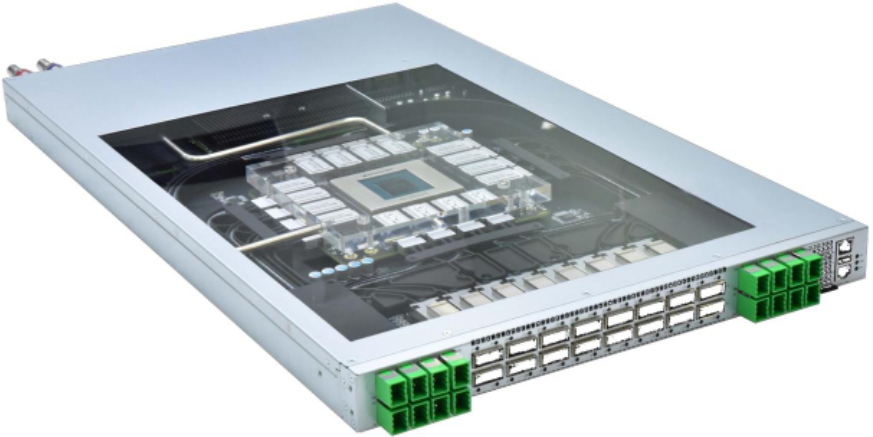
Source: Ruijie
NPO: From ELSFP to internal laser integration
HiSilicon Hi One 3.0 NPO Optical Engine (Integrated 1+1 Laser)
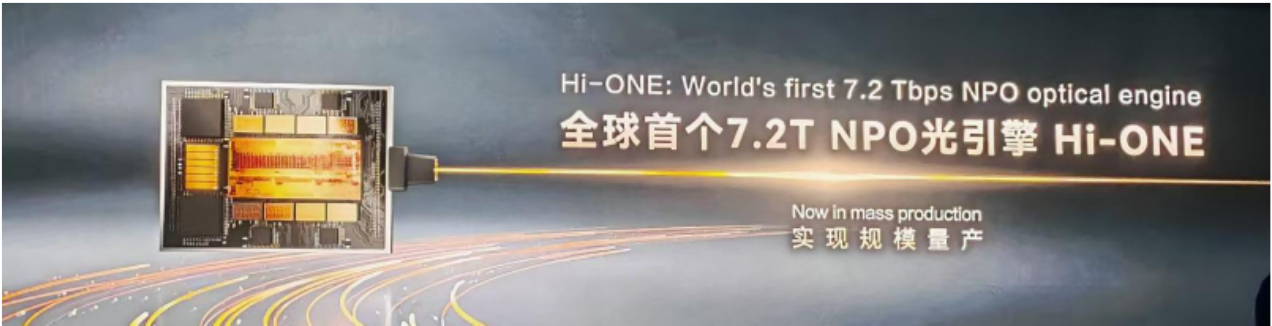
Source: HiSilicon
- Key technologies
- -Multi-die copackaging (20+ dies; five material systems)
- -Large-format, low-stress FC packaging
- -32/36-channel integrated optical fan out for small-pitch, high-precision coupling
- -Embedded light source with low-loss coupling means lower laser power and system power
- -High thermal conductivity/heat spreading mitigates local heat density and reliability risks
- -224G high-speed, high-density, low-crosstalk packaging means better link performance
Alibaba Cloud's views on LPO/NPO/CPO, power/reliability, and evolution
- Objective
- -Shorter electrical interconnects → higher energy efficiency (LPO → NPO/CPO)
- LPO (800G) vs. full retimed DSP version
- -Reliability: +68.2-78.8% improvement observed at 4K scale (field data close)
- -Power: ~29% lower (~6.5 W); module -50% + switch-side savings
- NPO/CPO vs. DSP (next-gen systems with optical engines)
- -CPO: -39% overall system power
- -NPO: -31% overall system power
- Reliability
- -CPO achieved 1 million 400G-equivalent port hours with zero link flaps: NPO keeps maintainability and improves fault isolation and asset risk vs. CPO
- Trajectory
- -Optical engines move closer to ASIC, progressing toward OIO
- -SerDes → 224G/448G escalates SI/power constraints
- Takeaway
- -Phased deployment that trades deeper integration for energy efficiency while managing reliability/maintainability
NPO timeline for Chinese ICPs
- According to reports disclosed by Alibaba Cloud, Tencent, and other ICPs, planned NPO progress is broadly similar.
- In 1Q26, they achieved 3.2T NPO optical engine samples and brought up 4×25.6T domestic switch systems.
- This product series is expected to begin volume shipments in 4Q26.
- In 4Q26, the initial spec for the 6.4T UPO standard, an NPO variant, will be released, and by 3Q27 it will evolve to the 448G version definition of 12.8T UPO.
- The corresponding 102.4T UPO switch is slated for release around 4Q26-1Q27.
- Disclosed partners for silicon photonics versions of NPO modules include HG Genuine and Accelink.
- We also found the 102.4T NPO Switch demo from Ruijie in CIOE. This design seems to be widely accepted by Chinese ICPs.
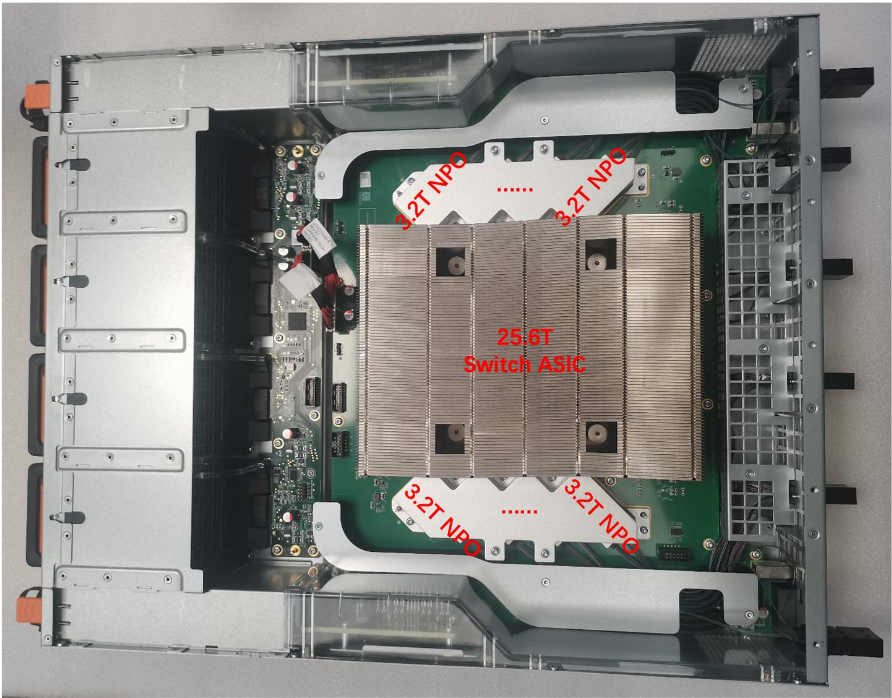
Source: Omdia analyst
© 2026 Omdia
InP and supply chain
Event Recap: CIOE - September 2026 | September 2026
InP is the biggest variable beyond AI supercycle orders
CIOE optical communications products
The indium phosphide ecosystem and comprehensive value chain
· Upstream: Strategic raw materials and capital equipment
- -Indium: China dominates raw indium by supplying 70% of global volume, but it heavily relies on imports for the ultrapure grade, firmly establishing indium as a strategic mineral.
- -Phosphorus: High-purity red phosphorus (6N-7N) is tightly controlled by a Japanese duopoly; it is categorized as a hazardous chemical with immense purification hurdles and a 12-18-month certification pipeline.
· Precursors and hardware
- -Metal-organic precursors are critical for MOCVD processes and mandate minimum purity levels of six 9s. Essential manufacturing infrastructure, including epitaxial reactors, lithography tools, and inspection equipment, remains vulnerable to stringent export controls.
- Midstream: Substrate manufacturing and epitaxial growth
- -Substrate consolidation: Global production of InP single-crystal substrates is highly concentrated: Sumitomo, AXT, and JX Metals collectively command over 90% of the market share. New Chinese vendors' capabilities are advancing in 2-4″ formats, while 6″ validation is still underway.
- -The epitaxy bottleneck: Growing multilayer quantum well structures via MOCVD/MBE is a highly customized service that directly dictates final chip performance and yield. Scaling up substrate capacity requires an 18-36-month cycle, with 6″ production demanding exponential technological leaps and billion-dollar-level capital investments.
Strategic vertical integration and margin dynamics
· Ecosystem construction pathways for IDMs
- -M&A and strategic alliances: Companies can rapidly acquire packaging and substrate capabilities through buyouts or can secure long-term supply and joint 6″ process development through strategic partnerships. The ultimate objective is complete supply chain autonomy-from substrate to packaged module-to solidify competitive moats.
- -Organic expansion: This involves transitioning upstream from chip design into in-house epitaxy and substrate R&D builds robust technological foundations, though it is hindered by extended development cycles.
· Value chain economics and bargaining power
- -InP Epitaxy (EML): This segment sees robust margins of over 40% and strong bargaining power.
- -Substrates: This segment yields exceptional gross margins exceeding 50%. Suppliers hold immense pricing leverage.
- -Chips to modules: 200G EML chips, packaging, and then modules have progressively weaker pricing power largely dictated by the end client.
· The IDM strategic imperative
- -Market economics dictate that upstream positioning ensures superior margins and leverage. Crucially, substrate defect densities and epitaxial quality strictly define final chip yields. Establishing an IDM model ensures rigorous source material control, safeguarding against severe supply disruptions that frequently paralyze pure-play design firms during shortages.
Looming market deficits, price trajectories, and manufacturing lifecycles
· Multiyear supply and demand imbalance
- -Peak crisis 2025-26 p: The supply gap will escalate from ~65% in 2025 to over 70% by 2026, triggering aggressive price hikes. Even the price of 2″ substrates is more than doubled.
- -Long-term scarcity 2027-30: Although 6″ upgrades may briefly ease the deficit in 2027, demand will explode again in 2028 because of a fourfold increase in volume and more applications. The InP substrate and high-end chip sectors will remain a seller's market through 2029 and beyond.
· Investment reality
- -A standard 3″ IDM facility necessitates CNY1-1.5bn, while next-generation 6″ fabs exceed CNY2.5bn. Reaching profitability takes five to seven years, characterizing this sector as a high-barrier, capital-intensive ecosystem that rewards successful players with 40-60% premium margins.
- -Factory: Up to 24 months for product roadmap alignment, facility construction, and achievement of cleanroom certifications
- -Infrastructure : More than 12 months for securing long-lead equipment (e.g., MOCVD systems) and locking in proprietary epitaxial formulas and lithography parameters
- -Commercial ramp: 12-18 months to improve production yields and pass clients' reliability validations for mass supply
Supply constraints catalyzing InP innovation
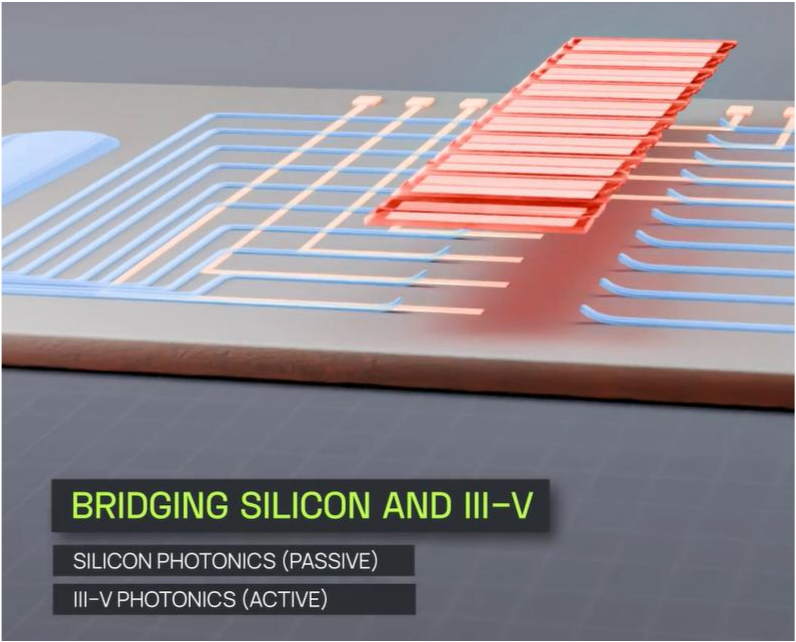
Source: Photon Bridge
- Supply chain constraints and concerns have, to some extent, accelerated R&D progress in InP-related areas. We are seeing more innovative products and platforms emerging and sharing a common goal: deliver light sources to the industry more efficiently.
- Photon bridge is a patented platform for heterogeneous photonics. Thick-film silicon photonics (2µm) vs. 220nm thin-film
- -Higher power handling; lower loss; process tolerance
- -Alignment advantage: A proprietary elastic component is expected to ease optical alignment/coupling (their 'secret recipe')
- -Net outcome: A more manufacturable, power-capable, and scalable silicon photonics platform with improved yield
Intel's heterogeneous integration and Sivers's array solution
- Intel's foundry: Differentiated packaging and test
- InP die bonded to SOI to cointegrate III-V light emission with silicon photonics
- Process advantages
- -InP processed after bonding
- -Wafer-scale manufacturing, test, and burn-in/reliability screening
- Demonstrated multiwavelength laser arrays (8/16 wavelengths) by Intel
- Design flexibility
- -InP design/functionality can be optimized per die and supports Known Good Die strategy for complete on-chip optical subsystems.
- -The platform offers higher flexibility to use SOA within the design (key differentiator vs. peers).
- Value proposition: Reduced alignment complexity, better material efficiency, scalable wafer-level integration, and reliability qualification
- Compared with platform-oriented differentiated competitors such as Intel, Sivers is a representative light-source supplier that leans more toward the semiconductor side.
- In our discussions, it conveyed a clear intent not to compete with its customers. This is often the tricky part for optics-leaning suppliers, some of whom are keen to expand their product lines upstream or downstream.
- There is little remaining need for technical debate around 70mW and 100mW products. In the next phase, Sivers is proud to focus on an arraybased light-source solution. The know-how for array implementations will be the core of its differentiated competitiveness.
Source: Sivers
OCS
Event Recap: CIOE - September 2026 | September 2026
OCS: Strong promise, but still no one-size-fits-all deployment model
- Hype and capital interest
- -Discussion intensity rivaling that for NPO
- -Triggered by NVIDIA and iPronics investment news
- -Investors scouted CIOE for targets, especially small-port-count silicon photonics OCS
- Attention boost
- -Google's definitive narrative reignited momentum.
- Market readout
- -Telcos: Actively discussing how to introduce OCS
- -Web-scale users: 'Under evaluation'
- Trajectory
- -Like CPO, it is widely seen as inevitable; OCI plus electrical PHY limits push parts of switching and even compute toward optical solutions.
- Reality check
- -Organizational inertia remains strong; rapid moves typically happen only when necessary.
- New applications are expected late this decade (massive deployment); it is not too early to talk about it, but still no standardization activities could be found.
OCS: Value, business reality, and success factors
- Thesis: OCS's value is software-centric not hardware-centric. Chip-only R&D focus can create revenue pressure.
- Market reality
- -Many new 'fast' OCS vendors also sell silicon photonics chips.
- -China's prior wave of silicon photonics startups underdelivered against expectations.
- -Some OCS firms will succeed; most likely will not.
- Playbook for small OCS device designers
- -Showcase core strengths at trade shows.
- -Pursue partnerships with system vendors.
- Investment does not equal inevitability:
- -Early MOUs or funding do not guarantee success. NVIDIA's broad investing is a rational hedge, not validation of a single path.
- What matters most
- -Convert 'hype-funded' concepts into meaningful, healthy revenue.
- -In the OCS supply chain, success hinges on tighter collaboration with switch architects/definers.
- -Question from a top system vendor in ECOC: 'If this application is truly going to see widespread use, why hasn't anyone standardized and defined the use cases for OCS?'
Scale across
Event Recap: CIOE - September 2026 | September 2026
Scale across is the new bandwidth
| Fabric tier | Example scale | Relative bandwidth |
|---|---|---|
| End-user (WAN/DCI) | - | 1× |
| Front-end (compute/storage) | - | 7× |
| Scale up (GPU complexes) | 100s of GPUs | 504× |
| Scale out (cluster) | ~50,000 GPUs | 56× |
| Scale across (multicluster) | 1 million-plus GPUs | 14× |
Source: Acacia
Acacia
- As a Cisco company, its perspective is strategically influential for WAN/DCI and data center optics.
- -Bandwidth demand varies sharply by fabric. The heaviest concentration is in scale-up GPU interconnects.
- -Significant capacity is also required for scale-out and scale-across fabrics as deployments grow to 50,000 to 1 million-plus GPUs.
- -Planning optics roadmaps should account for these tiers distinctly (frontend vs. GPU backend vs. intercluster).
- -Scale across is the new bandwidth; pluggables will play an essential role there.
Scale across enables cross-data-center GPU collaborative computing and is distinct from traditional data center interconnect
- Distance and efficiency
- -Up to 200km chosen to sustain ≥98% compute efficiency vs. single node
- -Around 1-2% efficiency drop per ~100km latency
- Latency profile
- -Traditional DCI: milliseconds for sync; up to 100s of milliseconds for async/CDC
- -Scale across: microseconds to milliseconds with latency directly reducing compute efficiency
- Optics today
- -Predominantly 400G/800G coherent pluggables; roadmap to 1.6T
- Next wave
- -Finer-grained specs and use-case segmentation; optimized variants (e.g., coherent lite)
- Supply chain watch
- -Optical amplifier bottlenecks as a result of InP-based pump lasers causing long lead times
- -InP-capable vendors pursuing in-house pump lasers
Passive component
Event Recap: CIOE - September 2026 | September 2026
Special fiber and passive platform
Source: Omdia analyst
© 2026 Omdia
- Launch
- -YOFC introduces CopackAlign for CPO/NPO:
- -Subbrands: Polalign (PMF) and EzAlign (SMF)
- -Series: Polalign CUP0012 and EzAlign CUE0023 for mainstream, large-scale deployments
- Platform approach
- -Paired companion fibers under unified geometric control; core-height uniformity from design, not binning
- System trend
- -Passive components become a core optimization focus in future CPO/NPO architectures; evidence of 'platformization'
- Supply-chain shift
- -Fragmented component landscape today; CPO's high-density design raises system-level optical interconnect requirements, driving integrated, co-optimized passives
Passive component time
- Detachable connectors are a key NPO-driven innovation area. NPO's manufacturability elevates connectors as a critical subsystem in advanced optical links.
- Current solutions are suboptimal in density, manufacturability, and cost.
- Innovation directions
- -Reusable detachable connectors
- -Micron-level repositioning accuracy
- -Integrated monolithic structures
- -Compatibility with high-speed packaging
- Packaging and test
- -Integrated packaging drives wafer-level test needs/challenges; lenstype innovations are pivotal.
- Market outlook
- -There is no clear convergence yet; expect more differentiated designs and segmentation; platformization becomes essential.
Source: Suna
Telecoms shift
Event Recap: CIOE - September 2026 | September 2026
PON enters the AI toolkit: Use cases and supply dynamics
- Observation
- -Though there were fewer access-network exhibits at CIOE this year, globally PON is being pulled into AI workflows.
- Emerging hyperscaler use case
- -Benefits: Simplified outside-plant, centralized management, and cost-effective scaling for OOB/control networks
- -Data center out-of-band management with PON enabled by P-P → P-MP upgrades (per Nokia white paper)
- Technology crossover
- -Some PON vendors are pivoting to high-power DFBs or laser arrays for datacom, leveraging existing InP expertise.
- -PON light sources remain largely InP-based DFB lasers using direct modulation.
- Commercial dynamics
- -The question of how much of the price uplift converts to sustainable margin amid rising upstream materials costs remains open.
- -Tight supply chains are improving vendors' pricing power.
- Action items
- -For component sourcing, track lead times for InP DFBs, and consider dual-sourcing or in-house capability roadmaps where feasible.
- -Evaluate PON-based OOB for new campuses/metro DCs; compare TCO vs. active Ethernet control-plane designs.
- -Pressure-test cost models under different raw-material inflation scenarios.
Capex forecast
Event Recap: CIOE - September 2026 | September 2026
North America continues to lead in data center spend, driven by the hyperscalers
China's AI buildout is accelerating, opening opportunities for regional suppliers and reshaping optical interconnect demand
- Global context
- -2024: US xAI deploys first 100,000-GPU cluster; US hyperscalers now pushing toward million-GPU builds, driving intense capex focus.
- -2025 (China): 42 clusters at 10,000-GPU scale completed.
- -2026/06 (China): 2,185EFLOPS FP16 nationwide (+177% year on year).
- -2026/08: Sugon '曙光8000,' China's first fully domestic 100,000-GPU supercluster, goes live in Zhengzhou.
- What's next? (China outlook)
- -Expect a large-scale hardware ramp within around two years following a trajectory similar to that in North America.
- -Power constraints prevent megaclusters at a single site; intersite/wide-area connectivity becomes mandatory.
- Implications for optics
- -There will be rising demand for low-latency DCI/scale-across links connecting multisite clusters beyond a single campus.
- -Product evolution seen in North America (e.g., coherent pluggables, latency-aware designs) will extend to other regions.
- -Supply chain tightness and price hikes elevate risk, but momentum remains strong as more builders enter.
- -There will be an untapped upside across the optics chain, especially optical transport networks (OTN) enabling resilient, low-latency WAN fabrics.
Appendix Event Recap: CIOE - September 2026 | September 2026
Appendix
Further reading
Optical Components - 1Q26 (Share Only) (July 2026)
100G+ Coherent Optical Equipment Ports - 2Q26 (September 2026)
100G+ Coherent Optical Equipment Ports - 1Q26 (June 2026)
Optical Networking - 1Q26 (Share Only) (May 2026)
'Coherent expands laser manufacturing to implement NVIDIA's AI vision' (June 2026)
'ECOC 2026 Market Focus: A systematic panorama of AI optical interconnects' (July 2026)
Author
Author Name, Job Title, Practice Area
Appendix
Omdia consulting
We hope that this analysis will help you make informed and imaginative business decisions. If you have further requirements, Omdia's consulting team may be able to help you. For more information about Omdia's consulting capabilities, please contact us directly at consulting@omdia.com.
Citation policy
Request external citation and usage of Omdia research and data via citations@omdia.com.
Disclaimer
The Omdia research, data and information referenced herein (the 'Omdia Materials') are the copyrighted property of TechTarget, Inc. and its subsidiaries or affiliates (together 'Informa TechTarget') or its third party data providers and represent data, research, opinions, or viewpoints published by Informa TechTarget, and are not representations of fact.
The Omdia Materials reflect information and opinions from the original publication date and not from the date of this document. The information and opinions expressed in the Omdia Materials are subject to change without notice and Informa TechTarget does not have any duty or responsibility to update the Omdia Materials or this publication as a result.
Omdia Materials are delivered on an 'as-is' and 'as-available' basis. No representation or warranty, express or implied, is made as to the fairness, accuracy, completeness, or correctness of the information, opinions, and conclusions contained in Omdia Materials.
To the maximum extent permitted by law, Informa TechTarget and its affiliates, officers, directors, employees, agents, and third party data providers disclaim any liability (including, without limitation, any liability arising from fault or negligence) as to the accuracy or completeness or use of the Omdia Materials. Informa TechTarget will not, under any circumstance whatsoever, be liable for any trading, investment, commercial, or other decisions based on or made in reliance of the Omdia Materials.
customersuc es @omdia.com Get in touch Americas customersuccess@omdia.com 08:00 - 18:00 GMT -5
customersuc es @omdia.com Europe, Middle East & Africa customersuccess@omdia.com 8:00 - 18:00 GMT
customersuc es @omdia.com Asia Pacific customersuccess@omdia.com 08:00 - 18:00 GMT + 8