PDF 原檔:報告_Citi_台灣半導體財報季回顧_20260802_original.pdf
已驗證圖片清單(Step 2.5,2026-08-04 逐張 Read)
| 檔名 | 分類 | 內容(親眼所見) |
|---|---|---|
260802_citi_TW-semi_001.png |
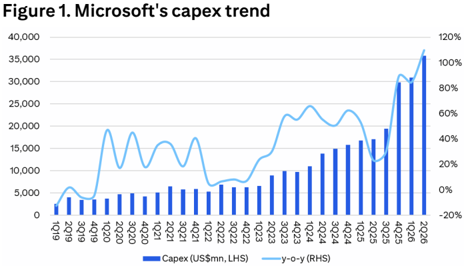
真資料圖 | Figure 1. Microsoft's capex trend — 季度 capex 長條(US$mn,左軸,1Q19–2Q26,2Q26 約 36,000)+ YoY 折線(右軸),2025-26 明顯陡升 |
260802_citi_TW-semi_002.png |
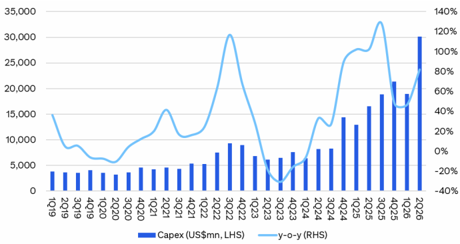
真資料圖 | Meta's capex trend — 同格式季度 capex 長條+YoY 折線,2Q26 約 30,000(圖內標題被裁切,依內文 Figure 3 判定為 Meta) |
260802_citi_TW-semi_003.png |
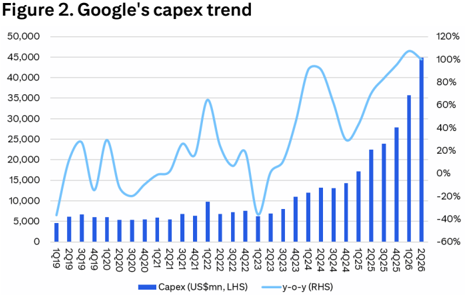
真資料圖 | Figure 2. Google's capex trend — 季度 capex 長條,2Q26 約 45,000+YoY 折線 |
260802_citi_TW-semi_004.png |
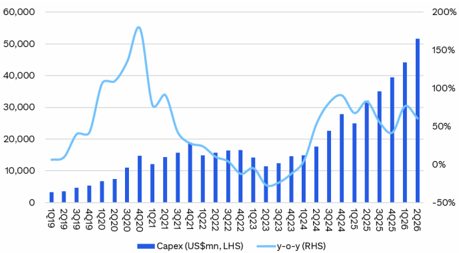
真資料圖 | Amazon's capex trend — 季度 capex 長條,2Q26 約 51,000+YoY 折線(標題被裁切,依內文 Figure 4 判定為 Amazon) |
原始內容
citivelocity.com
03 Aug 2026 01:54:18 ET │ 11 pages
Taiwan Semiconductors
Earnings Season Half-way Recap
CITI'S TAKE
Taiwan tech companies' earnings season is in the half way. Despite recent market turbulence, companies reaffirmed that AI investment cycle is broadening across the entire hardware ecosystem. TSMC remains the clear manufacturing leader, benefiting from sustained advanced-node demand and persistent CoWoS tightness, while UMC is beginning to participate through specialty technologies such as silicon photonics and AI power ICs. ASEH continues to benefit from rising packaging and testing complexity. MediaTek is also steadily expanding its AI silicon exposure beyond smartphones into edge and enterprise computing. And GUC benefits from accelerating hyperscaler custom CPU adoption. We see companies in the semiconductor supply chain raised guidance, increased capital expenditure or expressed improving visibility into 2027 AI demand, reinforcing our view that AI infrastructure investment remains in the early stages of a multi-year expansion and that the beneficiaries will increasingly extend well beyond computing but also in networking and power.
- US Hyperscalers - AI CapEx Continues to Move Higher Despite Temporary FCF Pressure. Recent results from major US CSPs reiterated that AI infrastructure investment continues to accelerate. Microsoft and Meta both raised or reaffirmed record capital expenditure plans, while Google also increased investment to support rapidly growing AI demand across Search, Cloud and Gemini. AWS similarly commented that AI infrastructure remains its highest investment priority as demand continues to outpace available capacity . Importantly, management teams consistently views near-term FCF pressure as a natural consequence of accelerating infrastructure deployment rather than a deterioration in underlying business fundamentals. The investment focus is also broadening from large-scale training clusters toward enterprise AI and inference infrastructure, driving demand not only for GPUs but also custom ASICs, networking, advanced packaging, memory and increasingly sophisticated power infrastructure.
- Foundry - TSMC and UMC Reinforce a Stronger AI Manufacturing Outlook. TSMC reiterated exceptionally strong AI demand across leadingedge nodes and advanced packaging, with CoWoS capacity continuing to sell out despite aggressive expansion. It also lift full year guidance to be 40% YoY growth with significant capex upgrade to US$60-64bn . In the trailing edge, UMC also turned noticeably more constructive, raising 2026 capex by 33% from US$1.5bn to US$2.0bn, mainly for silicon photonics and advanced packaging , the investment is expected to reach US$5bn in
See Appendix A-1 for Analyst Certification, Important Disclosures and Research Analyst Affiliations
Prepared for Kevin Lu
Laura (Chia Yi) Chen AC
+886-2-8726-9090 laura.cy.chen@citi.com
Jack Chen +886-2-8726-9091 jack1.chen@citi.com
Michael Hung +886-2-8726-9092 michael.hung@citi.com
Nicholas Lai +886-2-8726-9093 nicholas.lai@citi.com
Figure s. Meta s capex trend
Figure 1. Microsott s capex trend
40,000
35,000
35,000
30,000
30,000
25,000
25,000
20,000
20.000
15,000
15,000
10,000
10,000
5,000
5,000
Source: Citi Research
120%
200%
100%
150%
80%
60%
100%
40%
50%
20%
the next few years . Although UMC's AI revenue contribution remains modest today, management highlighted increasing exposure to PMIC, connectivity chips, and silicon photonics, with its 12-inch silicon photonics platform entering early production and broader commercial contribution expected from 2027. UMC expects its AI related revenue to reach US$1bn in 3 years , from US$300m currently . -60%| -50%
- Capex (US$mn, LHS)|
-v-o-y (RHS)|
• Capex (US$mn, LHS) |
-y-o-y (RHS)
- Packaging, Testing and AI Infrastructure - AI Revenue Mix Continues to Improve with GM upside. ASEH highlighted sustained strength in advanced packaging and testing driven by increasingly complex AI chips, while continuing to expand capabilities in CoWoS-related packaging, advanced test and next-generation panel-based technologies. LEAP revenue to be more than US$3.5bn this year and doubling in 2027 . Delta Electronics also see AI revelated revenue to be 25% for this year, higher than their previous expectation of 20%. AI data center products will be supported by strong demand for high-efficiency power supplies, power distribution, liquid cooling and higher rack power density. As AI servers migrate toward increasingly power-intensive rack architectures, Delta remains one of the key beneficiaries of higher system-level power content.
- ASIC Momentum Accelerates - MediaTek and GUC Expand AI Opportunities. MediaTek reiterated a constructive AI outlook while highlighting continued expansion across edge AI, automotive and enterprise AI opportunities. The company has updated its AI ASIC revenue to US$12-16bn (based on 15-20% market share of its US$80bn market estimate; lift from 10-15% market share; vs our estimate of US$18bn) . Mediatek also confirmed that they are working with second ASIC customer. GUC also continues to benefit from expanding hyperscaler ASIC CPU programs, with industry discussions pointing to an increasingly robust multi-year design pipeline as cloud providers diversify compute architectures beyond merchant GPUs, we expect CPU business to doubling next year with revenue contribution to reach +30%/50% in 2026/27.
© 2026 Citigroup Inc. No redistribution without Citigroup's written permission. Source: Citi Research
Figure 3. Meta's capex trend
© 2026 Citigroup Inc. No redistribution without Citigroup's written permission. Source: Citi Research
© 2026 Citigroup Inc. No redistribution without Citigroup's written permission. Source: Citi Research
Figure 4. Amazon's capex trend
© 2026 Citigroup Inc. No redistribution without Citigroup's written permission. Source: Citi Research
Prepared for Kevin Lu
120%
140%
120%
100%
100%
80%
80%
60%
60%
40%
40%
Figure 4. Amazon s capex trend rigure <. Google s capex trend
60,000
50,000
45.000
50,000
40.000
35,000
40,000
30.000
30,000
25.000
Prepared for Kevin Lu
Companies Mentioned:
Alphabet Inc (GOOGL.O; US$356.13; 1; 31 Jul 26; 16:00) Amazon.com, Inc. (AMZN.O; US$271.58; 1; 31 Jul 26; 16:00) ASE Technology Holding (3711.TW; NT$555.0; 1; 31 Jul 26; 13:30) Delta Electronics (2308.TW; NT$1640.0; 1; 31 Jul 26; 13:30) GUC (3443.TW; NT$3805.0; 1H; 31 Jul 26; 13:30) Mediatek (2454.TW; NT$3555.0; 1; 31 Jul 26; 13:30) Meta Platforms Inc (META.O; US$556.71; 1; 31 Jul 26; 16:00) Microsoft Corp. (MSFT.O; US$464.72; 1; 31 Jul 26; 16:00) TSMC (2330.TW; NT$2425.0; 1; 31 Jul 26; 13:30)
UMC (2303.TW; NT$121.0; 1; 31 Jul 26; 13:30)
Prepared for Kevin Lu
If you are visually impaired and would like to speak to a Citi representative regarding the details of the graphics in this document, please call USA 1-888-500-5008 (TTY: 711), from outside the US +1-210-677-3788