PDF 原檔:報告_MS_FCC光模組管制3.2T_20261001_original.pdf
圖片清單(已驗證 2026-10-02)
| 檔名 | size | 分類 | 親眼所見內容 |
|---|---|---|---|
報告_MS_FCC光模組管制3.2T_20261001_001.png |
12KB | 真資料圖 | Exhibit 1 長條圖「Annualized Transceiver Capacity (M units)」:AAOI 12.0、Innolight 44.3、Eoptolink 56.7(M units/年)。小於 40KB 但為報告唯一圖表,已 Read |
原始內容
M Update October 1, 2026 04:09 AM GMT
Telecom & Networking Equipment | North America
Potential FCC Rules on Optical Transceivers More Likely to Come in at 3.2T
Recent DC meetings highlight 3.2T as the most likely generation to see restrictions on China based optical transceivers. This echoes conversations with LITE during the Q noting that any restrictions would need to be phased in. See potential rules keeping laser market tight, a pos for LITE/COHR.
Key Takeaways
- Recent DC trip by our strategist team gave a greater idea of what potential FCC rules on optical transceivers could look like.
- Potential restrictions, likely to come in at 3.2T, limit Chinese-based transceivers, with a potential workaround if US-based content above 65% of the BOM.
- Solution seemingly a win-win for LITE/COHR, with laser market likely to stay tight, but not having to take on lower module assembly business.
- Also, does not create bottlenecks for hyperscalers.
- Assuring InP substrate delivery will be key to look at going forward.
What Happened: Morgan Stanley strategists recently met with a senior Washington telecom, FCC and e port-control legal team with direct engagement across the White House and FCC. Discussion focused on the Administration's efforts to reduce reliance on Chinese technology, with the FCC Covered List emerging as the more likely near-term mechanism for optical transceivers (a note we made in our AI Safety DC trip wrap-up last week). Policy discussions suggest 3.2T transceivers would likely be where restrictions would be phased in, potentially as soon as October, with industry recently asked to demonstrate credible U.S. or friend-shoring plans before 3.2T becomes broadly deployed. Our conversations noted that discussions are also indicating Chinese-built transceivers could still be importable, even at 3.2T, as long as 65% of the BOM comes from US-based companies (DSP / laser would get you pretty close). Initial 3.2T volumes are not e pected to ramp in volume until 2029, limiting the near-term revenue impact of a restriction even if action comes sooner.
We would see these rules as having the potential to avoid creating a constraint on hyperscalers' ability to build today, but eeping the laser mar et tighter given laser would largely need to be from a US-based vendor to meet a 65% value threshold, a positive for LITE/COHR.
How this echoes conversation with LITE earlier in the quarter: We hosted LITE at Nasdaq Asia in late August, where we asked the company about potential FCC rules. At the time they noted that the FCC had been in contact with them about potential Morgan Stanley & Co. LLC
| Meta A Marshall Equity Analyst Meta.Marshall@ organstanley.co | +1 212 761-0430 |
|---|---|
| Antonio Jaramillo Research Associate Antonio.Jara illo@ organstanley.co Morgan Stanley Asia (Singapore) Pte.+ | +1 212 761-4438 |
| Daniel K Blake Equity Strategist Daniel.Blake@ organstanley.co Morgan Stanley Asia Limited+ | +65 6834-6597 |
| Andy Meng, CFA Equity Analyst Andy.Meng@ organstanley.co Morgan Stanley MUFG Securities Co., Ltd.+ Yu Shirakawa Equity Analyst Yu.Shirakawa@ organstanley ufg.co | +852 2239-7689 +81 3 6836-5432 |
Telecom & Networking Equipment
North America Industry View In-Line
Morgan Stanley does and seeks to do business with companies covered in Morgan Stanley Research. As a result, investors should be aware that the firm may have a conflict of interest that could affect the objectivity of Morgan Stanley Research. Investors should consider Morgan Stanley Research as only a single factor in making their investment decision.
For analyst certification and other important disclosures, refer to the Disclosure Section, located at the end of this report.
= Analysts employed by non-U.S. affiliates are not registered with FINRA, may not be associated persons of the member and may not be subject to FINRA restrictions on communications with a subject company, public appearances and trading securities held by a research analyst account.
M Update
rules, with the company noting their feedback was that the rules would need to be phased in over time to prevent material supply/demand dislocation in the market with 60-65% of transceivers coming from China-based transceiver vendors. They also noted that pure transceiver volumes alone, at current pricing structures, would not be the most attractive business for them to bring on. These rules, which are both phased in and don't limit Chinese assemblers, as long as enough content is US-based, would seemingly address both of these concerns.
Our Thoughts:
- 3.2T loo s li e the li ely policy pressure point, but the near-term impact should be limited - Administration efforts appear focused on reshaping the supply chain before 3.2T reaches volume rather than disrupting the e isting 800G and 1.6T base. With the 3.2T ramp not e pected to begin until 2028 and broader adoption closer to 2029, an October Covered List action would provide roughly two years before meaningful volumes enter the market. Hyperscalers are already working on plans intended to demonstrate greater U.S. or friend-shored manufacturing, suggesting the policy objective is increasingly about determining where the ne t generation is built rather than immediately displacing current Chinese supply.
- Laser pricing loo s li e the stronger read-through versus transceiver share - A Covered List framework does not necessarily require Chinese module vendors to lose significant share if they can increase the U.S. content of the underlying BOM. Combining a U.S. DSP from Marvell with laser content from LITE/COHR could potentially move a Chinese-built transceiver to the 65% U.S.-value threshold discussed in our strategists team policy meeting. Such an outcome would leave Innolight and Eoptolink (both covered by Andy Meng) with less fle ibility to substitute toward China-based lasers while allowing them to remain relevant at the module level, reducing the risk from China-based laser makers. We therefore see a stronger read-through for high-speed laser pricing and LITE/COHR component share than for a wholesale redistribution of transceiver share.
- Replacement capacity not ready; nor is it the most attractive opportunity - As noted above, LITE noted that assembly of transceivers (mid-30's to low40s gross margin product), is not the most attractive opportunity for USbased optical companies (vs. EMLs and lasers well north of 50% steady state and approaching 75% today). While 3.2T is not yet in production, we use AAOI's current 800G and 1.6T capacity ramp as an illustration of the scale of US supply available to absorb a potential future demand shift. AAOI (not covered), the only material US-based production of transceivers, is currently ramping capacity. AAOI e ited Q2 with manufacturing capacity approaching 200,000 800G and 1.6T units per month and e pects to reach ~650,000 units per month by year-end 2026, while management continues to e pect demand to outpace production through mid-2027. AAOI's YE26 capacity annualizes to ~12M 800G/1.6T units, versus ~101M units combined for Innolight and Eoptolin based on annualized 1H capacity (44.3M and 56.7M, respectively), or >8x AAOI. Based on AAOI's year-end capacity plans and our Internet team's hyperscaler cape work, we estimate AAOI could support less than 4 GW of hyperscaler capacity even before
M Update
factoring in manufacturing utilization. Replacing a meaningful portion of Innolight and Eoptolink's supply would therefore require a substantial multiyear capacity build, with limited ability for e isting U.S. suppliers to absorb those volumes in the near term.
- InP supply and sourcing outside of China will still be areas to watch - Potential FCC rules could create a win-win for LITE/COHR by reducing the risk of China-based laser makers flooding the market, without forcing them to build significant transceiver module capacity to absorb lower-margin assembly business. Were China to view the rules as too one-sided, it could respond with tighter restrictions on InP substrate e ports, a key bottleneck to laser capacity ramping. At the same time, sourcing outside of China could broaden the beneficiary set beyond U.S. suppliers, supporting InP substrate demand at JX Advanced Metals (5016 JP), while providing a tailwind for Sumitomo Electric's (5802 JP) CWLD products and Furukawa Electric's (5801 JP) DFB lasers.
Exhibi 1: As it relates to optical transceivers (all speeds), Innolight and Eoptolink collectively have ~8x ore capacity than US player AAOI
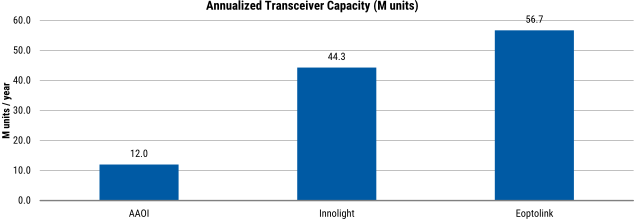
Source: Co pany data, Morgan Stanley Research
Note: AAOI (not covered) figures based on annualizing 4Q26 transceiver capacity; Innolight and Eoptolink figures based on annualizing 1H26 figures (both covered by Andy Meng)
Exhibi 2: While the industry has not yet seen 3.2T, based on AAOI's 800G and 1.6T capacity ra p plans in 4Q26E, we esti ate the co pany can support a axi u of ~3.7 GW without accounting for anufacturing utilization rates
| AAOI Capacity → GW Supported | Q4-26EAssumptions / Notes |
|---|---|
| 800G OSFP capacity (K units / month) | 420AAOI Q4-26 planned monthly capacity (capacity ramp slide) |
| (+) 1.6T OSFP capacity (K units / month) | 230AAOI Q4-26 planned monthly capacity (capacity ramp slide) |
| (=) 800G + 1.6T (K units / month) | 650Both speeds count one-for-one as modules |
| (×) Months per year | 12Annualizes the Q4-26 monthly run-rate |
| (×) Units per K | 1,000Converts thousands to units |
| (=) Annualized transceivers (units) | 7,800,000Max units per year at the Q4-26 run-rate |
| (/) Transceivers per 128K-GPU cluster | 655,000Lambda: ~655K pluggable modules for a 128K-GPU cluster |
| (=) 128K-GPU clusters supported | 11.9xNumber of 128K-GPU clusters the capacity could equip |
| (×) GPUs per cluster | 128,000Cluster size used in the Lambda example |
| (=) GPUs supported | 1,524,275GPUs that AAOI's annual capacity could network |
| (/) GPUs per 1 GW (GB300 NVL72) | 410,256GB300 NVL72 GPUs per 1 GW (MS assumption) |
| (=) GW supported | 3.7 GWUpper bound: assumes all units go to AI back-end fabric |
Source: Co pany data, Morgan Stanley Research
M Update
INDUSTRY COVERAGE: Telecom & Networking Equi ment
| Company (Ticker) | Rating (As Of) | Price* (09/30/2026) |
|---|---|---|
| Meta A Marshall | ||
| Arista Netw rks (ANET.N) | O (10/31/2023) | $203.59 |
| Ax n Enterprise Inc (AXON.O) | O (12/03/2024) | $422.52 |
| Ciena C rp rati n (CIEN.N) | E (10/10/2025) | $351.82 |
| Cisc Systems Inc (CSCO.O) | O (04/08/2024) | $107.63 |
| C herent C rp (COHR.N) | E (12/13/2023) | $287.81 |
| C rning Inc (GLW.N) | E (06/13/2024) | $153.76 |
| F5 Inc (FFIV.O) | E (04/12/2022) | $445.18 |
| Keysight Techn l gies Inc (KEYS.N) | O (07/13/2026) | $364.04 |
| Lumentum H ldings Inc (LITE.O) | E (05/12/2021) | $971.26 |
| M t r la S luti ns Inc (MSI.N) | O (12/17/2025) | $445.97 |
| Zebra Techn l gies C rp rati n (ZBRA.O) | E (12/02/2024) | $373.31 |
Stock Ratings are subject to change. Please see latest research for each co pany.
- Historical prices are not split adjusted.