PDF 原檔:報告_ML_FAU光纖陣列CPO_20260714_original.pdf
圖片清單(已驗證 2026-07-15)
| 檔名 | size | 分類 | 親眼所見內容 |
|---|---|---|---|
報告_ML_FAU光纖陣列CPO_20260714_001.png |
15KB | 真資料圖 | Nvidia CPO switch shipment 2026-30E 長條圖:14 / 52 / 190 / 685 / 1,442 K units |
報告_ML_FAU光纖陣列CPO_20260714_002.png |
38KB | 真資料圖 | Quantum Q3450 vs Spectrum 6810 BOM 百分比堆疊圖:Switch chip / OE / FAU / ELS / MPO&shuffle box / Others 佔比 |
報告_ML_FAU光纖陣列CPO_20260714_003.png |
23KB | 真資料圖 | FAU(for CPO)TAM 2026-30E 長條圖(US$mn):45 / 167 / 1,240 / 4,742 / 8,257 |
報告_ML_FAU光纖陣列CPO_20260714_004.png |
16KB | 真資料圖 | dFAU ASP trend(36-channel, 3.2T equivalent)2026-30E 長條圖:約 180 / 180 / 163 / 128 / 100 USD |
報告_ML_FAU光纖陣列CPO_20260714_005.png |
32KB | 真資料圖 | FAU BOM 圓餅圖:Fiber array(V-groove + PM fiber)~50%、Micro lens ~30%、Others(lid, substrate 等)20-25% |
報告_ML_FAU光纖陣列CPO_20260714_006.png |
92KB | 真資料圖 | FAU under grating coupler 結構示意圖:標示 Mirror、FAU、V-groove、Fiber、Pitch、Si lens、COUPE-GC |
報告_ML_FAU光纖陣列CPO_20260714_007.png |
124KB | 真資料圖 | Corning GlassBridge connector 產品實拍照:玻璃基材光纖連接器結構 |
報告_ML_FAU光纖陣列CPO_20260714_008.png |
62KB | 真資料圖 | Largan(LGANF)股價與 Price Objective 歷史沿革圖(分析師評等揭露附錄) |
報告_ML_FAU光纖陣列CPO_20260714_009.png |
61KB | 真資料圖 | Sunny Optical(SNPTF)股價與 Price Objective 歷史沿革圖(分析師評等揭露附錄) |
原始內容
Tech Hardware - Asia Pacific
The essence of FAU: alignment and automation
Industry Overview
FAU: lots of new entrants, but few likely winners
FAU acts as a highway connecting fiber to the optical engine for data transmission, and is essential to pluggable transceiver/NPO/CPO. Currently, FAUs are mostly supplied by legacy Asia supply chains, and FAU for CPO is 100% supplied by a Chinese vendor. We see more new entrants aiming to ramp up CPO/FAU-related components -e.g. fiber array, micro lens, prism, etc. However, in our view, not many of them could succeed due to high entry barriers, and we see Largan ' s progress as faster than other new entrants as it has moved on to certification after sampling/testing for two quarters. We highlight two key bottlenecks: (1) micron-level alignment, i.e. controlling the pitch tolerance at ≤ ± 0.5 µ m or even lower to ensure low-loss transmission; and (2) automatic alignment and testing to deliver consistent tolerance while lift efficiency. We note this know-how will take years of accumulated experience in precision optic manufacturing, mass production, as well as strong in-house automation capability.
CPO to take off in '28-29; FAU at 5-10% BOM/ $8bn TAM
Based on our checks, Nvidia ' s CPO switch volume may remain relatively low near-term, and a meaningful volume could happen in 2028-29, on rising penetration at scale-up. BofA tech team expects Nvidia CPO switch shipments to reach 14k/52k/190k units in 2026/27/28E. Among key components, we expect FAU to contribute 5-10% of the BOM, with the ASP ranging from US$80-200. The TAM for FAU in Nvidia CPO switches could hit US$8bn by 2030E. Amid multiple new optical solutions, we believe pluggable will remain a mainstream in scale-out into 2028-30. Within scale-up, the penetration of NPO and CPO depends on key CSPs ' preference as well as CPO ' s overall yield and cost.
GlassBridge: in early stage, not a replacement for FAU
Amid market ' s concern about potential threat from Corning ' s GlassBridge solution (to replace FAU), we argue that GlassBridge is still at an early stage, and is unlikely to be adopted in current and next-generation CPO design. Although GlassBridge could indeed improve the assembly yield, several bottlenecks need to be addressed, including misalignment with PIC due to the waveguide ' s uneven surface, rising manufacturing difficulty when channel numbers rise to 70+, etc. Also, under GlassBridge solution, a fiber array is still needed but likely with a lower precision-alignment requirement.
Upgrade Largan to Buy, Neutral on Sunny Optical
We see the datacom supply chain as a more closed ecosystem vs consumer electronics, given much higher requirements. Besides capability, customer engagement is another key. We upgrade Largan to Buy from Neutral on faster progress at CPO (see Largan report). We reiterate Neutral on Sunny Optical given the lack of concrete projects.
This research report provides general information only. No part of this report may be used or reproduced or quoted in any manner whatsoever in Taiwan by the press or other persons without the express written consent of BofA Securities.
>> Employed by a non-US affiliate of BofAS and is not registered/qualified as a research analyst under the FINRA rules.
Refer to "Other Important Disclosures" for information on certain BofA Securities entities that take responsibility for the information herein in particular jurisdictions.
BofA Securities does and seeks to do business with issuers covered in its research reports. As a result, investors should be aware that the firm may have a conflict of interest that could affect the objectivity of this report. Investors should consider this report as only a single factor in making their investment decision.
Refer to important disclosures on page 9 to 12. Analyst Certification on page 6. Price
14 July 2026
Equity Asia Pacific Tech Hardware
Katherine Zhu >> Research Analyst Merrill Lynch (Hong Kong) kexin.zhu@bofa.com
Robert Cheng >> Research Analyst Merrill Lynch (Taiwan) robert.cheng@bofa.com
Doris Kao >>
Research Analyst Merrill Lynch (Taiwan) doris.kao@bofa.com
For acronyms, please refer to Exhibit 13
FAU in CPO: $8bn TAM by '30 on volume take-off from '28
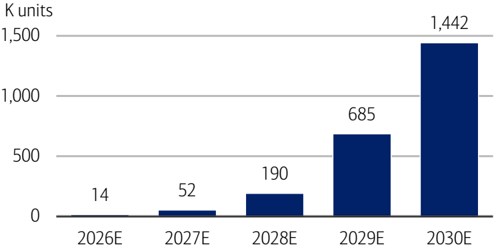
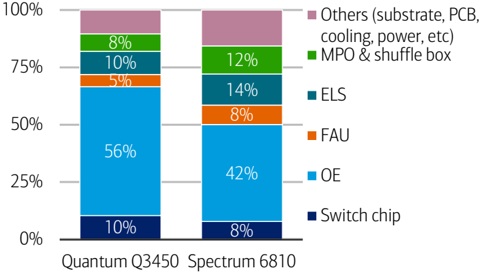
Based on our supply chain check, Nvidia ' s CPO switch shipment may remain relatively low near-term, and a meaningful volume likely takes off in 2028-29 following rising penetration at scale-up. BofA tech team expects volume to reach 14k/52k/190k units in 2026/27/28E. Among key components, optical engine (OE) acts as the core to convert electric and light signals, while FAU acts as a highway connecting optical fiber and optical engine for data transmission. Outside of CPO switch, external laser source (ELS) is responsible for projecting laser that helps drive light signal through optical fiber, while MPO/MMC are connectors that connect optical fibers housed in the shuffle box to external ports. Looking at the BOM of a CPO switch, optical engine, ELS, and FAU are likely contribute 40-55%, 10-15% and 5-10% of the total BOM, respectively.
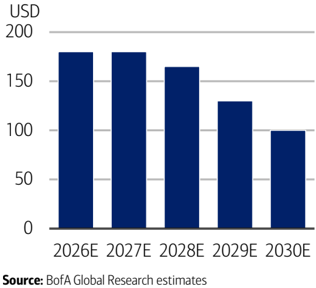
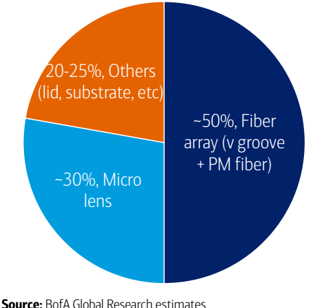
Specifically for FAU, we believe its TAM in Nvidia CPO switch could reach US$8bn by 2030E, based on an assumption of 1.4mn units of CPO switch and 115 units of 1.6T equivalent OEs per switch. Our check suggests FAU ' s ASP ranges from US$80-200, depending on current specs. General FAU consists of fiber array (V-groove and optical fiber), lid, substrate and casing, etc, while some high-end FAU also integrate optical components like micro lens, prism and MT ferrules. For example, Spectrum 6810 adopts 36 channels of dFAU, and dFAU pricing could be in the range of US$150-200. With volume gradually rising into 2030, the ASP could fall to US$100. However, as specs migrate to 70-100 channels and potential muti-layer design, FAU could witness content value upside.
Exhibit 1: We expect Nvidia CPO switch shipment to reach 14k/52k/190k units in 2026/27/28E Nvidia CPO switch shipment, 2026-30E
Source: BofA Global Research estimates
Exhibit 2: Spectrum 6810 features 36 FAUs (include 4 redundancy) Nvidia CPO switch component summary
| Quantum X800 Q3450 | Spectrum 6810 | Spectrum 6800 | |
|---|---|---|---|
| Switch chip | 4 | 1 | 4 |
| OE | 72 | 36 | 144 |
| FAU | 72 | 36 | 144 |
| ELS | 18 | 16 | 64 |
| Laser | 144 | 128 | 512 |
| MPO/MMC | 144 | 128 | 512 |
Source: Company data, BofA Global Research
BofA GLOBAL RESEARCH
Exhibit 3: We estimate FAU value per switch could reach US$6-7k
Nvidia CPO switch BOM analysis
| US$ | Quantum Q3450 | Spectrum 6810 |
|---|---|---|
| Switch chip | 12,000 | 5,000 |
| OE | 64,800 | 32,400 |
| FAU | 6,120 | 6,480 |
| ELS | 11,700 | 10,400 |
| MPO &shuffle box | 8,760 | 9,400 |
| Others (substrate, PCB, cooling, power, etc) | 15,000 | 15,000 |
| 118,380 | 78,680 |
Source: BofA Global Research estimates
BofA GLOBAL RESEARCH
BofA GLOBAL RESEARCH
Exhibit 4: FAU roughly contributes 5-10% BOM of a Nvidia CPO switch
Nvidia Quantum and Spectrum CPO switch BOM analysis
Source: BofA Global Research estimates
BofA GLOBAL RESEARCH
Exhibit 5: We expect FAU's TAM for CPO switch to reach US$8bn by 2030E
FAU (for CPO) TAM analysis, 2026-30E
Source: BofA Global Research estimates
BofA GLOBAL RESEARCH
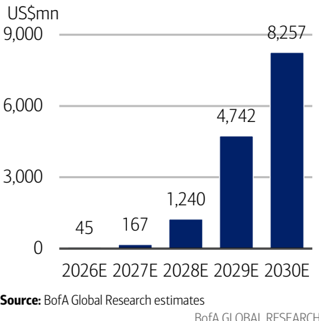
Exhibit 6: We see dFAU ASP at around USD180 in recent 1-2 years
dFAU ASP trend (36-channel, 3.2T equivalent), 2026-30E
Source: BofA Global Research estimates
BofA GLOBAL RESEARCH
Exhibit 8: Key FAU suppliers are mostly located in Asia (China, Japan, Taiwan) Key suppliers in CPO supply chain
| Component | Key suppliers | |||||
|---|---|---|---|---|---|---|
| Optical engine | Nvidia | Broadcom | Marvell | TSMC (foundry) | TSMC (foundry) | |
| FAU | ||||||
| V-groove | TFC Corning TFC | Senko Fujikura Coherent Senko | Orbray YOFC FOCI | Corning Largan | Focuslight Himax | |
| Optical fiber | ||||||
| Micro lens | Focuslight | |||||
| FAU | TFC | Coherent | Corning | Largan (potential) | ||
| ELS | ||||||
| Laser | Lumentum | Coherent | Broadcom | Furukawa | Yuanjie | DS Precision |
| Module | TFC | Lumentum | Coherent | Innolight | Eoptolink | DS Precision |
| Shuffle box | Corning (T&S) | Browave | Senko | Molex | TFC | |
| MPO/MMC | US Conec | Senko | T&S | |||
| Assembly/testing | Fabrinet | Hon Hai/FII | ASE/SPIL | USI | ||
| Equipment | Chroma | FiconTEC |
Source: BofA Global Research
BofA GLOBAL RESEARCH
Alignment and automation lift entry barrier
FAU acts as a highway connecting optical fiber to the optical engine for data transmission, and is essential to pluggable transceiver/NPO/CPO. Currently, FAUs are mostly supplied by legacy Asia supply chains, while FAU for CPO is 100% supplied by Chinese vendors. We highlight two key bottlenecks faced by the supply chain: (1) micronlevel alignment, i.e. controlling the pitch error tolerance at ≤ ± 0.5 µ m (or even ≤ ± 0.3 µ m) to ensure light signal efficiency; and (2) automatic alignment to deliver consistent accuracy while lifting efficiency.
Alignment: solving the pitch tolerance
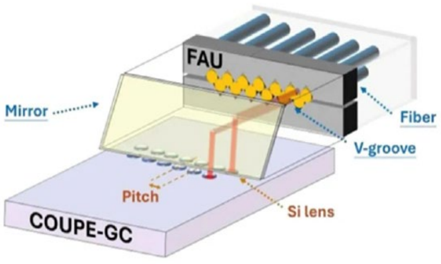
Fiber array used in FAU acts as a multi-lane highway for light, allowing multiple data channels to be connected simultaneously with the optical engine for conversion of electronic and light signals. Under a fiber array, multiple optical fibers are densely seated on a V-groove (features parallel and microscopic V-shaped channels). The process requires highly precise alignment to achieve low-loss transfer. To compare, an optical
Exhibit 7: FA likely to contribute 50% of the
BOM, followed by micro lens at ~30%
BOM analysis of FAU (with micro lens, prism etc)
Source: BofA Global Research estimates
BofA GLOBAL RESEARCH
transceiver usually has a pitch tolerance (i.e. alignment accuracy) of ± 0.5 µ m to ± 1.0 µ m. NPO ' s pitch tolerance is likely at ≤ ± 0.5 µ m, while CPO ' s pitch tolerance could be ≤ ± 0.3 µ m. As V-groove and fiber also have their own geometric tolerance, alignment error could accumulate linearly when channel numbers rise. V-groove ' s etching depth and angle variation could introduce misalignment from channel to channel. Even if a Vgroove is perfectly etched, optical fiber could also lead to alignment difficulties. A single-mode fiber generally has a diameter of 80-125 µ m (core at 6-10 µ m); any diameter variation of a fiber could cause it to sit higher or lower on a V-groove, leading to alignment mismatch. Additionally, for dFAU, maintaining positioning tolerance after multiple detach/plug processes is also key.
This level of precision alignment usually requires years of accumulation, deep know-how in optic coupling and mass production experiences. Although smartphone optic suppliers could leverage their active alignment (AA) know-how used in lens/module, the level of precision still has a big gap (for example, telephoto camera ' s AA tolerance is ≤ ± 5 µ m).
Automation: crucial when channel numbers continue rising
As optical fiber channel numbers are expected to increase to 60-100 from the current 20-36 channels while CPO volume is waiting for take-off in 2028-29, fiber array alignment based on labor-intensive process looks increasingly difficult. Thus, automation becomes crucial. It could not only reduce labor intensity and lift efficiency, but more importantly help troubleshoot alignment issues and improve accuracy. As the industry has no standard automation/testing at current stage, suppliers able to ramp up automation faster or have in-house automation capability could have a better edge.
Exhibit 9: FAU assembles PM fibers on a V-groove to direct light, and leverages micro lens and prism to project light onto PIC Illustration of FAU under grating coupler solution
Source: FOCI
Exhibit 10: CPO has the lowest pitch error tolerance at ≤ ±0.3µm FAU spec summary under different applications
| Pluggable transceiver | NPO | CPO | |
|---|---|---|---|
| FAU location | Inside module | On host PCB | On substrate |
| Pitch error tolerance | ±0.5µm - ±1.0µm | ≤ ±0.5µm | ≤ ±0.3µm |
| Channel count | 4 to 16 | 16 to 32 | 32 to 128+ |
| Insertion loss target | <0.5dB | <0.3dB | <0.2dB |
Source: BofA Global Research
BofA GLOBAL RESEARCH
GlassBridge not a threat near-term, also not a replacement
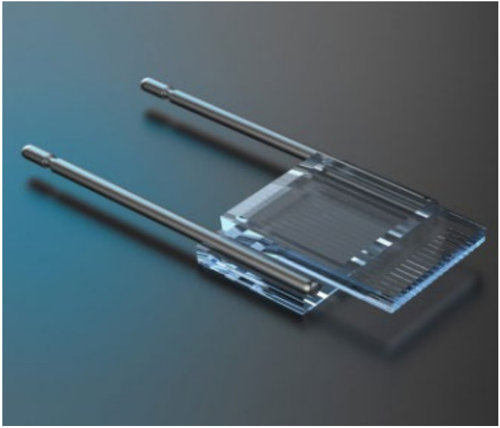
We note market ' s concern about Corning ' s GlassBridge, a wafer-based fiber-to-PIC technology, which could be an alternative solution to FAU. We argue that GlassBridge is still at an early stage and is unlikely to be adopted in current and next-generation CPO design. Although GlassBridge could indeed improve the assembly yield, several bottlenecks need to be addressed, including misalignment with PIC due to the waveguide ' s uneven surface (due to edge coupling), rising manufacturing difficulty when channel numbers rise to 70+, etc. Further, GlassBridge uses edge coupling technology -i.e. horizontal coupling, with light projected directly into the PIC horizontally. Compared with grating coupling (vertical coupling), edge coupling is not able to conduct waferscale testing, leading to potentially lower efficiency. The horizontal design also faces space limitations and demands an extreme alignment requirement.
BofA GLOBAL RESEARCH
Exhibit 11: GlassBridge is a wafer -based fiber -to -PIC technology
platform
Corning's GlassBridge connector
Couveo. Cornina
Source: Corning
BofA GLOBAL RESEARCH
Exhibit 13: Summary of acronyms used in this report
Acronym
Acronym
| AI | Artificial Intelligence |
|---|---|
| ASP | Average Selling Price |
| BOM | Bill of Materials |
| CPO | Co-packed Optics |
| ELS | External Laser source |
| FA | Fiber Array |
| FAU | Fiber Array Unit |
| dFAU | Detachable Fiber Array Unit |
| MPO | Multi-fiber Push-On |
| MMC | Multiport Modular Connector |
| MT | Mechanical Transfer |
| NPO | Near-packaged Optics |
| OE | Optical Engine |
| PIC | Photonic Integrated Circuit |
| PCB | Printed Circuit Board |
Source:
BofA Global Research
Exhibit 14: Stocks mentioned in this report
Stocks mentioned
| BofA Ticker | Bloomberg Ticker | Company Name | Price (LC) | Rating |
|---|---|---|---|---|
| LGANF | 3008 TT | Largan Precision | 4345 | B-1-7 |
| SNPTF | 2382 HK | Sunny Optical | 55.05 | C-2-8 |
Source:
BofA Global Research
Exhibit 12: Edge coupling is more efficient in insertion loss, but faces limitation in terms of wafer-level testing and spatial constraint
Comparison of grating coupling and edge coupling
| Grating coupling | Edge coupling | |
|---|---|---|
| Coupling type | Vertical | Horizontal |
| Insertion loss | Good efficiency | High efficiency |
| Alignment tolerance | High | Extreme |
| Wafer level testing | Yes | No |
| Spatial constraint | No | Yes |
Source:
BofA Global Research
BofA GLOBAL RESEARCH
BofA GLOBAL RESEARCH
BofA GLOBAL RESEARCH
Investment Rationale
Largan Precision
We have a Buy rating on Largan, eyeing on rising visibility on potential CPO project gain. We believe CPO will drive valuation a re-rating and a potential earning upside from 2028E. Besides, legacy business should stay resilient thanks to iPhone's multi-year spec upgrade cycle.
Price objective basis & risk
Largan Precision (LGANF)
Our PO of NT$5,600 is based on 25x 2028E P/E. 25x is at Largan's historical peak P/E during last earnings upcycle. We believe CPO take-off from 2028 will drive another new multi-year earnings upcycle for Largan, justifying our valuation multiple.
Downside risks are: 1) weaker than expected end-demand, which leads to pressured topline and margin on lower utilization rate, 2) more intense competition from Greater China competitors including Sunny Optical, Genius and AAC, 3) slower than expected spec upgrade, and 4) slower than expected progress at CPO.
Upside risks are: 1) better than expected end demand and faster than expected spec upgrade, 2) higher than expected ASP and market on competitors' inferior execution, 3) eased competition from key peers, and 4) faster than expected progress at CPO.
Sunny Optical (SNPTF)
We set our PO at HK$69, on 17x 2026E P/E, we view 17x, around -0.5SD, is justified by potentially slower margin improvement amid uncertainties at smartphone shipment and spec into 2026, while reflect business diversification into datacom.
Downside risk: (1) demand at consumer electronics further deteriorate with continuous de-spec, (2) slower than expected share gain at iPhone, (3) slower-than-expected auto momentum and slower ADAS penetration, (4) intensified competition at both smartphone and auto. (5) Government subsidy is removed.
Upside risk: (1) better than expected demand/spec at consumer electronics, (2) faster than expected share gain at iPhone, (3) strong auto momentum and faster ADAS penetration, (4) eased competition at both smartphone and auto, and (5) faster than expected progress at datacom.