PDF 原檔:報告_BofA_光模組mSAP_20261105_original.pdf
圖片清單(已驗證 2026-11-07)
驗證日 2026-11-07。
| 檔名 | 分類 | 親眼所見內容 |
|---|---|---|
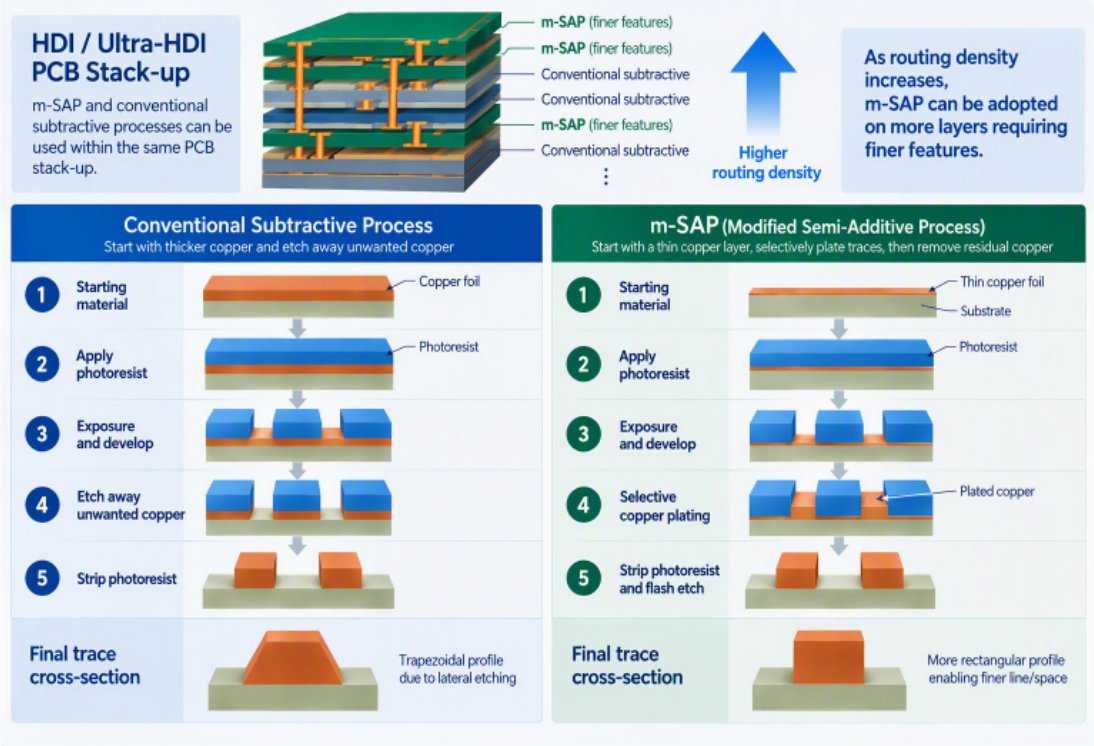
| 報告_BofA_光模組mSAP_20261105_001.png | 真資料圖 | mSAP 與傳統減成法對照示意:上方 HDI/Ultra-HDI 疊構,mSAP(綠)與傳統 subtractive(灰)層可共存於同一板,並標示「routing density 越高,mSAP 可用在越多需細線路的層」;下方左右並列五步驟流程——減成法為厚銅箔→光阻→曝光顯影→蝕刻多餘銅→去光阻,截面為梯形(側蝕);mSAP 為薄銅箔→光阻→曝光顯影→選擇性電鍍銅→去光阻並 flash etch,截面較接近矩形,利於更細線寬線距 |
| 報告_BofA_光模組mSAP_20261105_002.png | 真資料圖 | 光模組 mSAP PCB 對 800G+ 模組「需求」的供需比:2026E 約 −24%、2027E 約 −25%、2028E 約 −29%(折線,負值=供給缺口) |
| 報告_BofA_光模組mSAP_20261105_003.png | 真資料圖 | mSAP PCB 對 800G+ 模組「出貨」的供需比(不含 2.4T):2026E −2%、2027E +3%(過剩)、2028E −3% |
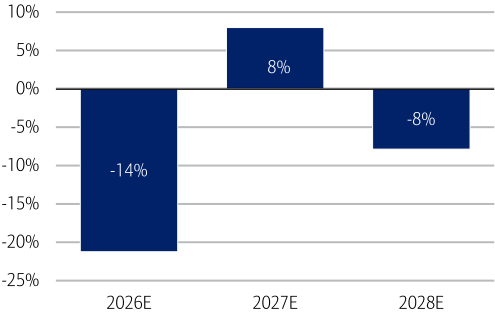
| 報告_BofA_光模組mSAP_20261105_004.png | 真資料圖 | 1.6T/NPO mSAP PCB 供需比長條:2026E −14%、2027E +8%、2028E −8%(長條底端繪圖偏移,數字以標籤與內文為準) |
| 報告_BofA_光模組mSAP_20261105_005.png | 真資料圖(股價,不嵌 lib) | 深南電路(XAMKF)股價與目標價歷史走勢,最新 PO CNY409、股價約 CNY200 |
| 報告_BofA_光模組mSAP_20261105_006.png | 真資料圖(股價,不嵌 lib) | 欣興(UMCRF)股價與 PO 歷史,最新 PO NT$1,650(2026-10-10),股價約 NT$900 |
| 報告_BofA_光模組mSAP_20261105_007.png | 真資料圖(股價,不嵌 lib) | 臻鼎(XFAGF)股價與 PO 歷史,最新 PO NT$630(2026-08-11),股價約 NT$450 |
原始內容
Technology - Asia Pacific (H/A)
mSAP for optical transceivers: tightness to persist despite brief relief in 2027
Industry Overview
Tight supply, ASP upcycle; relief likely in 2027, but briefly
mSAP supply for optical transceivers remains a key focus for PCB, as demand is strong but supply is tight. The process was previously used mainly by Apple, and few suppliers are available. While 400G can still use ultra-thin HDI, 800G relies more on mSAP, and 1.6T is fully mSAP-based given its higher insertion-loss requirement. On specs, 1.6T adopts a 6/7-build-up HDI design with M8+ CCL, while 800G uses 4/5-build-up HDI with M7+ CCL. As a result, 1.6T generally has lower yield and consumes more capacity. The supply chain did not begin expanding mSAP capacity until early 2026. We expect 800G+ supply to remain tight this year, with a 2% demand/supply ratio, while the 1.6T gap is even wider at 14%. Our checks suggest 1.6T PCB ASP has risen to CNY250-300 currently from CNY200 in early 2026. Capacity expansion could bring brief relief in 2027, but supply could tighten again in 2028 as NPO takes off.
Demand: 1.6T shipments critical watch point
We highlight that the 2027 relief reflects a low 1.6T fulfillment rate rather than PCB over-supply. The supply chain expects global 800G and 1.6T demand to reach 90-100mn units each in 2027. But a DSP shortage means the industry is likely to ship only 60-70mn 1.6T transceivers. Against real demand, we still expect a wide demand/supply gap of 25% in 2027, and any better-than-expected DSP supply could tighten PCB supply.
Supply: equipment and yield are swing factors
Many suppliers are expanding mSAP capacity, with Zhen Ding, Kinwong, and Victory Giant among the more aggressive (Exhibit 7). We expect total supply to reach 153/199 million units in 2027/28. We see two key swing factors: (1) equipment lead times are long (2+ years), and some equipment is also used for substrates (SAP), which are in even tighter supply; and (2) mSAP is more complex than HDI/HLC and few suppliers have experience with it, so yield could become a bottleneck, especially given mSAP's much finer line/space (L/S) requirement.
Beyond 2027: new technologies and spec migration matter
The industry also expects NPO/2.4T/3.2T demand from late 2027 into 2028-29. Our checks suggest NPO requires higher layer counts and even finer L/S, consuming more capacity. We therefore expect supply to tighten again in 2028 as NPO volume rises. The industry is also discussing using BT substrate rather than PCB for 2.4T transceivers, a potential positive for substrate suppliers Unimicron, Shennan, Kinsus, and Zhen Ding.
Initiate Kinwong at Buy; Buy Zhen Ding/Unimicron/Shennan
We initiate coverage of Kinwong-H/-A at Buy (Initiation report) on its strong positioning in AI server/optical transceiver, and maintain Buy on Zhen Ding, Unimicron and Shennan on mSAP/substrate upside.
This research report provides general information only. No part of this report may be used or reproduced or quoted in any manner whatsoever in Taiwan by the press or other persons without the express written consent of BofA Securities.
>> Employed by a non-US affiliate of BofAS and is not registered/qualified as a research analyst under the FINRA rules.
Refer to "Other Important Disclosures" for information on certain BofA Securities entities that take responsibility for the information herein in particular jurisdictions.
BofA Securities does and seeks to do business with issuers covered in its research reports. As a result, investors should be aware that the firm may have a conflict of interest that could affect the objectivity of this report. Investors should consider this report as only a single factor in making their investment decision.
Refer to important disclosures on page 10 to 13. Analyst Certification on page 7. Price
05 November 2026
Equity Asia Pacific Technology
Katherine Zhu >> Research Analyst Merrill Lynch (Hong Kong) kexin.zhu@bofa.com
Doris Kao >> Research Analyst Merrill Lynch (Taiwan) doris.kao@bofa.com
Mike Yang >> Research Analyst Merrill Lynch (Taiwan) mike.c.yang@bofa.com
Robert Cheng >>
Research Analyst Merrill Lynch (Taiwan) robert.cheng@bofa.com
Gina Wu >> Research Analyst Merrill Lynch (Hong Kong) gina.wu@bofa.com
For abbreviations, please refer to Exhibit 8
mSAP brief intro: more complex than HDI/HLC
Conventional PCBs (general HDI, MLPCB, etc.) use a subtractive process. mSAP is an advanced PCB fabrication technology that achieves finer L/S and higher routing density than conventional subtractive processing. As routing density rises, mSAP can be adopted on more of the layers that require finer features.
The key difference between mSAP and the subtractive process lies in how circuit traces are formed. Subtractive processing starts with copper-clad laminate and forms the circuitry by etching away unwanted copper. mSAP, by contrast, starts with thin copper foil, typically a few microns thick, and builds up traces through selective copper plating, followed by photoresist removal and flash etching of the residual base copper. The thinner starting copper reduces the amount that must be etched and allows tighter control of trace geometry, enabling finer L/S and higher routing density.
Exhibit 1: mSAP is an advanced PCB fabrication technology used to achieve finer line/space and higher routing density than subtractive process PCB fabrication flow: mSAP vs subtractive process adopted in conventional PCBs (general HDI, MLPCB, etc.)
Source: BofA Global Research
Exhibit 2: mSAP and SAP technologies enable the production of highly miniaturized PCBs with high yields
Three distinct PCB fabrication technologies: subtractive, mSAP, and SAP
| Process | Starting Copper | Circuit Formation | Fine-Line Capability | Typical Applications |
|---|---|---|---|---|
| Subtractive | Thick copper foil, 12-35 µm | Etch away excess copper | ≥30 µm | Conventional multilayer PCBs |
| mSAP | Ultra-thin copper foil, 1.5-5 µm | Pattern plating + flash etching of base copper | 10-20 µm | Advanced HDI, substrate-like PCBs (SLP) |
il
BofA GLOBAL RESEARCH
Exhibit 2: mSAP and SAP technologies enable the production of highly miniaturized PCBs with high yields
Three distinct PCB fabrication technologies: subtractive, mSAP, and SAP
| Process | Starting Copper | Circuit Formation | Fine-Line Capability | Typical Applications |
|---|---|---|---|---|
| SAP | No copper foil (thin electroless Cu seed layer) | Pattern plating + seed-layer etching | ≤2 µm | IC substrates (ABF) |
Source: BofA Global Research
Supply-demand dynamics in 2026-28E
We expect 800G+ supply to remain tight this year, with a 2% demand/supply ratio, while the 1.6T gap is even wider at 14%. Our checks suggest 1.6T PCB ASP has currently risen to CNY250-300 from CNY200 in early 2026. Capacity expansion could bring brief relief in 2027, but supply could tighten again in 2028 as NPO takes off.
Although the market is concerned about potential oversupply from 2027, we highlight several swing factors that could change the dynamics.
- 1.6T shipments: our current shipment forecast is 40% below real end-demand due to the DSP shortage (based on TSMC's 3nm capacity allocation). Although the market sees DSP as the bottleneck least likely to ease given tight 3nm supply, any upside from other foundries (e.g., MaxLinear's DSP at Samsung) could lift shipments, which would in turn tighten mSAP supply.
- mSAP equipment: lead times are long at 2+ years, including for laser drilling and plating equipment. Some of this equipment is also used in SAP to make BT/ABF substrates, which are in even tighter supply. Despite the supply chain's aggressive expansion goals, we believe equipment could become a key bottleneck.
- Yield: few suppliers have mSAP experience, and the more complex process and stricter manufacturing requirements usually lead to lower yield. Given long equipment lead times, some suppliers have chosen to use low-end equipment for expansion, which could undermine yield and output.
Exhibit 3: We expect pluggable transceiver demand for 800G+ to reach 200mn units
Optical transceiver demand/supply and mSAP output, 2026-28E
| 2026E | 2027E | 2028E | |
|---|---|---|---|
| Optical transceiver demand (mn units) | |||
| 800G | 60 | 100 | 70 |
| 1.6T | 30 | 100 | 150 |
| 2.4T | 2 | 12 | |
| NPO | 4 | 60 | |
| Total | 90 | 206 | 292 |
| Optical transceiver shipment (mn units) | |||
| 800G | 50 | 85 | 65 |
| 1.6T | 20 | 60 | 100 |
| 2.4T | 0 | 10 | |
| NPO | 4 | 40 | |
| Total | 70 | 149 | 215 |
| mSAP output (mn units) | |||
| 800G | 53 | 84 | 70 |
| 1.6T/NPO | 16 | 69 | 129 |
| Total | 68 | 153 | 199 |
Source: BofA Global Research estimates
Exhibit 4: Compared with transceiver demand, we note big demand/supply gap at PCB side at over 20% in 2026-28E
Optical transceiver mSAP PCB demand/supply ratio vs. 800G+ transceiver demand, 2026-28E
BofA GLOBAL RESEARCH
BofA GLOBAL RESEARCH
BofA GLOBAL RESEARCH
Exhibit 5: Compared with transceiver shipment, we expect tight supply in 2026, and only a temporary relief in 2027
Optical transceiver mSAP PCB demand/supply ratio vs. 800G+ transceiver shipment (ex. 2.4T), 2026-28E
Exhibit 6: We expect PCB supply for 1.6T/NPO to tighten again in 2028 following NPO deployment, 2026-28E
Optical transceiver mSAP PCB demand/supply ratio vs. 1.6T/NPO shipment, 2026-28E
BofA GLOBAL RESEARCH
Exhibit 7: We expect mSAP PCB supply for 1.6T/NPO to reach 16/69/129mn units in 2026/27/28
Optical transceiver mSAP PCB - supply analysis, 2026-28E
| 2026E | 2027E | 2028E | |
|---|---|---|---|
| Monthly output - 800G equivalent | |||
| Unimicron | 2,550 | 3,570 | 4,675 |
| Zhen Ding/Avary | 1,200 | 3,800 | 5,000 |
| Shennan | 1,080 | 2,160 | 2,808 |
| Kinwong | 900 | 3,500 | 4,800 |
| Victory Giant | 200 | 600 | 1,000 |
| Founder | 90 | 600 | 1,000 |
| Total (k) | 6,020 | 14,230 | 19,283 |
| Annual output (mn) | 72 | 171 | 231 |
| % 800G mix | |||
| Unimicron | 70% | 50% | 30% |
| Zhen Ding/Avary | 50% | 30% | 20% |
| Shennan | 90% | 60% | 40% |
| Kinwong | 98% | 70% | 40% |
| Victory Giant | 70% | 60% | 40% |
| Founder | 0% | 0% | 0% |
| % 1.6T/NPO mix | |||
| Unimicron | 30% | 50% | 70% |
| Zhen Ding/Avary | 50% | 70% | 80% |
| Shennan | 10% | 40% | 60% |
| Kinwong | 2% | 30% | 60% |
| Victory Giant | 30% | 40% | 60% |
| Founder | 100% | 100% | 100% |
| 800G output | |||
| Unimicron | 1,785 | 1,785 | 1,403 |
| Zhen Ding/Avary | 600 | 1,140 | 1,000 |
| Shennan | 972 | 1,296 | 1,123 |
| Kinwong | 882 | 2,450 | 1,920 |
| Victory Giant | 140 | 360 | 400 |
| Founder | 0 | 0 | 0 |
| Total (k) | 4,379 | 7,031 | 5,846 |
| Annual output (mn) | 53 | 84 | 70 |
| 1.6T/NPO output - 80% yield of 800G | |||
| Unimicron | 612 | 1,428 | 2,618 |
| Zhen Ding/Avary | 480 | 2,128 | 3,200 |
| Shennan | 86 | 691 | 1,348 |
| Kinwong | 14 | 840 | 2,304 |
Source: BofA Global Research estimates
Source: BofA Global Research estimates
BofA GLOBAL RESEARCH
Exhibit 7: We expect mSAP PCB supply for 1.6T/NPO to reach 16/69/129mn units in 2026/27/28
Optical transceiver mSAP PCB - supply analysis, 2026-28E
| 2026E | 2027E | 2028E | |
|---|---|---|---|
| Victory Giant | 48 | 192 | 480 |
| Founder | 72 | 480 | 800 |
| Total (k) | 1,313 | 5,759 | 10,750 |
| Annual output (mn) | 16 | 69 | 129 |
Source: Company data, BofA Global Research estimates
Exhibit 8: Summary of abbreviations
Abbreviations
| Abbreviation | |
|---|---|
| ABF | Ajinomoto Build-up Film |
| ASP | Average Selling Price |
| BT | Bismaleimide Triazine |
| CCL | Copper Clad Laminate |
| DSP | Digital Signal Processor |
| HDI | High-Density Interconnect |
| HLC | High Layer Count |
| MLPCB | Multi-Layer Printed Circuit Board |
| mSAP | Modified Semi-Additive Process |
| NPO | Near-Packaged Optics |
| PCB | Printed Circuit Board |
| SAP | Semi-Additive Process |
Source: BofA Global Research
Exhibit 9: Stocks mentioned
Ratings and prices summary
Investment Rationale
Kinwong
We have a Buy rating on Kinwong-A. We expect Kinwong to benefit from a strong revenue led by rising AI mix, while AI PCB's higher content value margin should support a faster earnings expansion. Meanwhile, auto PCB business will remain as a pillar on CCL cost pass-through near-term and rising ADAS penetration in the long-term.
Kinwong
We have a Buy rating on Kinwong-H. We expect Kinwong to benefit from a strong revenue led by rising AI mix, while AI PCB's higher content value margin should support a faster earnings expansion. Meanwhile, auto PCB business will remain as a pillar on CCL cost pass-through near-term and rising ADAS penetration in the long-term.
| BofA Ticker | Bloomberg Ticker | Company name | Price | Rating |
|---|---|---|---|---|
| XENZF | 3228 HK | Kinwong | 53.65 | C-1-7 |
| XDENF | 603228 CH | Kinwong | 61.53 | C-1-7 |
| XFAGF | 4958 TT | Zhen Ding Tech | 433 | C-1-7 |
| UMCRF | 3037 TT | Unimicron | 888 | C-1-7 |
| XAMKF | 002916 CH | Shennan Circuits | 225.6 | C-1-7 |
| Source: BofA Global Research | Source: BofA Global Research |
BofA GLOBAL RESEARCH
BofA GLOBAL RESEARCH
BofA GLOBAL RESEARCH
Price objective basis & risk
Kinwong (XDENF)
We set Kinwong-A PO at CNY98, which is at 40% share price premium to Kinwong-H's PO. 40% premium is in line with the average premium for dual-listed A/H hardware names. Our PO implies 17x 2027E P/E, at the higher-end of A-share listed PCB peers' trading range of 10-17x.
Downside risks: (1) weaker-than-expected end-market demand, led by various factors including macro slowdown, tariffs/ trade policy, weaker consumer confidence, etc., (2) weaker-than-expected customer/ product performance, (3) slower-than-expected technology upgrades amid rising competition, and (4) margin pressure from rising capex, manufacturing and supply chain risks.
Upside risks: (1) stronger-than-expected end-market demand, (2) outperformance of key customer/ products that drives order growth and project ramp-ups, (3) content value growth and share gain potential from faster technology upgrades and leading edge in competition, and (4) better capacity utilization and cost execution through disciplined capex spending and management.
Kinwong (XENZF)
We set Kinwong-H PO at HK$82 on 12x 2027E P/E. Our 12x P/E is in line with average P/E of HK/China PCB peers'. 12x is at a premium to Kinwong's H-share listed PCB peers, justified by more resilient earnings and better business visibility near-term.
Downside risks: (1) weaker-than-expected end-market demand, led by various factors including macro slowdown, tariffs/ trade policy, weaker consumer confidence, etc., (2) weaker-than-expected customer/ product performance, (3) slower-than-expected technology upgrades amid rising competition, and (4) margin pressure from rising capex, manufacturing and supply chain risks.
Upside risks: (1) stronger-than-expected end-market demand, (2) outperformance of key customer/ products that drives order growth and project ramp-ups, (3) content value growth and share gain potential from faster technology upgrades and leading edge in competition, and (4) better capacity utilization and cost execution through disciplined capex spending and management.
Shennan Circuits (XAMKF)
We set our PO at CNY409, based on 30x 2027E P/E. The 30x P/E is around historical trading average since IPO, justified by Shennan Circuit's strong earnings expansion led by AI datacenter from server/switch to memory/optical transceiver, and across China and US CSPs.
Downside risks are: (1) slower AI datacenter capex, (2) slower market share gain at US CSPs' AI server projects, (3) more severe competition, (4) worse than expected yield issue, and (6) intensified US/China disputes.
Upside risks to our PO are: (1) faster AI datacenter capex, (2) faster market share gain at US CSPs' AI server projects, (3) eased competition, (4) better than expected yield improvement, and (6) eased US/China disputes.
Unimicron (UMCRF)
Our PO of NT$1,650 is based on 35x 2H27-1H28E, which is roughly 1 standard deviation above the historical average of 20x since 2017. In our view, the multiple is appropriate, as we expect Unimicron's earnings to be supported by its high-end technology offerings, where end market demand seems more resilient.
il Upside risks are (1) tighter ABF supply, (2) greater PC and regular server demand, and (3) lower competition pressure.
Downside risks are (1) greater ABF expansion from peers, (2) lower ASP content increase at AI server, and (3) bigger drop in the demand of consumer electronic products.
Zhen Ding Tech (XFAGF)
Our price objective of NT$630 is based on 25x 2027E EPS, which is at the company's historical high P/E level thanks to ongoing business transformation (rising AI sales mix vs. previously key exposure to consumer/communication business) and ongoing margin expansion to record high levels. Our multiple is set below its closest AI PCB and substrate peers (trading at an average of ca 27x) mainly due to ZDT's lower exposure to AI (i.e. relatively higher mix to consumer/communication business) and lighter margin profiles than peers. Our forecasts and valuation base mainly reflects ZDT's market leading position to benefit from AI and foldable iPhone demand, improving product mix (rising IC substrate/server/optical sales contribution), and expected margin expansion in 2026-28.
Downside risks to our PO: (1) weaker-than-expected Apple product (iPhone/iPad/MacBook) demand, (2) weaker macro that drags global Apple product purchases, (3) slower progress/investment in IC substrate and server business, and (4) higher upfront cost for new IC substrate and server capacity ramp-up.
Upside risks to our PO: (1) better-than-expected Apple product (iPhone/iPad/MacBook) demand, (2) stronger-than-expected Apple product momentum, (3) faster progress/investment in IC substrate and server business, and (4) lower upfront cost for new IC substrate and server capacity ramp-up.